The Ferrari Daytona SP3 is a limited-production, mid-engined supercar from Ferrari’s Icona series, built in a run of exactly 599 units, all of which sold out before a single car left the factory.
This guide covers what defines the SP3 and why Ferrari capped it at that number, how its production compares to other Icona models, what the car costs and what it sells for now, who was eligible to buy one, its key specs and legal status, and how its fixed supply shapes its investment value.
Ferrari deliberately set the 599-unit ceiling as a strategic decision, not a manufacturing limitation, preserving the aspirational status that defines the Icona series and reinforcing scarcity as a repeatable brand tool.
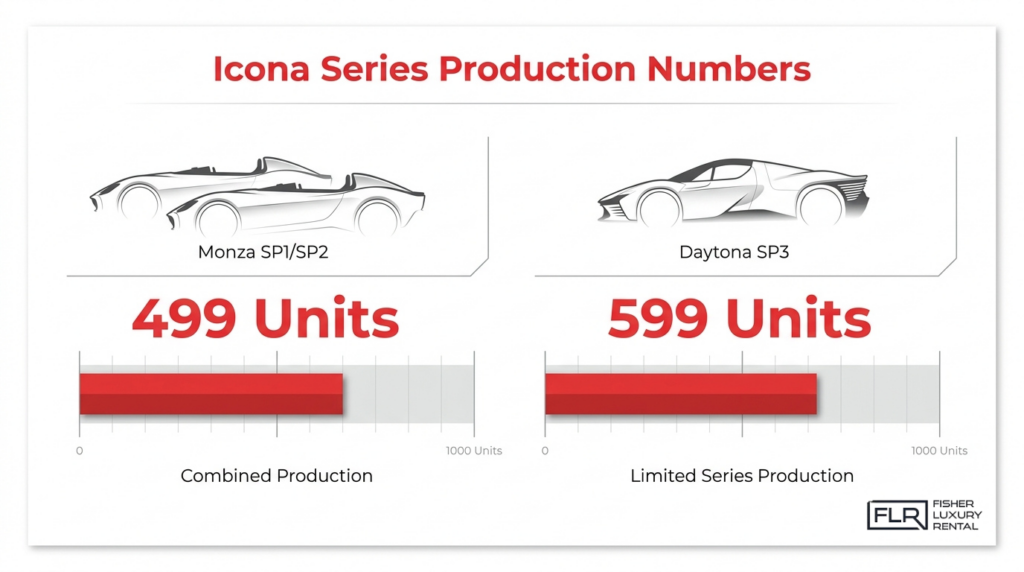
Placed within the Icona lineup, the SP3’s 599 units sit above the combined 499 cars produced across the Monza SP1 and SP2, giving it a slightly broader collector base while both generations sold out entirely before production began.
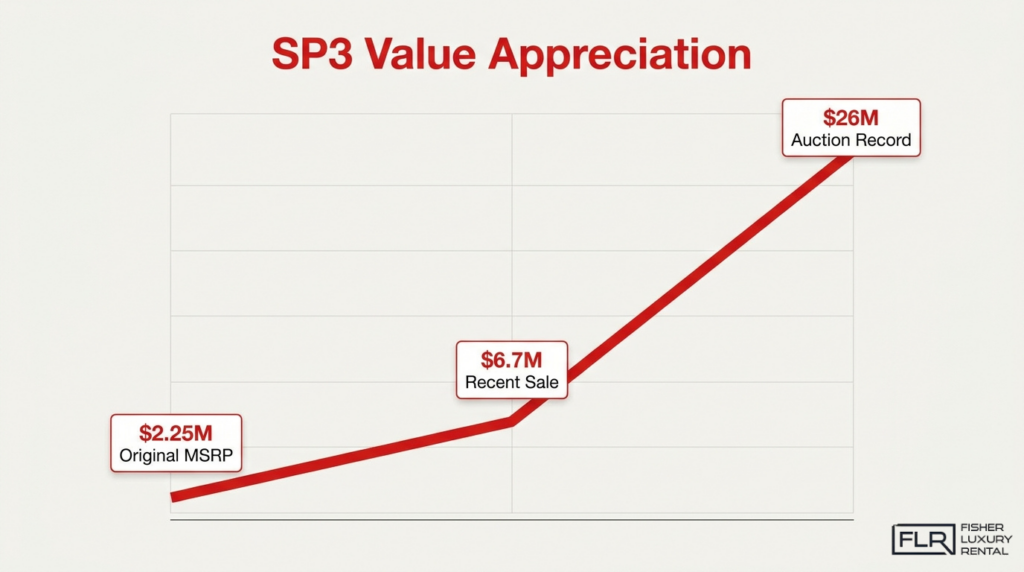
The original MSRP of $2.25 million per unit has proven to be a floor rather than a ceiling. Recent resale transactions have ranged from $6.6 million to $26 million, with the car’s fixed supply making meaningful price softening unlikely.
Buyer eligibility required prior Ferrari ownership, an invitation from the brand, and a track record of compliant ownership behaviors including authorized servicing and no unauthorized modifications.
The SP3 is the first road-going Ferrari since the Enzo to carry a mid-mounted naturally aspirated V12 without hybrid support, is factory street legal in the US, and remains one of the most aerodynamically efficient road cars Ferrari has ever produced.
What Is the Total Production Number of the Ferrari Daytona SP3?
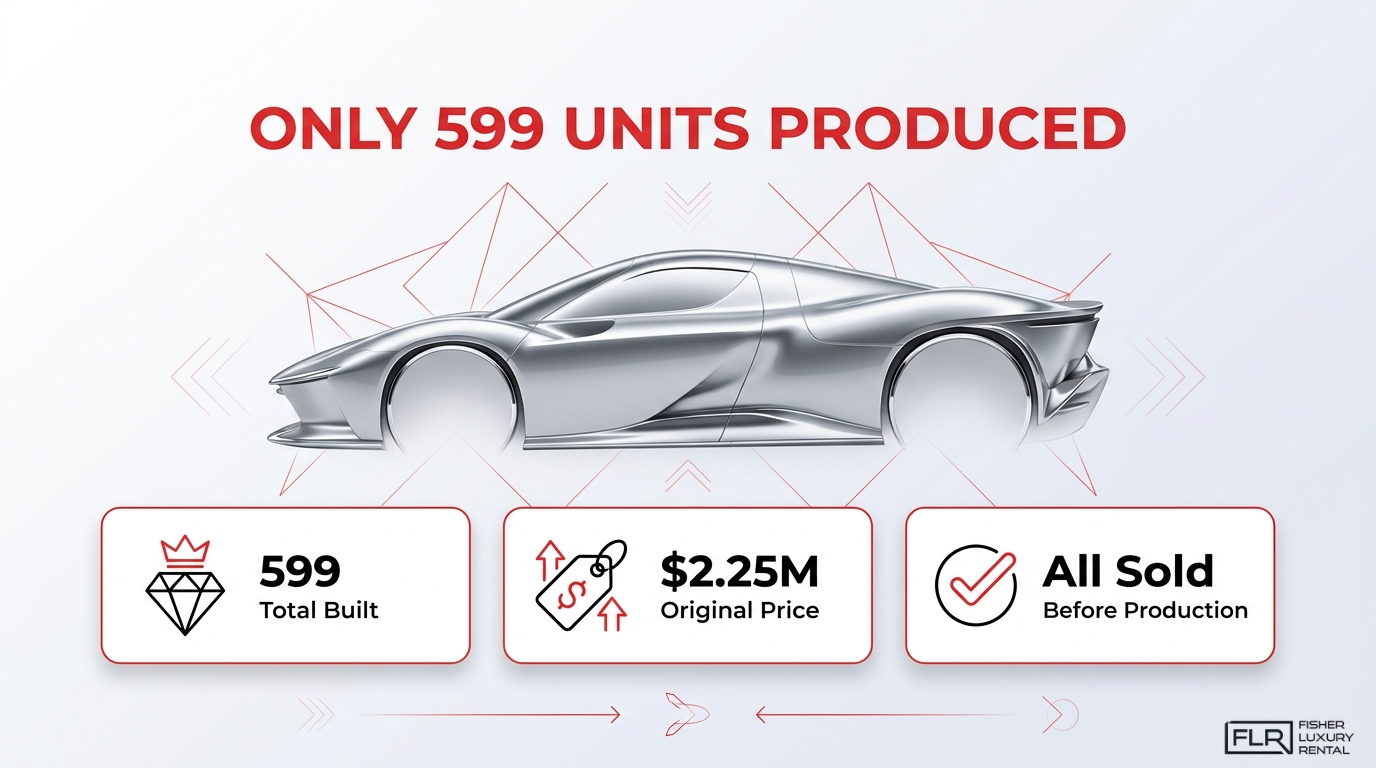
The total production number of the Ferrari Daytona SP3 is 599 units. Ferrari capped the Icona series model at this figure, and every allocated example sold before production even began. At a base price of $2.25 million each, the SP3 represents one of the most exclusive modern Ferraris ever built.
Why Did Ferrari Limit the Daytona SP3 Production Count?
Ferrari limited the Daytona SP3 production count to protect brand exclusivity, sustain collector demand, and reinforce its Icona series positioning. Three interconnected factors drove this decision: deliberate scarcity strategy, buyer qualification requirements, and the precedent set by earlier limited-edition Ferrari models.
How Does Ferrari’s Exclusivity Strategy Drive Limited Production?
Ferrari’s exclusivity strategy drives limited production by treating scarcity as a core brand asset rather than a manufacturing constraint. Keeping supply below demand ensures that every Icona model retains aspirational status long after the order books close. According to a PESTEL marketing analysis, Ferrari’s product strategy heavily features exclusive special series and limited editions, with models like the Daytona SP3 and the anticipated F80 serving as flagship examples. In practice, this means Ferrari caps production volumes deliberately, not because building more units is technically impossible. The 599-unit ceiling on the SP3 was a strategic choice, and the car sold out entirely before a single example left the factory floor.
What Role Did Buyer Eligibility Play in Keeping Production Low?
Buyer eligibility played a direct role in keeping production low by ensuring that every one of the 599 units went to a vetted, existing Ferrari customer. Prospective buyers had to have owned at least one Ferrari previously and be in good standing with the brand just to receive a purchase invitation. Ferrari’s ownership policy further discourages unauthorized modifications and limits resale timelines for limited-edition models like the SP3, reinforcing tight control over who holds these cars and how they are treated. With only a finite pool of pre-qualified, invitation-only buyers, a production run exceeding that pool would dilute both exclusivity and the carefully curated ownership community Ferrari has built over decades.
Did Ferrari’s Icona Series Precedent Influence the SP3 Cap?
The Icona series precedent directly influenced the SP3 production cap, as Ferrari had already established a clear limited-run template with the Monza SP1 and SP2 before the SP3 was announced. Limiting each Icona model to a few hundred units created a consistent framework of rarity across the series. Capping the SP3 at 599 units placed it slightly above the Monza pair’s combined 499 total, signaling a step up in scale while still maintaining the scarcity that defines Icona identity. This graduated approach lets Ferrari calibrate collector interest across models without any single release cannibalizing demand for the next, making scarcity a repeatable and deliberate strategic tool rather than a one-time decision.
How Does the Daytona SP3 Production Count Compare to Other Icona Models?
The Daytona SP3 production count sits higher than its Icona predecessors, with 599 units built versus the combined 499 cars produced across the Monza SP1 and SP2. The H3s below break down each model’s figures directly.
How Many Ferrari Monza SP1 and SP2 Were Produced?
The Ferrari Monza SP1 and SP2 combined for 499 cars across both variants. Ferrari split this allocation between the single-seat SP1 and the two-seat SP2, keeping total output under 500 units to reinforce the Icona series’ positioning as the brand’s most exclusive collector tier. That sub-500 ceiling made the Monza pair meaningfully rarer than the SP3 that followed.
How Many Ferrari SP1 Monza Were Made Versus the Daytona SP3?
The Daytona SP3 was limited to 599 examples, compared to the 499 combined units of the Monza SP1 and SP2, according to RM Sotheby’s. That 100-unit difference gives the SP3 a slightly broader collector base while still preserving scarcity. Both models sold out before production began, confirming that allocation size alone does not determine desirability within Ferrari’s Icona lineup.
What Is the Ferrari Daytona SP3 and Why Is It Special?
The Ferrari Daytona SP3 is a limited-production, mid-engined supercar from Ferrari’s Icona series, built to honor one of the most celebrated moments in motorsport history. Its name, design, and powertrain all trace back to a single legendary race. The sections below cover its historical roots, technical achievements, and the expert praise it has earned.
What Racing Event Inspired the Ferrari Daytona SP3?
The racing event that inspired the Ferrari Daytona SP3 is the 1967 Daytona 24 Hours, where Ferrari’s 330 P3/4, 330 P4, and 412 P crossed the finish line in a historic 1-2-3 formation. That sweep is widely regarded as Ferrari’s greatest moment in endurance racing, and the SP3 was designed as a direct tribute to those prototype racers. The car’s cresting front wings and open-top silhouette echo the sports-prototype bodywork of that era, making it as much a rolling monument as a driving machine.
What Makes the Ferrari Daytona SP3 Technically Significant?
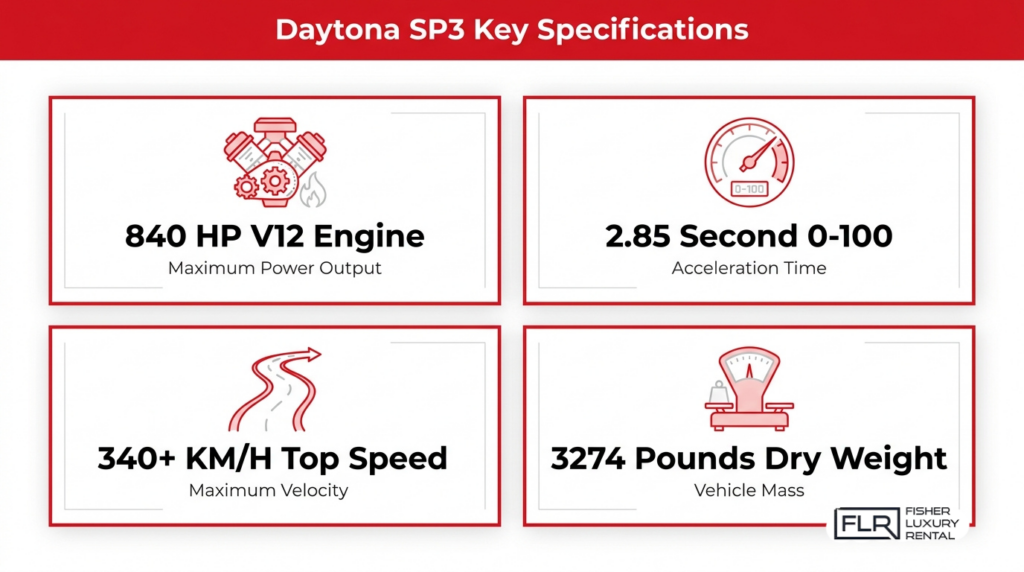
The Ferrari Daytona SP3 is technically significant because it is the first road-going Ferrari to feature a mid-mounted naturally aspirated 12-cylinder engine without electric hybrid support since the Ferrari Enzo. According to Ferrari S.p.A., that 6,496 cc V12 produces 840 cv at 9,250 rpm and 697 Nm of torque at 7,250 rpm, enabling a 0-100 km/h sprint in 2.85 seconds and a top speed exceeding 340 km/h. Ferrari also recognized it as the marque’s most aerodynamically efficient car ever produced. For enthusiasts who value pure, unassisted combustion performance, the SP3 stands in a category of its own among modern supercars.
What Do Experts Say About the Ferrari Daytona SP3?
Expert opinion on the Ferrari Daytona SP3 is overwhelmingly superlative. Car and Driver stated that even the most jaded car enthusiasts agree it is one of the most beautiful and desirable exotics ever made. Motor Trend called it “more than a car, it’s a V-12 celebration,” capturing the emotional register the SP3 operates in. These are not simply marketing endorsements; they reflect a genuine critical consensus that Ferrari achieved something rare: a modern production car that earns comparison to the classics it references.
How Much Does a Ferrari Daytona SP3 Cost Given Its Rarity?
The Ferrari Daytona SP3 carried an original MSRP of $2.25 million, and resale prices have climbed dramatically above that figure. The H3s below cover the factory price and current secondary market valuations.
What Was the Original MSRP of the Ferrari Daytona SP3?
The original MSRP of the Ferrari Daytona SP3 was $2.25 million per unit, according to Supercar Blondie. All 599 units sold out before production even began, meaning no buyer paid sticker price through any normal retail channel. Ferrari extended purchase invitations exclusively to vetted existing clients, so the MSRP functioned more as a floor than a true market price. Given the instant sellout, it is safe to say $2.25 million represented exceptional value relative to what the open market would later prove willing to pay.
How Much Does a Ferrari Daytona SP3 Sell for on the Resale Market?
The Ferrari Daytona SP3 sells for well above its original factory price on the resale market. A 2024 example sold for $6,692,890 on October 11, 2025, per the Hagerty Valuation Tool, representing nearly triple the original MSRP. At the extreme end, a Tailor Made SP3 fetched $26 million at RM Sotheby’s Monterey Car Week auction in August 2025, with proceeds benefiting the Ferrari Foundation. Rarity drives this appreciation directly: only 599 were ever built, creating persistent demand that far outstrips supply in the collector car market.
Who Was Eligible to Buy a Ferrari Daytona SP3?
Eligibility to buy a Ferrari Daytona SP3 required meeting Ferrari’s strict invitation-only criteria. The following H3s cover the ownership prerequisites, Ferrari’s behavioral expectations, and the role of service history in maintaining access.
What Were the Requirements to Receive a Purchase Invitation?
The requirements to receive a purchase invitation included prior Ferrari ownership and a positive standing with the brand. According to community documentation on r/Ferrari, a buyer had to have owned at least one Ferrari previously and remain in good standing with Ferrari to qualify for an invitation. No amount of wealth alone guaranteed access. Ferrari selectively offered the SP3 to collectors who had already demonstrated loyalty through prior purchases, making the invitation a reward for relationship history rather than purchasing power.
What Ownership Behaviors Did Ferrari Expect from SP3 Buyers?
Ferrari’s ownership expectations for SP3 buyers included discouraging unauthorized modifications, limiting early resale, and maintaining service records through authorized channels. According to HotCars, Ferrari’s ownership policy enforced these standards specifically when offering limited-edition models like the SP3. Buyers who resold too quickly, modified cars without approval, or ignored authorized servicing risked losing access to future allocations. This behavioral framework is, in practice, Ferrari’s most effective gatekeeping tool: money is secondary to compliance.
How Did Service History Affect SP3 Purchase Eligibility?
Authorized service history directly affected SP3 purchase eligibility by protecting a collector’s standing in Ferrari’s records. Ferrari of Fort Lauderdale notes that maintaining authorized service history protects eligibility, reduces resale friction, and preserves centralized documentation continuity. Collectors who serviced their Ferraris through independent shops, even competently, risked gaps in the ownership record that Ferrari monitors when selecting SP3 candidates.
What Are the Key Specs of the Ferrari Daytona SP3?
The key specs of the Ferrari Daytona SP3 are defined by a naturally aspirated 6,496 cc V12 engine producing 840 cv at 9,250 rpm, 697 Nm of torque at 7,250 rpm, a 0–100 km/h time of 2.85 seconds, and a top speed exceeding 340 km/h. According to Ferrari S.p.A., these figures make the SP3 the highest-powered naturally aspirated road car the marque has ever produced.
The Daytona SP3 is also the first road-going Ferrari since the Enzo to feature a mid-mounted 12-cylinder engine without electric hybrid support systems, keeping the powertrain pure and unassisted. At 3,274 pounds dry, the car sits at a competitive weight for a modern high-performance sports car. Ferrari has described the SP3 as its most aerodynamically efficient road car ever built, with a body shaped entirely around downforce and stability at speed. For a naturally aspirated machine without electrification, this combination of output, weight, and aerodynamic precision represents an engineering achievement that may never be repeated.
Is the Ferrari Daytona SP3 Street Legal or Track Only?
The Ferrari Daytona SP3 is street legal, not track only. Ferrari homologated the SP3 for road use in each market where it is sold, submitting the car to the required emissions and safety tests. In the United States specifically, the SP3 is street legal from the factory.
Homologation is the formal process that qualifies a vehicle for public road use in a given country. To be street legal, the Daytona SP3 must be homologated in each country where Ferrari intends to sell it, involving emissions compliance and safety certification. Unlike dedicated track-day hypercars such as the LaFerrari XX or FXX K, the SP3 was built to satisfy both regulatory standards and the demands of an extreme road-going driving experience. For collectors who store rather than drive their SP3, this street-legal status also protects resale value and maintains full eligibility within Ferrari’s ownership ecosystem.
How Does Daytona SP3 Rarity Affect Its Investment Value?
Daytona SP3 rarity affects its investment value by creating a structurally limited secondary market where demand consistently exceeds supply, driving prices well above the original purchase price. The sections below cover original pricing, auction results, and resale performance.
What Was the Original MSRP of the Ferrari Daytona SP3?
The original MSRP of the Ferrari Daytona SP3 was $2.25 million per unit, according to Supercar Blondie. With only 599 examples built and the entire allocation sold out before production began, buyers paid a significant premium simply for the invitation to purchase. At that price point, the SP3 entered the market already positioned as a collector asset rather than a conventional automobile purchase.
How Much Does a Ferrari Daytona SP3 Sell for on the Resale Market?
The Ferrari Daytona SP3 sells for substantially more on the resale market than its original MSRP. A 2024 example sold for $6,692,890 in October 2025, according to the Hagerty Valuation Tool, representing nearly three times the factory price. At the upper extreme, a Tailor Made SP3 sold for $26 million at RM Sotheby’s Monterey Car Week auction in August 2025, with proceeds benefiting the Ferrari Foundation. With 599 units in total circulation and no additional production possible, resale values are unlikely to soften meaningfully over time. For collectors, the combination of fixed supply and growing demand makes the SP3 one of the most defensible stores of value in the modern hypercar segment.
Can You Experience a Ferrari Without Owning a Limited-Production Model?
Yes, you can experience a Ferrari without owning a limited-production model. Rental companies like Fisher Luxury Rental make Ferrari driving accessible to enthusiasts who cannot secure an invitation to purchase an Icona series car.
Does Fisher Luxury Rental Offer Ferrari Rentals for Enthusiasts?
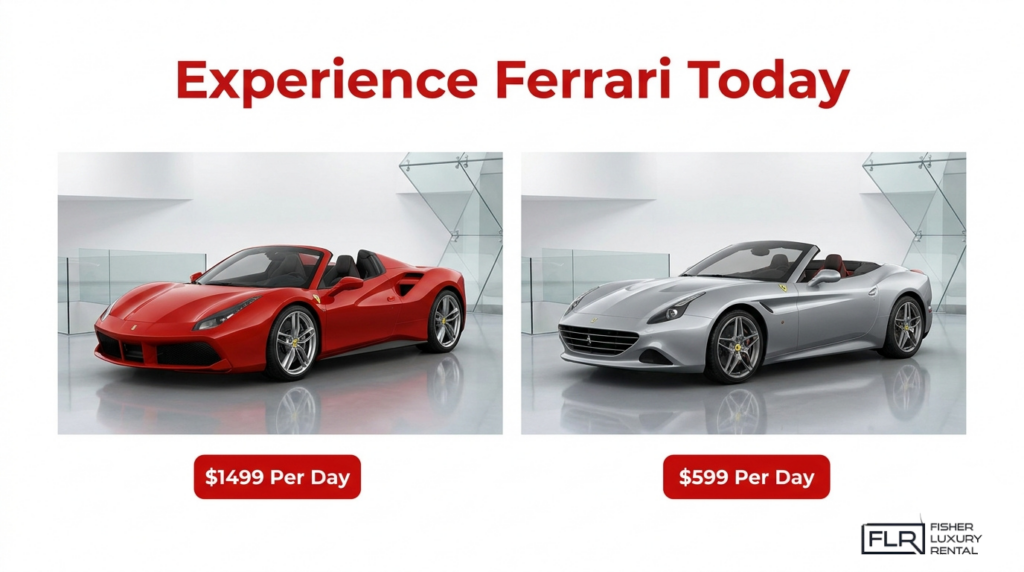
Fisher Luxury Rental offers Ferrari rentals for enthusiasts through its exotic car fleet, serving Phoenix, AZ and Portland, OR. The Ferrari 488 Spider is available at $1,499 per day, and the Ferrari California T Convertible starts at $599 per day, providing a genuine V8 Ferrari experience without the $2.25 million purchase price or collector relationship required for models like the Daytona SP3. For drivers who love the prancing horse badge but cannot meet Ferrari’s strict buyer eligibility criteria, this is genuinely the most practical path to seat time in a factory Ferrari.
What Are the Key Takeaways About the Ferrari Daytona SP3 Production Count?
The key takeaways about the Ferrari Daytona SP3 production count are that Ferrari built only 599 examples, all sold out before production began, at $2.25 million each. Ownership required a prior Ferrari purchase history and a direct invitation from the brand. The Daytona SP3 pairs a naturally aspirated V12 with racing-inspired design rooted in Ferrari’s 1967 Daytona 24 Hours triumph, making it one of the most collectible road cars ever produced. For most enthusiasts, renting a Ferrari through Fisher Luxury Rental remains the most realistic way to experience the marque firsthand.