
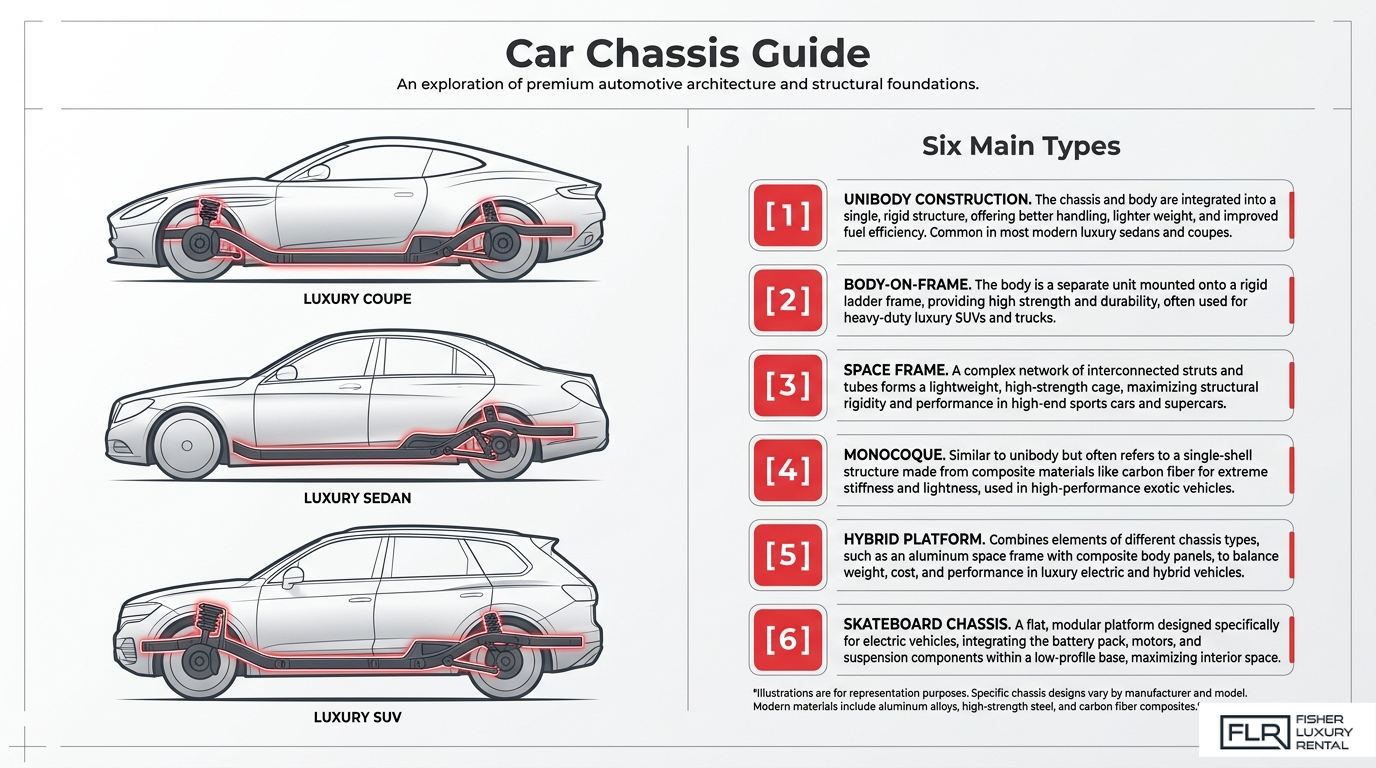
A car chassis is the complete rolling foundation of a vehicle, encompassing the structural frame, suspension, steering, brakes, and drivetrain as a unified system. The frame is one component within that assembly, not a synonym for it, and the construction method chosen shapes everything from handling precision to occupant safety.
This guide covers chassis fundamentals, the six main frame types, how construction affects real-world driving dynamics, material science, and how luxury and exotic manufacturers apply these principles.
A car chassis is more than a structural skeleton. It governs torsional rigidity, noise transmission, crash energy distribution, and suspension response, and understanding how it works explains why a track-focused supercar feels nothing like a heavy-duty pickup.
The six primary frame types, body-on-frame, unibody, monocoque, backbone chassis, tubular space frame, and subframe, each distribute structural loads differently, with direct consequences for weight, repairability, and vehicle application. Monocoque architecture alone holds over 80% of the global automotive chassis market, while body-on-frame endures in trucks and large SUVs where payload and off-road durability outweigh the weight penalty.
Chassis materials, spanning steel, aluminum, carbon fiber, and titanium, determine the structural ceiling of each design. Carbon fiber composites can reduce chassis mass by up to 50% compared to traditional steel structures, a gap that translates directly into acceleration, braking, and cornering performance.
Identifying a vehicle’s chassis type, whether through manufacturer documentation, VIN lookup, or undercarriage inspection, connects technical specification to driving feel. In luxury and exotic cars, that connection is most visible: vehicles like the McLaren 720S, Lamborghini Huracan, and Ferrari 488 Spider each use a distinct chassis architecture that Fisher Luxury Rental’s fleet makes directly comparable.
What Is a Car Chassis and Why Does It Matter?
A car chassis is the structural foundation of a vehicle, supporting the body, drivetrain, suspension, and all major mechanical systems. The sections below cover how the chassis differs from the frame and why chassis design directly shapes how a vehicle performs.
What Is the Difference Between a Chassis and a Frame?
The difference between a chassis and a frame is one of scope. A frame is the rigid structural skeleton of the vehicle, typically made from steel or aluminum, providing the load-bearing foundation. A chassis is the complete rolling assembly: the frame plus the suspension, steering system, wheels, brakes, and drivetrain. In other words, the frame is a component of the chassis, not a synonym for it. This distinction matters when evaluating how different vehicle architectures distribute structural and dynamic responsibilities across their components.
What Role Does the Chassis Play in Vehicle Performance?
The chassis plays a central role in vehicle performance by governing ride quality, handling precision, structural stiffness, and noise isolation. According to David C. Barton and John D. Fieldhouse in Automotive Chassis Engineering, chassis engineers are specifically tasked with reducing the transmission of noise from the tyre through the vehicle structure to the occupants. Beyond noise control, the chassis manages load distribution under acceleration, braking, and cornering forces. A stiffer chassis allows suspension components to respond more predictably, which directly sharpens handling response. In performance and luxury vehicles, chassis tuning is often as critical as powertrain selection for delivering a refined, controlled driving experience.
What Are the Different Types of Car Chassis Frames?
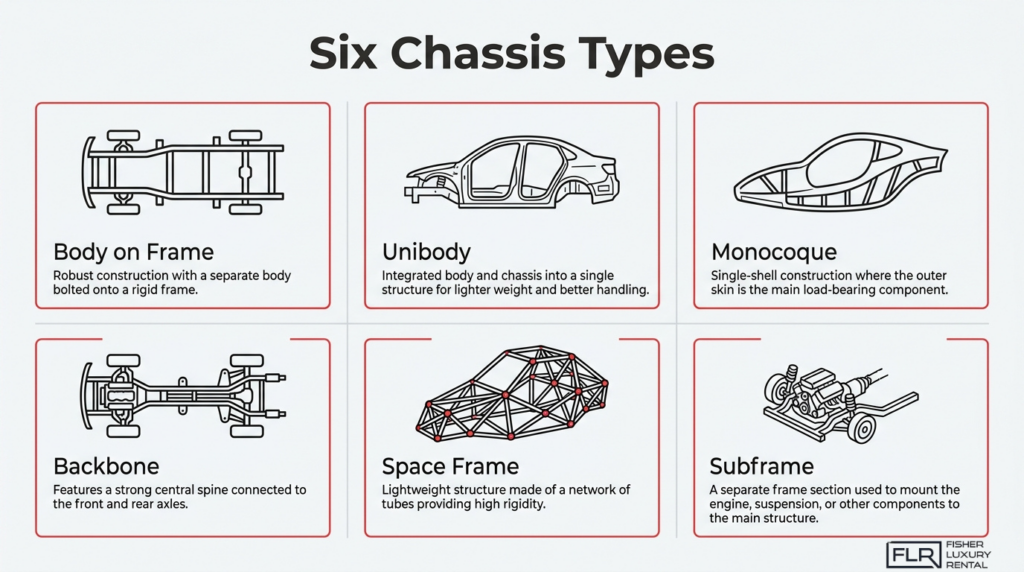
The different types of car chassis frames are body-on-frame, unibody, monocoque, backbone chassis, tubular space frame, and subframe. Each design distributes structural loads differently, influencing weight, rigidity, repairability, and vehicle application.
Body-on-Frame
Body-on-frame is a construction method where a separate body structure sits on top of a rigid ladder-style frame. The frame carries all mechanical loads, while the body provides enclosure and interior space. This separation simplifies repairs and allows heavy payloads, making body-on-frame the dominant design for trucks, full-size SUVs, and commercial vehicles. The 2024 Ford F-150, for example, uses a fully boxed high-strength steel frame paired with a military-grade aluminum alloy body.
Unibody
Unibody construction integrates the body and structural frame into a single stamped-steel shell. Load paths run through the entire body rather than a dedicated frame, which reduces weight and lowers the vehicle’s center of gravity compared to body-on-frame designs. Unibody is standard in modern passenger cars and crossover SUVs, offering better fuel economy and a stiffer platform for handling.
Monocoque
Monocoque is a structural system where the outer skin carries the primary loads, eliminating internal framing entirely. Derived from aerospace engineering, it produces an extremely stiff, lightweight shell. In motorsport, the 1981 McLaren MP4/1 set the template by becoming the first Formula 1 car built with a carbon fiber monocoque. Today, monocoque architecture holds over 80% of the automotive chassis market, driven by gigacasting and Cell-to-Body integration technologies.
Backbone Chassis
Backbone chassis design routes structural loads through a central spine running the length of the vehicle, with outriggers supporting the body. It is compact, lightweight, and well-suited to sports cars with mid or rear engine layouts. The folded steel backbone chassis of the Lotus Elan S1 and S2 was built primarily from 18-gauge mild steel with 16-gauge stiffeners and weighed just 40 kg. The Volkswagen Beetle used a similar principle, with a flat platform and a central tube backbone that also housed the shift linkage and hand brake cable.
Tubular Space Frame
Tubular space frame construction uses a three-dimensional network of welded steel or aluminum tubes to form a rigid structural cage. Load is distributed across the entire lattice rather than concentrated in any single member, enabling very high stiffness-to-weight ratios. Modern space frame designs combined with lightweight panel technology reduce overall vehicle mass and simplify the manufacturing process, making them attractive for low-volume exotic and racing applications.
Subframe
A subframe is a secondary structural assembly bolted to a main chassis to isolate and support specific mechanical components, such as the engine, transmission, or suspension. It serves as a localized load-bearing unit within a larger unibody or body-on-frame structure. Research from the Society of Plastics Engineers highlights carbon fiber subframes as a promising development, with work focused on minimizing vibrations and enhancing ride quality through optimized dynamic behavior.
How Does a Body-on-Frame Chassis Work?
A body-on-frame chassis works by mounting a separate body structure onto a rigid steel frame, with the two components connected by rubber isolators or bolts. This section covers which vehicles still use this construction, its key advantages, and its notable drawbacks.
What Vehicles Still Use Body-on-Frame Construction?
The vehicles that still use body-on-frame construction are primarily trucks, large SUVs, and commercial vehicles, such as the Ford F-150, Chevrolet Silverado, Toyota Tundra, and Jeep Wrangler. These platforms demand the high towing capacity and payload durability that a rigid, separate frame delivers. According to a study published in PubMed, occupants of passenger vehicles that crashed with compact unibody SUVs were at 18% lower risk of death compared to those that crashed with compact body-on-frame SUVs, which explains why body-on-frame has largely disappeared from passenger cars and smaller crossovers. Today, body-on-frame survives in segments where off-road capability and load-bearing strength outweigh the safety trade-offs seen in consumer vehicle collisions.
What Are the Advantages of Body-on-Frame Design?
The advantages of body-on-frame design include high towing capacity, easier repairability, strong off-road durability, and effective isolation of cabin noise and vibration. Because the body and frame are separate, collision damage to one component does not necessarily compromise the other, simplifying structural repairs. The rubber mounts between body and frame also absorb road vibration and flex, which is why heavy-duty trucks maintain this construction for rough terrain. For applications involving regular hauling or trail use, body-on-frame remains one of the most practical engineering choices available.
What Are the Drawbacks of Body-on-Frame Design?
The drawbacks of body-on-frame design include greater weight, higher ride height, reduced crash-safety performance, and less precise handling compared to unibody vehicles. The added mass of a separate frame increases fuel consumption and raises the vehicle’s center of gravity, which limits cornering agility. Structurally, the two-piece system distributes crash energy less efficiently than an integrated unibody shell, contributing to the elevated collision fatality risk cited in safety research. For drivers prioritizing everyday fuel efficiency and dynamic handling over towing strength, body-on-frame is increasingly the wrong tool for the job.
How Does a Unibody Chassis Work?
A unibody chassis works by integrating the body and structural frame into a single welded assembly, so the entire shell bears loads rather than a separate frame beneath it. The sections below cover which vehicles use this construction, its core advantages, and its key limitations.
What Vehicles Use Unibody Construction?
Vehicles that use unibody construction include most modern passenger cars, crossovers, and compact SUVs, such as the Toyota Camry, Honda CR-V, and Tesla Model 3. The design dominates mainstream automotive production because it suits high-volume manufacturing efficiently. According to Astute Analytica, monocoque and unibody architecture together hold over 80% market share of the global automotive chassis market, driven by advances like gigacasting and Cell-to-Body integration. Tesla’s gigacasting process for the Model 3, for instance, consolidates front and rear underbody sections into single large castings, drastically reducing part count.
What Are the Advantages of Unibody Design?
The advantages of unibody design include lower overall vehicle weight, greater structural rigidity, improved crash energy distribution, and a lower center of gravity compared to body-on-frame alternatives. Because the entire shell shares structural loads, unibody vehicles achieve higher torsional stiffness, which translates directly into sharper handling response. A study published on PubMed found that occupants in vehicles that crashed with compact unibody SUVs faced an 18% lower risk of death than those crashing with compact body-on-frame SUVs. From an engineering standpoint, the distributed load-bearing of a unibody is one of the most efficient structural strategies available in mass-market vehicle design.
What Are the Drawbacks of Unibody Design?
The drawbacks of unibody design include reduced repairability after collision damage, higher sensitivity to corrosion over time, and limited suitability for heavy towing or off-road punishment. Because structural integrity depends on the entire welded shell, localized damage often requires specialized equipment and sectioning techniques to restore properly. The TRID database notes that research comparing unibody and body-on-frame vehicles after collision repair identifies significant differences in repairability and insurance cost implications. For buyers prioritizing long-term durability under heavy use, this repairability gap is worth weighing carefully against the weight and safety benefits.
How Does a Monocoque Chassis Work?
A monocoque chassis works by distributing structural loads across the entire outer skin of the vehicle rather than through a separate internal frame. According to Astute Analytica, monocoque architecture holds over 80% market share of the automotive chassis market, driven by gigacasting and Cell-to-Body (CTB) integration. The H3s below examine why performance vehicles favor this design and which materials make it possible.

Why Do Supercars and Race Cars Use Monocoque Frames?
Supercars and race cars use monocoque frames because the design delivers exceptional rigidity at minimal weight, two properties that directly determine cornering precision and lap times. When every panel contributes to structural stiffness, engineers eliminate redundant framing components, lowering the center of gravity and improving dynamic balance. Setting the standard for the modern F1 car, the 1981 McLaren MP4/1 was the first Formula 1 car to use a carbon fiber monocoque, according to McLaren Racing. That breakthrough proved the design could survive extreme crash loads while keeping mass low enough for competitive performance. For high-performance applications, the monocoque is genuinely the only logical choice.
What Materials Are Used in Monocoque Construction?
The materials used in monocoque construction include steel, aluminum, carbon fiber-reinforced polymers (CFRPs), and hybrid composites. According to Automobili Lamborghini, the Revuelto features a carbon-fiber monofuselage extending the monocoque to the front end, making it the first supersports car with a front structure of 100% CFRP. CFRPs offer high specific stiffness, excellent fatigue resistance, and low thermal expansion, though production costs remain significant. Aluminum monocoques balance weight savings with more accessible manufacturing, while steel variants remain common in mainstream vehicles where cost and repairability outweigh the need for extreme mass reduction.
How Does a Space Frame Chassis Work?
A space frame chassis works by distributing structural loads across a three-dimensional network of interconnected tubes rather than concentrating stress in a single plane. The following sections cover the key advantages of tubular construction and the exotic cars built around this design.
What Are the Advantages of Tubular Space Frames?
The advantages of tubular space frames include exceptional rigidity, low weight, and flexible body panel options. Because the tube network carries loads in multiple directions simultaneously, engineers can achieve high torsional stiffness without relying on heavy sheet metal. This makes the architecture especially well-suited for performance vehicles where every kilogram matters. Plastic or composite body panels can then be fitted over the structure without contributing to structural load, simplifying the manufacturing process considerably.
Which Exotic Cars Use Space Frame Construction?
Exotic cars that use space frame construction include the Lamborghini Huracan, Audi R8, and early Dodge Vipers, all of which pair a tubular or extruded aluminum space frame with lightweight body panels. According to a University of Southern Queensland study, modern space frame construction combined with plastic panel technology reduces overall vehicle mass while simplifying the production process. Repair complexity and insurance costs remain a consideration, as a TRID Transport Research Board report noted meaningful differences in repairability between frame-style and unibody construction after collision events.
How Does a Backbone Chassis Work?
A backbone chassis works by routing all structural loads through a single rigid central tube or spine that runs the length of the vehicle, connecting the front and rear suspension assemblies. The body panels attach to this central structure but carry no primary load.
What Is the Central Tube in a Backbone Chassis?
The central tube is the load-bearing spine of a backbone chassis, typically a hollow steel box or tubular section running from front to rear. It houses mechanical components such as the driveshaft, shift linkage, and brake cables, consolidating structural and mechanical functions into one channel. The Volkswagen Beetle’s backbone, for example, held the shift linkage and hand brake cable within a flat central platform tube. This integration makes backbone designs compact and mechanically efficient, though the open sides offer less torsional rigidity than a full perimeter frame.
What Makes the Backbone Chassis Lightweight?
The backbone chassis achieves low weight by eliminating the heavy outer rails of a conventional ladder frame and concentrating material only where structural load demands it. The folded steel backbone chassis of the Lotus Elan S1 and S2 was constructed primarily from 18-gauge mild steel with 16-gauge stiffeners and weighed just 40 kg, demonstrating how minimal material use can still deliver a rigid, performance-oriented platform. For lightweight sports cars where unsprung mass and chassis weight directly affect handling response, this efficiency is difficult to match with other frame types.
What Chassis Materials Affect Strength and Weight?
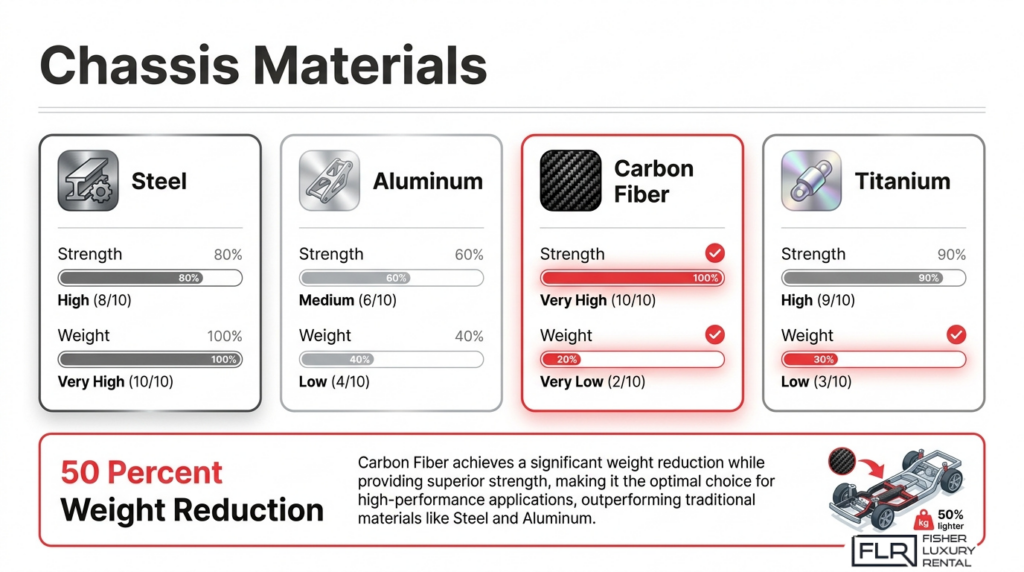
Chassis materials affect strength and weight through their density, stiffness, and structural efficiency. The following sections cover the four primary materials used in chassis construction: steel, aluminum, carbon fiber, and titanium.
Steel
Steel is the most widely used chassis material, offering high tensile strength, excellent weldability, and low cost. It handles significant load without permanent deformation, making it the default choice for trucks, body-on-frame SUVs, and commercial vehicles. Its main drawback is weight: steel is dense, and heavier frames increase fuel consumption and reduce handling responsiveness.
Aluminum
Aluminum is a lightweight chassis material that reduces vehicle mass without sacrificing structural integrity. It is approximately one-third the density of steel, which improves acceleration, braking, and fuel efficiency. Automakers frequently use aluminum in unibody construction and subframes. The trade-off is higher material and manufacturing cost compared to steel.
Carbon Fiber
Carbon fiber is the highest-performing structural material available for chassis applications. Carbon fiber-reinforced polymers (CFRPs) offer an exceptional strength-to-weight ratio, high specific stiffness, excellent fatigue resistance, low thermal expansion, and superior chemical resistance, according to MDPI’s Journal of Composites Science. Carbon fiber composites can reduce chassis mass by up to 50% compared to traditional steel structures. The Lamborghini Revuelto is the first supersports car with a front structure built entirely from CFRP, extending its carbon-fiber monofuselage to the front end. CFRPs are expensive to produce, which limits their use to high-performance and exotic vehicles.
Titanium
Titanium alloys offer the highest strength-to-weight ratio among metallic materials used in high-performance chassis. Stronger than steel at roughly half the weight, titanium performs exceptionally in components where both rigidity and mass reduction are critical. Its high cost and machining complexity make it impractical for mainstream production, so its use is limited to motorsport and ultra-premium applications.
How Does Chassis Type Affect Handling and Driving Feel?
Chassis type directly shapes how a car corners, accelerates, and brakes. The sections below cover how structural rigidity influences cornering precision and how chassis weight affects straight-line and stopping performance.
How Does Chassis Rigidity Influence Cornering?
Chassis rigidity influences cornering by determining how much the structure flexes under lateral load during a turn. A stiffer chassis transmits suspension inputs more accurately, allowing the wheels to maintain consistent contact with the road surface. In a typical passenger vehicle, the frame supplies approximately 37% of torsional rigidity, with the body structure supplying the remainder, according to the Naval Education and Training Professional Development and Technology Center (NAVEDTRA). When torsional stiffness is low, the chassis twists as cornering forces build, causing unpredictable understeer or oversteer. Monocoque and carbon fiber chassis designs achieve the highest rigidity-to-weight ratios, which is precisely why they dominate performance and supercar applications where cornering precision is non-negotiable.
How Does Chassis Weight Affect Acceleration and Braking?
Chassis weight affects acceleration and braking by directly influencing the total unsprung and sprung mass a powertrain and braking system must manage. A lighter chassis reduces the inertia a vehicle must overcome to accelerate and shortens the stopping distance under hard braking. Carbon fiber composites can reduce chassis mass by up to 50% compared to traditional steel structures, according to the International Journal of Advanced Science and Technology. That mass reduction translates into measurably faster response in both acceleration and braking, since less kinetic energy must be generated or dissipated. For performance-oriented vehicles, reducing chassis weight is often a more efficient path to quicker lap times than simply increasing engine output.
How Do You Identify What Chassis Type a Car Has?
You can identify what chassis type a car has through three reliable methods: checking the manufacturer’s technical documentation, inspecting the vehicle’s physical structure, and consulting the VIN-linked vehicle history report.
Check the Owner’s Manual and Manufacturer Specs
The owner’s manual and manufacturer specifications identify chassis type directly, usually under the “Vehicle Specifications” or “Body and Frame” section. For most production vehicles, the manufacturer’s press kit or model page names the construction method explicitly, such as “unibody construction” or “body-on-frame.” Automaker data portals and dealership spec sheets are the fastest verified sources for this information.
Look Up the VIN
The VIN connects to a database record that includes the vehicle’s build configuration, platform code, and structural classification. Services such as the NHTSA vehicle lookup tool or manufacturer-specific decoders decode the VIN into production details, including platform type. Platform codes often indicate whether a vehicle shares a unibody or body-on-frame architecture with other models in the same lineup.
Inspect the Undercarriage
You can identify chassis type visually by inspecting the undercarriage. Body-on-frame vehicles show a visible, separate ladder frame running the length of the vehicle beneath the body panels. Unibody and monocoque vehicles have an integrated floor pan with no discrete frame rails. Space frame vehicles display a visible network of tubes or structural nodes. A basic visual inspection on a lift, without any disassembly, typically makes the distinction clear.
With chassis type identified, understanding how luxury and exotic manufacturers apply these structures reveals why certain vehicles drive the way they do.
How Does Chassis Design Differ in Luxury and Exotic Cars?
Luxury and exotic cars use chassis designs optimized for performance, refinement, and safety — favoring monocoque, carbon fiber, and advanced aluminum structures over the body-on-frame builds common in trucks and SUVs. The sections below explore how those differences translate into real driving experiences and what Fisher Luxury Rental offers.
Can You Experience Different Chassis Types with Fisher Luxury Rental?
Yes, you can experience different chassis types with Fisher Luxury Rental across its fleet of luxury and exotic vehicles. The McLaren 720S uses a carbon fiber monocoque tub, delivering exceptional rigidity at minimal weight. The Lamborghini Huracan Spyder combines an aluminum and carbon fiber hybrid structure for a balance of stiffness and driver feedback. The Ferrari 488 Spider employs an advanced aluminum space frame, while the Porsche 911 Carrera S and Audi R8 Spyder both use high-rigidity aluminum-intensive unibody platforms. For drivers who want to feel the difference that chassis engineering makes, these vehicles provide a direct, tangible comparison that no specification sheet can replicate.

What Are the Key Takeaways About Car Chassis Types?
The key takeaways about car chassis types are that construction method, material, and geometry all shape how a vehicle performs, handles, and protects occupants. Body-on-frame remains dominant in trucks and large SUVs, prizing durability and payload. Unibody and monocoque designs dominate passenger cars and performance vehicles, prioritizing rigidity, weight efficiency, and safety. Carbon fiber composites represent the leading edge, reducing mass significantly while increasing structural stiffness. Tesla’s gigacasting approach consolidates hundreds of body parts into single cast sections, reflecting how manufacturing innovation continues to reshape chassis engineering. Understanding these fundamentals helps any driver appreciate what makes a high-performance exotic feel fundamentally different from an everyday vehicle.