
Driving a supercar is harder than driving a regular car. Supercars deliver sharper steering, stronger acceleration, and reduced visibility compared to standard vehicles, which means they demand greater skill and awareness from every driver.
This guide covers what separates supercars from normal cars, the skills and training needed to drive one safely, common operational challenges, how weather affects performance, the sensory and emotional side of the experience, and how renting a supercar shapes the entire process.
Modern supercars use quicker steering ratios, active aerodynamics, and advanced traction systems that respond faster than conventional cars. These differences create a driving feel that is precise but less forgiving of sloppy inputs.
Safe supercar driving requires focus, fast reaction time, and ideally some performance driving training. Novice drivers face a steeper learning curve because the power-to-weight ratio amplifies every mistake.
Aggressive acceleration, shorter braking distances, and ground clearance as low as four inches create real challenges on public roads. City driving demands constant attention to speed bumps, potholes, and tight parking situations.
Rain and cold conditions cut available traction significantly, making stability control systems and proper tire selection critical for maintaining grip in a high-powered vehicle.
The sensory experience is intense. Engine sound, g-forces during cornering, and rapid speed changes create a combination of physical and emotional stimulation that most drivers describe as both intimidating and deeply rewarding.
Renting through a reputable provider simplifies the experience with safety briefings, vehicle preparation, and driver assessments that help bridge the gap between curiosity and confidence behind the wheel.
What Makes Driving a Supercar Different From Regular Cars?
Driving a supercar differs from driving a regular car in three fundamental ways: handling precision, onboard technology, and cockpit design. The sections below break down how each factor creates a distinct driving experience.
How Do Supercars Handle Compared to Standard Vehicles?
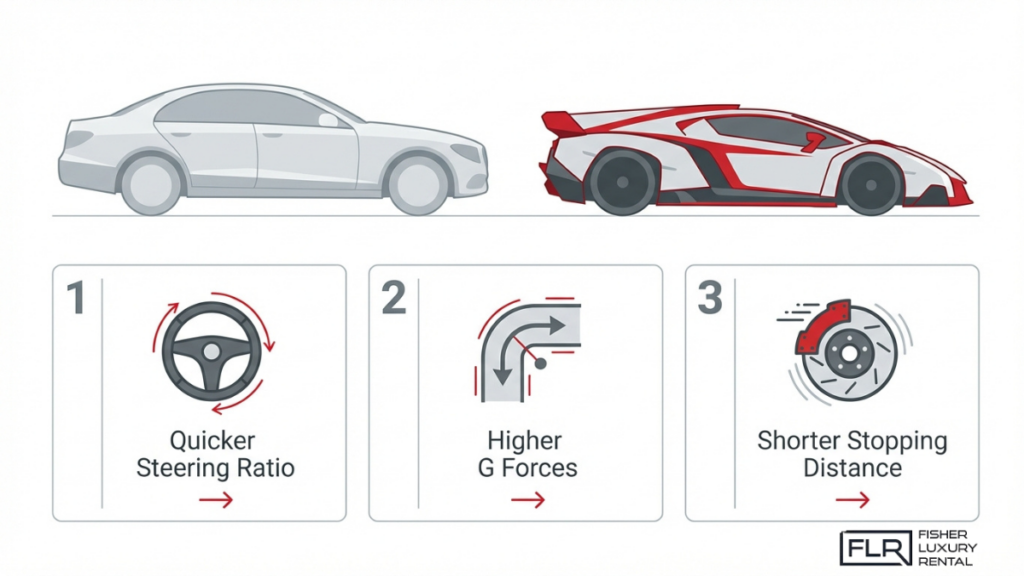
Supercars handle with sharper responsiveness, higher cornering limits, and more aggressive steering feedback compared to standard vehicles. According to Grassroots Motorsports, modern supercars achieve lateral acceleration exceeding 1.1g, while standard passenger vehicles typically max out between 0.8g and 0.9g before losing traction.
Steering ratio is another key differentiator. High-performance vehicles use ratios around 12:1, considerably quicker than the 16:1 or 18:1 found in standard sedans. Every small input at the wheel translates into immediate directional change, which can feel twitchy to drivers accustomed to more forgiving setups.
Active aerodynamic systems add another layer. The 2026 Aston Martin Valhalla, for example, combines torque vectoring with active aero components to maintain stability during heavy braking and high-speed cornering. For anyone stepping into a supercar for the first time, this level of mechanical precision demands respect and smooth inputs.
What Advanced Technologies Are Found in Supercars?
Advanced technologies found in supercars include active aerodynamics, adaptive chassis systems, and hybrid powertrains calibrated for extreme performance. The 2026 Aston Martin Valkyrie Spider illustrates this well, generating 1,160 hp and 664 lbs.-ft. of torque through precise recalibrations of its active aerodynamic and chassis systems, as reported by Aston Martin Michigan.
These technologies do not simply add speed; they manage it. Active aero adjusts downforce in real time, while adaptive suspension reads road surfaces and recalibrates damping within milliseconds. 2026 Formula 1 regulations are also introducing active aerodynamics that will likely shape future road-going supercar designs. For drivers, this means the car is constantly working to keep you safe, though understanding what these systems are doing builds confidence behind the wheel.
Why Is Visibility and Ergonomics a Challenge in Supercars?
Visibility and ergonomics are a challenge in supercars because their low-slung, aerodynamically optimized designs prioritize performance over outward sightlines. Seating positions sit just inches from the pavement, windshields rake at extreme angles, and rear visibility is often minimal.
According to the Insurance Institute for Highway Safety, forward blind zones in modern vehicles have grown significantly over the past 25 years. Supercars amplify this problem with compact cabin dimensions and thick structural pillars. Mirror-specific challenges in high-performance car design further contribute to blind spot variability and perception errors, requiring heightened driver awareness at intersections and during lane changes.
Tight cockpits also mean limited elbow room and pedals positioned closer together than in a standard sedan. None of these traits are deal-breakers, but they require an adjustment period. Understanding these ergonomic differences before your first drive sets the stage for building the skills covered next.
What Skills and Experience Are Required to Drive a Supercar Safely?
Driving a supercar safely requires a combination of performance driving training, situational awareness, and sharp reaction time. The following sections cover formal training options, how novice drivers can manage these vehicles, and why focus matters behind the wheel.
Do You Need Performance Driving Training for Supercars?
Yes, you need performance driving training to safely extract a supercar’s full capability. Standard driving lessons do not prepare you for vehicles producing over 600 horsepower with steering ratios as quick as 12:1. Performance driving courses teach critical skills:
- Threshold braking under high deceleration forces
- Cornering techniques at elevated lateral g-loads
- Throttle modulation to prevent oversteer in rear-wheel-drive layouts
- Emergency lane-change maneuvers at speed
Simulation-based preparation is also gaining traction. According to a 2026 LinkedIn market report, the United States driving training simulators market is projected to grow annually by 14.3%, reflecting increased adoption for high-performance driver preparation. Even for a rental experience, completing a half-day performance course dramatically improves confidence and control.

Can Novice Drivers Safely Handle Supercars?
Novice drivers can safely handle supercars when proper precautions are in place, though the risk profile is significantly higher without experience. Modern driver aids like traction control, stability management, and adaptive suspension help bridge skill gaps. Still, these systems have limits.
According to a 2021 study published in PubMed Central, novice drivers under 30 or over 55 are more prone to fatal accidents, while experienced drivers show decreased crash risk as seat time increases. In a supercar, where acceleration and braking forces exceed anything encountered in standard vehicles, that experience gap becomes more consequential. Starting in a controlled environment, following a thorough safety briefing, and choosing comfort-oriented drive modes are the most practical steps for first-time supercar drivers.
How Important Is Reaction Time and Focus When Driving a Supercar?
Reaction time and focus are critically important when driving a supercar because these vehicles compress decision windows significantly. A car reaching 60 mph in under three seconds leaves almost no margin for delayed inputs, and closing speeds on public roads demand constant spatial awareness.
The mental demands are substantial even for professionals. Real-world racing drivers experience average heart rates of 159 BPM, roughly 85% of maximum heart rate, during operation, according to data from Elite Formula PT. That elevated cardiovascular response reflects the sustained cognitive load of processing speed, traffic, and vehicle dynamics simultaneously. For everyday supercar drivers, maintaining undivided attention, avoiding distractions, and staying physically alert are non-negotiable habits.
With training and focus addressed, understanding the common physical challenges of operating these vehicles adds another layer of preparation.
What Common Challenges Do Drivers Face When Operating Supercars?
Drivers face common challenges related to extreme acceleration and braking forces, limited ground clearance, and demanding urban navigation. The following sections break down each of these operational hurdles.
Why Are Acceleration and Braking More Demanding?
Acceleration and braking are more demanding in supercars because the forces involved far exceed what standard vehicles produce. According to Car and Driver, the quickest cars tested in 2025 demonstrated quarter-mile times as low as 9.2 seconds, outperforming previous high-performance benchmarks. That level of thrust requires precise throttle modulation; even slight over-application can overwhelm rear tires and trigger loss of traction.
Braking presents an equally steep learning curve. High-performance carbon-ceramic brake systems deliver stopping power that can catch inexperienced drivers off guard, requiring progressive pedal input rather than sudden pressure. Mastering both extremes of the performance envelope takes deliberate practice and respect for the machine’s capabilities.
How Does Low Ground Clearance Affect Everyday Use?
Low ground clearance affects everyday use by making supercars vulnerable to obstacles that standard vehicles clear without issue. According to Bridjit, average ground clearance for sports cars and supercars ranges between 4.0 and 6.0 inches, compared to 7.9 to 9.8 inches for standard SUVs.
Common hazards that become genuine threats at this ride height include:
- Speed bumps and raised crosswalks that can scrape front splitters.
- Steep driveway transitions and parking garage ramps that risk undercarriage contact.
- Potholes and uneven pavement that may damage low-mounted suspension components.
Planning routes carefully and approaching inclines at an angle are habits every supercar driver should develop quickly.
What Should You Know About Navigating City Streets and Highways?
You should know that navigating city streets and highways in a supercar demands heightened spatial awareness due to limited visibility and wider dimensions. Forward blind zones in modern vehicles have grown significantly over the past 25 years, according to the Insurance Institute for Highway Safety, and supercars amplify this problem with their low seating position and raked windshields.
Tight urban lanes, parallel parking, and congested intersections all require slower, more calculated maneuvering than most drivers expect. On highways, the quicker steering response, often optimized to a 12:1 ratio, means small inputs produce immediate directional changes. Staying smooth with steering, throttle, and lane transitions is essential for maintaining control and confidence at speed.
With these operational challenges understood, drivers can better prepare for how weather and road conditions add another layer of complexity.
How Do Weather and Road Conditions Impact Driving Supercars?
Weather and road conditions impact driving supercars by dramatically reducing available traction and amplifying the consequences of high horsepower on compromised surfaces. The sections below cover specific weather challenges and the stability features that help manage them.
Are Supercars Difficult to Drive in Rain, Snow, or Heat?
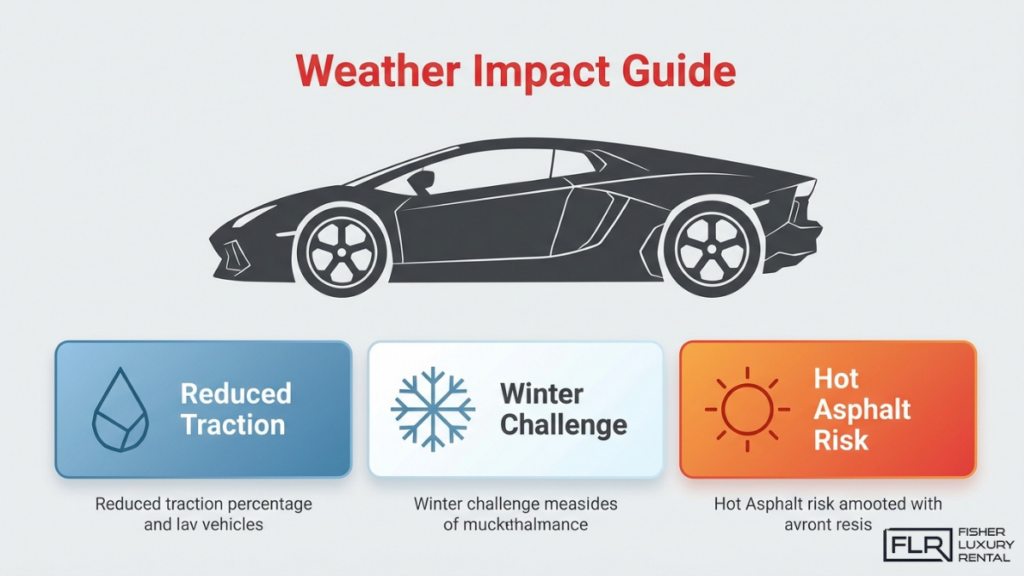
Supercars are difficult to drive in rain, snow, or heat because their high-power, rear-biased drivetrains and performance tires lose grip significantly on wet or slippery surfaces. According to SuperCars.net, heavy rain can drop the coefficient of friction on pavement to 0.4, approximately half the traction available on dry roads.
That reduction matters far more when an engine delivers 600 or more horsepower through wide, low-profile tires designed for dry grip. Snow compounds the problem; performance tires lack the siping and soft compounds needed for cold-weather traction. Extreme heat softens asphalt, which can feel unpredictable under aggressive braking. For anyone driving a supercar in less-than-ideal conditions, smooth throttle inputs and extended following distances become essential.
Which Traction and Stability Features Help in Adverse Conditions?
The traction and stability features that help in adverse conditions include electronic stability control, torque vectoring, all-wheel-drive systems, and active aerodynamics. These systems work together to redistribute power and maintain grip when road surfaces become unpredictable.
Key features found in modern supercars include:
- Electronic stability control (ESC) detects wheel slip and applies individual brakes to correct oversteer or understeer.
- Torque vectoring shifts power between wheels to improve cornering balance on wet or uneven pavement.
- All-wheel-drive (AWD) systems distribute torque across all four tires, reducing wheelspin during acceleration.
- Active aerodynamics adjust downforce in real time to keep tires loaded against the road surface at varying speeds.
As reported by Popular Science, active aerodynamic systems in 2026 supercars like the Aston Martin Valhalla utilize torque vectoring and active aero components to maintain stability during heavy braking and high-speed cornering. Even with these technologies engaged, no electronic system fully replaces attentive, measured driving inputs when conditions deteriorate.
With weather challenges understood, the sensory and emotional side of supercar driving adds another dimension to the experience.
What Emotional and Sensory Experiences Come With Driving a Supercar?
The emotional and sensory experiences that come with driving a supercar include visceral sound, intense acceleration forces, and a heightened mental state that transforms ordinary driving into something unforgettable. The following sections explore how sound and speed shape the experience, whether drivers feel intimidated or empowered, and what creates lasting memories.
How Does the Sound and Speed Affect the Driving Experience?
The sound and speed affect the driving experience by creating an immersive sensory environment that engages the driver physically and psychologically. Engine note, exhaust tone, and wind noise at high velocity combine to produce an auditory signature unique to each supercar. Rapid acceleration pins the body against the seat, while lateral g-forces during cornering heighten spatial awareness. Ferrari collaborated with NASA to study how extreme g-forces and instant torque in electric supercars impact the human body, aiming to ensure the experience remains manageable for drivers. This physiological intensity elevates heart rate and sharpens focus, turning speed into something felt rather than simply observed. For most people, that combination of sound pressure and forward thrust is unlike anything a standard vehicle delivers.
Is Supercar Driving Intimidating or Empowering for Most People?
Supercar driving is empowering for most people, though initial moments behind the wheel often carry a wave of intimidation. The low seating position, responsive steering, and raw engine presence can feel overwhelming at first. However, once drivers settle into the controls and build confidence through the first few turns, that nervousness typically shifts into exhilaration. Professional drivers have reported that even under 2026 regulations, the intense focus required causes significant mental drain, suggesting that heightened concentration is inherent to high-performance driving at every level. For everyday drivers, this focused state creates a sense of total control. The intimidation fades quickly; what remains is a feeling of capability that most people rarely experience in daily life.
What Makes Driving a Supercar a Memorable Experience?
Driving a supercar becomes a memorable experience because it activates multiple senses simultaneously while demanding complete present-moment attention. Several elements contribute to that lasting impression:
- The exhaust note creates an emotional soundtrack tied to specific moments of acceleration and deceleration.
- Physical g-forces during cornering and braking imprint the experience into the body’s muscle memory.
- The precision of steering and throttle response rewards even small driver inputs with immediate feedback.
- Visual stimulation from the cockpit design, low driving perspective, and passing scenery intensifies the sense of speed.
Together, these factors produce a level of engagement that ordinary driving simply cannot replicate. This sensory richness is what transforms a supercar drive from transportation into an event worth remembering, and it explains why renting one appeals to both enthusiasts and first-time drivers alike.

How Does Renting a Supercar Enhance or Affect the Driving Experience?
Renting a supercar enhances the driving experience by providing access to high-performance vehicles without the commitment of ownership. The sections below cover what renters can expect, required safety protocols, and how providers maintain their fleets.
What Should You Expect During a Luxury Car Rental Experience?
You should expect a luxury car rental experience to include a guided vehicle orientation, a walkthrough of the car’s performance features, and dedicated support from the rental provider. Most exotic rental companies pair each booking with a concierge-style process: vehicle selection, documentation review, and a familiarization period before you drive.
Renters typically receive instruction on drive modes, paddle shifters, and launch control systems specific to models like the Lamborghini Huracan Spyder or McLaren 720S. The goal is confidence behind the wheel from the first mile. For anyone accustomed to standard vehicles, the transition to a supercar’s cockpit, seating position, and throttle sensitivity can feel dramatic, which makes this orientation period essential.
Are There Safety Briefings or Driving Requirements for Renters?
Yes, there are safety briefings and driving requirements for most supercar renters. According to a Prime Insurance Company report, exotic car rental companies must conduct thorough risk assessments to identify potential hazards and evaluate driver profiles before providing insurance coverage. These assessments typically include verifying a valid driver’s license, confirming minimum age requirements, and reviewing driving history for major violations.
Safety briefings cover key topics before departure:
- Proper use of traction control and stability management systems.
- Braking technique differences compared to standard vehicles.
- Acceleration limits appropriate for public roads.
- Awareness of low ground clearance when navigating speed bumps or driveways.
This pre-drive protocol reduces risk for both the renter and the vehicle, ensuring first-time supercar drivers understand the heightened responsiveness they will encounter.
How Do Rental Providers Ensure Their Supercars Are Ready for Clients?
Rental providers ensure their supercars are ready for clients through rigorous pre-delivery inspection routines, scheduled maintenance cycles, and post-return condition assessments. Each vehicle undergoes checks on tire pressure, brake pad wear, fluid levels, and exterior condition before every rental period begins.
Fleet quality also depends on vehicle selection. Providers that stock top-trim, late-model exotics reduce the likelihood of mechanical issues and deliver the full performance each car was designed to offer. Consistent detailing, both interior and exterior, preserves the sensory impact that makes driving a supercar memorable.
For most renters, the vehicle’s readiness directly shapes their confidence and enjoyment. A well-maintained supercar feels precise and responsive, while deferred maintenance introduces unpredictability that no driver wants at high speed. Understanding how rental providers prepare their fleet offers renters a clear advantage when choosing where to book.
How Can Fisher Luxury Rental Help You Experience the Thrill of Supercar Driving?
Fisher Luxury Rental can help you experience the thrill of supercar driving by providing a curated fleet of high-performance exotics with service tailored to every skill level. Below, explore the specific rental offerings and key takeaways from this guide.
What Premium Supercar Rental Services Does Fisher Luxury Rental Offer for First-Time and Experienced Drivers?
Fisher Luxury Rental offers premium supercar rental services for first-time and experienced drivers through a fleet of top-trim exotic vehicles available in Arizona and Northwest Oregon. Established in 2022, Fisher Luxury Rental specializes in high-performance models that let clients experience genuine supercar dynamics without long-term ownership.
The fleet includes vehicles built to deliver the handling precision and sensory intensity covered throughout this guide:
- Lamborghini Huracan Spyder delivers mid-engine balance and open-air performance.
- McLaren 720S provides sharp steering response and aggressive acceleration.
- Ferrari 488 Spider combines iconic V8 power with convertible versatility.
- Porsche 911 Carrera S offers an accessible entry point into rear-engine sports car dynamics.
- Corvette C8 Z06 pairs track-focused engineering with daily drivability.
Whether you are a first-time exotic driver or someone with high-performance seat time, Fisher Luxury Rental matches the right vehicle to your comfort level. For those newer to supercar driving, choosing a model like the Corvette C8 or Porsche 911 builds confidence before stepping into more aggressive platforms.
What Are the Key Takeaways About Driving a Supercar Hard? Challenges & Experience 2026 We Covered?
The key takeaways about whether driving a supercar is hard center on preparation, vehicle awareness, and respecting the performance envelope. Supercars demand more from drivers than standard vehicles across every dimension: handling, braking, visibility, and environmental sensitivity.
The most actionable lessons from this guide include:
- Supercar steering ratios, lateral grip, and braking distances require deliberate input adjustments compared to regular cars.
- Low ground clearance and limited visibility make urban driving a learned skill, not an afterthought.
- Weather reduces available traction significantly, making tire and stability system awareness essential.
- Novice drivers face measurably higher risk, so gradual progression through vehicle tiers is the safest approach.
- The sensory and psychological intensity of supercar driving is real; mental focus matters as much as physical control.
Renting before buying remains one of the smartest ways to build supercar experience in a controlled, low-commitment setting. Fisher Luxury Rental makes that accessible by offering multiple performance tiers, so every driver can find the right starting point and progress confidently.