
An affordable luxury sports car is a high-performance vehicle that delivers premium materials, advanced technology, and thrilling driving dynamics at a price point typically between $50,000 and $100,000. This segment bridges the gap between mainstream sports cars and six-figure exotics, offering genuine luxury without the extreme cost of entry.
We cover market definitions and leading brands, a ranked list of the top 10 models, performance and ownership comparisons, buying versus leasing considerations, and ways to experience these cars firsthand.
The affordable luxury segment in 2026 has expanded as automakers pack more power and refinement into accessible price brackets. Models now range from turbocharged four-cylinders producing 300 horsepower to naturally aspirated V8s pushing nearly 500, all within this segment’s price ceiling.
Our top 10 list spans iconic nameplates including the Porsche 718 Cayman T, Chevrolet Corvette Stingray, BMW M2, and Ford Mustang Dark Horse, alongside standouts from Audi, Lexus, Jaguar, Mercedes-AMG, Nissan, and Toyota. Each model balances raw performance with luxury cabin appointments like premium leather, advanced infotainment, and driver-assistance systems.
Ownership costs vary significantly across the segment. Annual maintenance can range from around $900 for more reliable marques to over $1,700 for brands with higher service demands, while insurance on high-performance models can reach five figures. Leasing has become a popular alternative for accessing these cars at lower monthly commitments.
For those who want the experience without a long-term purchase, luxury rental services and test-drive events now make it possible to get behind the wheel of these vehicles for a weekend or special occasion.
What Defines an Affordable Luxury Sports Car in 2026?
An affordable luxury sports car in 2026 combines premium materials, advanced technology, and high performance at a price below the segment average. The following subsections break down qualifying price ranges, distinguishing features, and how affordability in this class has shifted.
What Price Ranges Qualify as “Affordable” for Luxury Sports Cars?
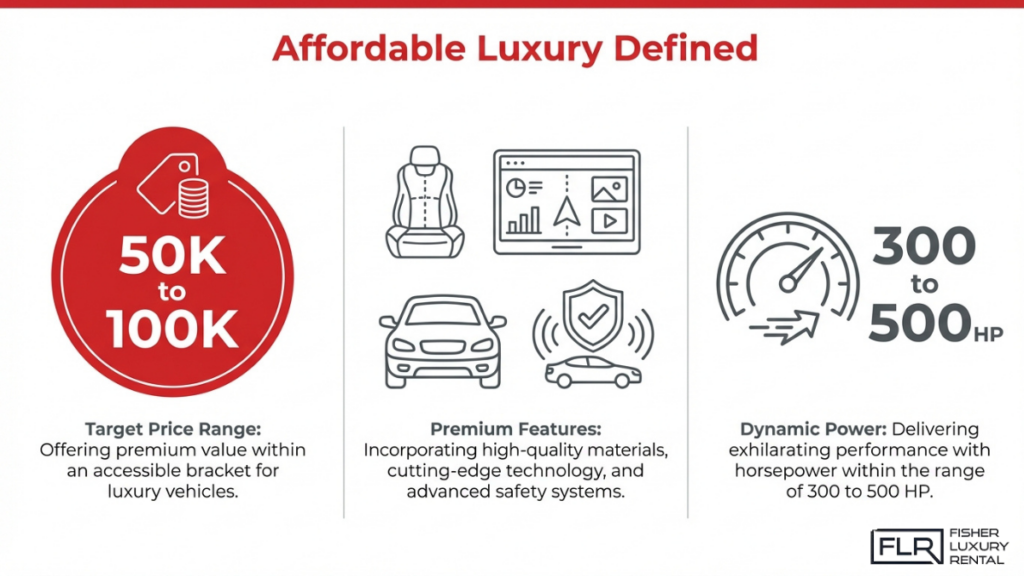
The price ranges that qualify as “affordable” for luxury sports cars fall between $50,000 and $100,000. According to iSeeCars, the average starting price for a luxury sports car in 2026 is approximately $97,439, placing entry-level models well below that threshold. Vehicles like the Toyota GR Supra starting at $58,300 and the BMW M2 at $69,375 sit comfortably in this band, delivering genuine performance without crossing into six-figure territory.
For most buyers, this range represents the sweet spot where world-class engineering becomes realistically attainable rather than aspirational.
What Key Features Set Luxury Sports Cars Apart From Regular Sports Cars?
The key features that set luxury sports cars apart from regular sports cars include:
- Higher quality audio systems and larger infotainment screens
- First-rate interior accents such as leather upholstery and aluminum trim
- Advanced driver-assistance and safety technology
- Refined ride quality tuned for daily comfort alongside track capability
Models like the Ford Mustang Dark Horse and the Nissan Z Nismo illustrate this balance, pairing raw power with cabin refinement that standard sports cars typically lack. A common misconception is that luxury sports cars are strictly for show; modern engineering allows many models to serve as reliable daily drivers with comprehensive safety suites.
How Has the Definition of “Affordable Luxury” Evolved Recently?
The definition of “affordable luxury” has evolved from simply meaning a discounted premium badge to describing cars that genuinely deliver high-end experiences within a middle-market budget. Rising vehicle prices across the industry, combined with stalling battery electric vehicle adoption, have pushed manufacturers toward refining hybrid and high-performance ICE models that offer stronger value propositions. Features once reserved for six-figure grand tourers, including adaptive suspension, carbon fiber accents, and configurable drive modes, now appear standard on cars priced under $80,000.
This shifting landscape means today’s affordable luxury buyer gets more capability per dollar than at any previous point in the segment’s history, setting the stage for the specific models worth considering in 2026.
Which Brands Are Leading the Affordable Luxury Sports Car Market in 2026?
The brands leading the affordable luxury sports car market in 2026 include Porsche, BMW, Audi, and Lexus, among others. Below, we explore what sets these established players apart and whether any newcomers are disrupting the segment.
What Makes Brands Like Porsche, BMW, and Audi Stand Out in 2026?
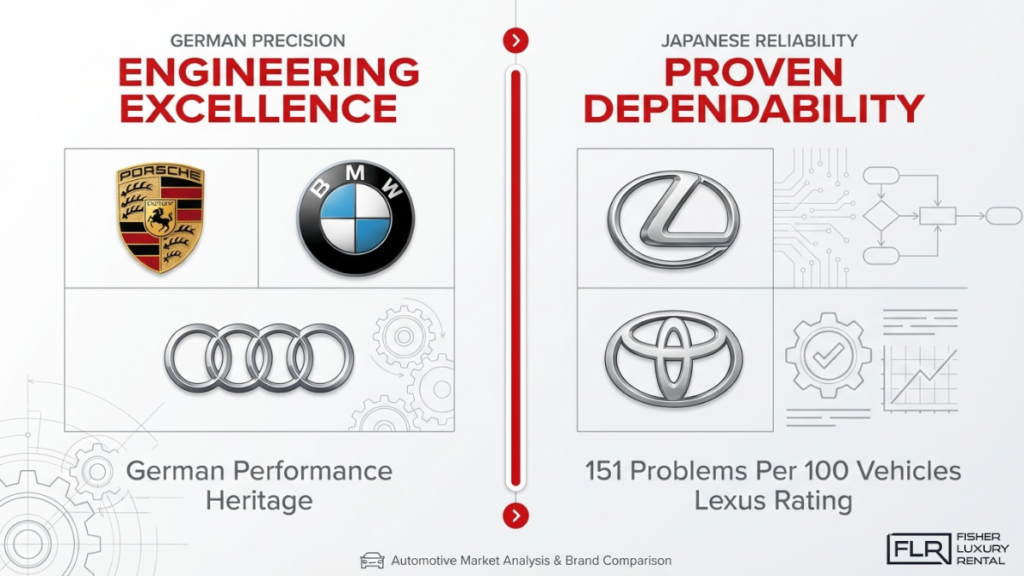
Brands like Porsche, BMW, and Audi stand out in 2026 because each delivers a distinct blend of engineering precision, performance, and brand heritage that competitors struggle to replicate. Porsche anchors its lineup with the 718 Cayman T, featuring a 2.0-liter flat-four turbo producing 300 horsepower and a 4.7-second 0-60 sprint via PDK. Audi counters with the RS3’s legendary 2.5-liter five-cylinder turbo, generating 394 horsepower and reaching 60 mph in just 3.6 seconds. What may be the last production five-cylinder engine you can buy new, the RS3 sounds like nothing else on the road. According to J.D. Power’s 2026 Vehicle Dependability Study, Lexus ranks highest among premium brands for the fourth consecutive year at 151 problems per 100 vehicles. BMW, while offering thrilling dynamics, carries higher ownership costs; annual maintenance can exceed $1,700 in the first five years compared to the industry average of just over $900. For buyers weighing long-term value against pure driving engagement, this spread matters more than most shoppers initially realize.
Are Any New or Unexpected Brands Entering This Segment?
New or unexpected brands are entering this segment, though established automakers still dominate. The global sports car market, valued at USD 68.13 billion in 2026 and projected to grow at a 4.23% CAGR through 2035, continues attracting investment from both legacy manufacturers and emerging players. Genesis, Hyundai’s luxury division, has steadily pushed into performance territory with competitive pricing that undercuts traditional European rivals. Meanwhile, Chinese automakers like BYD are exploring high-performance electric platforms that could eventually challenge the affordable luxury sports car definition. Still, with the average luxury sports car starting around $97,439 and “affordable luxury” spanning $50,000 to $100,000, breaking into this space demands more than competitive pricing; it requires the brand prestige and driving credibility that takes decades to build.
With the brand landscape mapped, the next step is examining each top model in detail.
What Are the Top 10 Affordable Luxury Sports Cars Available in 2026?
The top 10 affordable luxury sports cars available in 2026 represent a diverse mix of European precision, Japanese reliability, and American muscle. Each model balances high performance with premium craftsmanship at price points well below six figures.
- Porsche 718 Cayman T delivers mid-engine balance through a 2.0-liter flat-four turbocharged engine producing 300 horsepower, sprinting 0-60 mph in 4.7 seconds with the PDK transmission. Its lightweight chassis and rear-wheel drive layout create one of the purest driving experiences in this price range.
- BMW M2 Competition pairs a 3.0-liter twin-turbocharged inline-six with 473 horsepower and 406 lb-ft of torque. According to Car and Driver, the 2026 BMW M2 starts at an MSRP of $69,375, making it one of the most powerful options per dollar in its class.
- Audi TT RS channels the brand’s rally heritage through a distinctive five-cylinder turbocharged engine. Quattro all-wheel drive provides exceptional traction, while the compact coupe body keeps weight manageable for sharp handling responses.
- Lexus LC 500 combines a naturally aspirated 5.0-liter V8 with one of the most striking designs in the segment. Its grand touring character blends genuine performance with long-distance comfort few competitors can match.
- Jaguar F-Type P450 offers a supercharged V8 with British character and aggressive styling. The F-Type’s all-wheel-drive system and adaptive dynamics create a confident, composed ride at both street and spirited speeds.
- Mercedes-AMG CLA 45 packs AMG-tuned turbocharged power into a compact four-door coupe profile. The combination of all-wheel drive, aggressive suspension tuning, and a refined interior makes it uniquely practical among sports car competitors.
- Chevrolet Corvette Stingray (C8) features an LT2 6.2L V8 producing 490 horsepower, capable of reaching 60 mph in just 2.9 seconds with the Z51 Performance Package. No other car on this list matches its supercar-level acceleration at this price point.
- Nissan Z Nismo produces 420 horsepower and 384 lb-ft of torque from its NISMO-tuned 3.0-liter twin-turbocharged V6. The heritage-inspired design and aggressive aero kit give it a distinct personality among modern sports cars.
- Toyota Supra GR features a twin-scroll single-turbo inline six-cylinder engine producing 382 horsepower and 368 lb-ft of torque, with a starting price of $58,300. Its BMW-sourced powertrain, paired with Toyota’s reliability reputation, creates a compelling ownership proposition.
- Ford Mustang Dark Horse is equipped with a naturally aspirated 5.0-liter Coyote V8 generating 500 horsepower and 418 lb-ft of torque. For buyers who prioritize raw, visceral engine character over turbocharging, the Dark Horse remains the definitive American choice in this segment.
From mid-engine precision to V8 thunder, these ten models cover every driving personality; the next section breaks down how they compare head-to-head on performance and driving dynamics.
How Do These 2026 Sports Cars Compare on Performance and Driving Experience?
These 2026 sports cars compare on performance and driving experience through significant differences in horsepower, acceleration, and daily usability. The following subsections break down raw power figures, driving thrills per dollar, and real-world comfort.
What Are Their Horsepower, 0-60 Times, and Handling Characteristics?
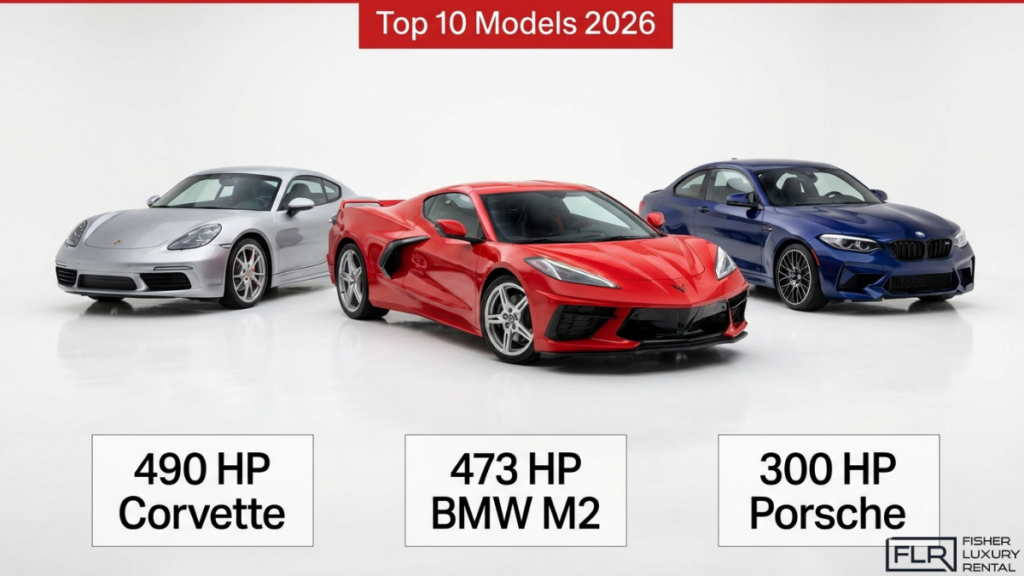
Their horsepower, 0-60 times, and handling characteristics vary widely across engine configurations and drivetrain layouts. According to Chevrolet, the 2026 Corvette Stingray produces 490 horsepower from its LT2 6.2L V8 and reaches 60 mph in 2.9 seconds with the Z51 Performance Package.
Key performance benchmarks across top contenders include:
- The Jaguar F-Type R 75 delivers 575 horsepower from a 5.0-liter supercharged V8, hitting 60 mph in 3.5 seconds with a 186 mph top speed.
- The Ford Mustang Dark Horse generates 500 horsepower from its naturally aspirated 5.0-liter Coyote V8.
- The BMW M2 produces 473 horsepower from a twin-turbocharged inline-six.
- The Audi RS3 pushes 394 horsepower through its quattro all-wheel-drive system, reaching 60 mph in 3.6 seconds.
Mid-engine layouts like the Corvette’s offer superior weight distribution, while front-engine models like the Mustang Dark Horse reward drivers who enjoy traditional rear-drive handling balance.
Which Models Offer the Most Thrilling Driving Dynamics for the Price?
The models offering the most thrilling driving dynamics for the price are the Corvette Stingray and the Ford Mustang Dark Horse, both delivering V8 power well under $100,000. The Corvette’s mid-engine architecture provides supercar-level grip and acceleration that rivals cars costing twice as much. Meanwhile, the Mustang Dark Horse pairs its ferocious V8 soundtrack with rear-wheel-drive engagement, though Car and Driver notes it remains expensive compared to the standard GT trim.
According to PwC’s 2026 automotive outlook, vehicle prices remain elevated as BEV adoption stalls, pushing more buyers toward high-performance ICE models. This shift makes naturally aspirated V8 sports cars especially compelling while they remain in production.
Are There Notable Differences in Everyday Use and Comfort?
There are notable differences in everyday use and comfort across these 2026 sports cars. Four-door models like the Audi RS3 accommodate passengers and cargo far more practically than two-seat coupes like the Corvette or Jaguar F-Type. Ride quality also diverges sharply; adaptive dampers on the BMW M2 and Mercedes-AMG CLE 53 soften highway cruising, while track-focused setups on models like the Nissan Z Nismo prioritize stiffness over compliance.
Cabin noise is another consideration. Turbocharged inline engines tend to run quieter at cruising speeds, whereas naturally aspirated V8s in the Mustang Dark Horse and Lexus RC F produce constant exhaust presence. For drivers splitting time between commuting and weekend spirited drives, the RS3 and BMW M2 strike the most versatile balance between performance and livability.
What Luxury Features Are Standard or Optional in These Affordable Sports Cars?
Luxury features in these affordable sports cars range from premium leather interiors and advanced infotainment systems to comprehensive safety suites. The sections below cover which models lead in standard equipment and how customization expands the ownership experience.
Which Models Offer Premium Interiors, Infotainment, and Safety Tech?
The models offering premium interiors, infotainment, and safety tech most comprehensively include the Mercedes-AMG CLE 53, Lexus RC F, BMW M2, and Audi RS3. According to Verne Eide Acura, luxury sports cars are distinguished from standard models by higher quality audio systems, larger infotainment screens, and first-rate interior accents such as leather and aluminum.
Key standard features across leading models include:
- The Mercedes-AMG CLE 53 provides the MBUX infotainment system with a widescreen cockpit display and active safety assists.
- The BMW M2 includes an iDrive 8 curved display, M sport seats in Vernasca leather, and a Harman Kardon surround sound system.
- The Lexus RC F delivers a Mark Levinson premium audio system alongside Lexus Safety System+.
- The Audi RS3 equips a virtual cockpit, MMI navigation, and Audi pre sense collision mitigation as standard.
- The Chevrolet Corvette Stingray offers a dual-zone climate system, Bose premium audio, and Performance Data Recorder.
For buyers who value interior refinement alongside driving performance, the Mercedes-AMG CLE 53 and Lexus RC F represent the strongest blend of cabin luxury and technology in this price segment.
How Customizable Are These Cars With Additional Luxury Options?
These cars are highly customizable with additional luxury options, as most manufacturers offer extensive packages and à la carte upgrades that transform the base specification. Porsche leads this space; the 718 Cayman T supports dozens of individual options, from adaptive sport seats to ceramic composite brakes and Burmester audio.
Notable customization highlights include:
- The BMW M2 offers an available M Performance carbon fiber exterior package, adaptive M suspension, and an upgraded M Carbon bucket seat option.
- The Ford Mustang Dark Horse provides a Handling Package with MagneRide active suspension and Recaro sport seats.
- The Toyota GR Supra 3.0 features an available A91-MT Edition trim with Cognac leather interior and forged alloy wheels.
- The Nissan Z Nismo includes factory-upgraded Recaro seats and a sport-tuned exhaust, though further personalization is more limited than European rivals.
Most manufacturers also offer wheel, brake caliper color, and paint customization, allowing buyers to tailor aesthetics alongside performance. Understanding which luxury features matter most can help determine whether owning or renting is the right way to experience these cars.
How Does Ownership Cost for These 2026 Sports Cars Compare to Traditional Luxury Cars?
Ownership cost for these 2026 sports cars varies significantly across maintenance, insurance, and depreciation, though several models compete favorably with traditional luxury sedans and grand tourers.
What Are Typical Maintenance, Insurance, and Depreciation Costs?
Typical maintenance, insurance, and depreciation costs for 2026 affordable luxury sports cars depend heavily on brand, powertrain complexity, and vehicle value. According to a 2026 ConsumerAffairs analysis, the average annual maintenance and repair cost for vehicles on the road is estimated at just over $900, though luxury brands like BMW can exceed $1,700 annually within the first five years.
Insurance adds another layer. High-performance models with elevated replacement costs can push premiums into five figures per year. Depreciation tends to hit hardest in the first three years, though models with strong demand, like the Corvette Stingray and Porsche 718 Cayman, historically retain value better than many traditional luxury sedans. Budgeting for all three categories before purchasing prevents costly surprises down the road.
Do Any Models Have Notably Lower or Higher Long-Term Expenses?
Some models do have notably lower or higher long-term expenses compared to the segment average. Japanese-built options like the Toyota GR Supra and Nissan Z benefit from lower parts costs and broader service network availability, which keeps routine maintenance affordable. The Chevrolet Corvette Stingray also stands out; its Chevrolet dealer network and domestic parts supply chain reduce service bills relative to European rivals.
On the higher end, models from Porsche, BMW, and Mercedes-AMG typically carry steeper maintenance and parts costs, particularly once factory warranties expire. For buyers weighing total cost against driving enjoyment, factoring in long-term expenses alongside sticker price reveals the true value each model delivers.
What Are the Pros and Cons of Buying Versus Leasing a 2026 Luxury Sports Car?
The pros and cons of buying versus leasing a 2026 luxury sports car depend on your financial goals, driving habits, and how often you want a new model. Below, we cover common financing options and whether leasing offers better value.
What Financing Options Are Typically Available for These Models?
The financing options typically available for 2026 luxury sports cars include traditional auto loans, manufacturer-sponsored lease programs, and balloon financing. Most brands offer tiered options:
- Standard auto loans spread the full purchase price over 48 to 72 months, building equity with each payment.
- Manufacturer lease programs provide fixed monthly payments for 24 to 36 months with mileage caps, often through captive finance arms like BMW Financial Services or Porsche Financial Services.
- Balloon financing combines lower monthly payments with a large lump sum due at the end of the term.
According to Autoblog, BMW Financial Services offers 2026 M2 lease deals at approximately $999 per month for 36 months for qualified lessees. For buyers who rotate vehicles frequently, leasing keeps monthly costs predictable while avoiding long-term depreciation risk.
Does Leasing Provide Better Value for Accessing Luxury Models?
Leasing provides better value for accessing luxury models when the priority is driving the newest vehicles without absorbing steep depreciation. Luxury sports cars often lose 40% to 50% of their value within the first three years, which means lease payments cover only that depreciation rather than the full sticker price.
Key advantages of leasing include:
- Lower monthly payments compared to financing the full purchase price.
- Access to the latest performance technology and safety features every two to three years.
- Warranty coverage that typically lasts the entire lease term, reducing out-of-pocket repair costs.
Buying makes more sense for drivers who plan to keep a car beyond five years, want unlimited mileage, or intend to modify the vehicle. For enthusiasts who crave variety without long-term commitment, renting from a specialist provider offers another path entirely.
What Do Reviews and Ratings Say About the 2026 Affordable Luxury Sports Cars?
Reviews and ratings for the 2026 affordable luxury sports cars highlight strong performance credentials alongside varying reliability outcomes. Expert assessments and owner feedback reveal which models deliver the best blend of satisfaction, build quality, and long-term value.
How Do Automotive Experts and Owners Rate Reliability and Satisfaction?
Automotive experts and owners rate reliability and satisfaction unevenly across the 2026 affordable luxury sports car segment. According to J.D. Power’s 2026 U.S. Vehicle Dependability Study, Lexus ranks highest overall among premium brands for the fourth consecutive year, scoring 151 problems per 100 vehicles. Japanese manufacturers like Lexus and Toyota consistently earn top marks for long-term dependability, which translates directly into higher owner satisfaction scores.
German brands present a more complex picture. Models like the BMW M2 CS earn praise for driving dynamics, yet annual maintenance costs for BMW can exceed $1,700 during the first five years. Owner satisfaction often hinges on whether buyers anticipate these higher running costs upfront.
A persistent misconception is that luxury sports cars serve only as weekend toys. Modern engineering has made many models viable daily drivers with advanced safety technology and refined ride quality. For buyers prioritizing satisfaction alongside thrills, reliability data should weigh as heavily as horsepower figures.
Which Models Stand Out for Build Quality and Value Retention?
The models that stand out for build quality and value retention in 2026 are the Porsche 718 Cayman T, Chevrolet Corvette Stingray, and Lexus RC F. Porsche’s meticulous assembly standards and strong brand cachet keep 718 Cayman residual values among the highest in the segment. The Corvette Stingray, with its mid-engine architecture and 490-horsepower LT2 V8, offers supercar-level engineering at a fraction of European pricing, which supports strong resale demand.
Lexus pairs its naturally aspirated V8 with industry-leading dependability, making the RC F a compelling choice for buyers who plan to hold their vehicle beyond the initial warranty period. Models carrying limited-edition status, such as the Jaguar F-Type R 75 farewell edition, also tend to retain value well due to collector interest.
For buyers weighing long-term ownership, prioritizing brands with proven build quality over raw spec-sheet numbers consistently yields better financial outcomes at resale time. Understanding how expert reviews align with real-world ownership data is a practical first step before committing to a purchase or exploring rental options.
Are There Any Common Misconceptions About Affordable Luxury Sports Cars?
There are several common misconceptions about affordable luxury sports cars, particularly around reliability and true accessibility. The sections below address whether modern models still suffer dependability issues and whether “affordable” pricing genuinely puts these cars within reach.
Is Reliability Still a Concern With Modern Luxury Sports Cars?
Reliability is far less of a concern with modern luxury sports cars than many buyers assume. A persistent myth suggests that high-performance vehicles are inherently unreliable, yet contemporary engineering has closed much of the gap between luxury and mainstream dependability. According to the 2026 J.D. Power Vehicle Dependability Study, Lexus ranks highest overall among premium brands for the fourth consecutive year, scoring 151 problems per 100 vehicles. Models like the Corvette Stingray and Toyota GR Supra also benefit from powertrains shared with high-volume platforms, which increases parts availability and long-term durability. Advanced safety tech and onboard diagnostics now allow many luxury sports cars to serve comfortably as daily drivers. For anyone still hesitant, the data increasingly favors these vehicles over their reputation.
Can “Affordable” Really Mean Accessible for Most Buyers?
“Affordable” can mean accessible for many buyers, though it requires realistic expectations about total cost. Entry-level luxury sports cars typically start between $50,000 and $100,000, which places them within financing or leasing range for a broader audience than most people expect. Lease programs, such as BMW Financial Services offering the 2026 M2 at approximately $999 per month for 36 months, lower the barrier further by eliminating large down payments. However, ownership costs beyond the sticker price matter significantly. Insurance for high-performance models can reach five figures annually, and maintenance for brands like BMW can exceed $1,700 per year during the first five years. True accessibility depends on budgeting for these recurring expenses, not just the purchase price. Understanding total cost of ownership separates informed buyers from those caught off guard by hidden expenses.
How Can You Experience the Thrill of 2026 Luxury Sports Cars Without Buying One?
You can experience the thrill of 2026 luxury sports cars without buying one through short-term rentals, special occasion packages, and dealer test-drive events. These options let you feel the performance of models like the Corvette Stingray or Porsche 911 firsthand.
What Companies Offer Luxury Sports Car Rentals for Short-Term Experiences?
Companies that offer luxury sports car rentals for short-term experiences include specialty exotic rental providers, premium tier services from national agencies, and peer-to-peer car-sharing platforms. These businesses maintain fleets featuring high-performance vehicles such as the Lamborghini Huracan, Porsche 911, Corvette C8, and Ferrari 488 Spider.
Specialty rental companies typically provide the widest selection of true exotic and luxury sports cars, often with curated packages for weekend getaways or track days. For someone considering a $50,000 to $100,000 purchase, spending a few hundred dollars on a day rental offers a realistic preview of what ownership feels like, from cabin comfort to throttle response on open roads. This hands-on approach often reveals preferences that spec sheets and reviews simply cannot convey.
Are Special Occasion and Test-Drive Opportunities Becoming More Popular?
Yes, special occasion and test-drive opportunities are becoming more popular as automakers and rental companies expand experiential access to high-performance vehicles. Dealer-hosted driving events, manufacturer experience centers, and rental packages tailored for weddings, birthdays, and corporate outings now reach a broader audience than ever before.
Several factors are driving this trend:
- Automakers use curated test-drive events to let potential buyers sample models like the BMW M2 or Audi RS3 on closed courses.
- Rental companies offer special occasion packages for milestones such as anniversaries, proposals, and prom nights.
- Track-day experiences give enthusiasts seat time in vehicles they may never purchase, from the Ford Mustang Dark Horse to the Jaguar F-Type R 75.
For anyone exploring the 2026 affordable luxury sports car segment, these experiences provide the clearest path to an informed decision. Fisher Luxury Rental offers one way to get behind the wheel of top-trim exotic and luxury cars without a long-term commitment.
How Can Fisher Luxury Rental Help You Experience Affordable Luxury Sports Cars in 2026?
Fisher Luxury Rental can help you experience affordable luxury sports cars in 2026 by offering a curated fleet of exotic and high-performance vehicles for short-term rental. The sections below cover available models and key takeaways from this guide.
What Exotic and Luxury Sports Cars Can You Rent From Fisher Luxury Rental?
The exotic and luxury sports cars you can rent from Fisher Luxury Rental include several models featured on the 2026 best affordable luxury list. Fisher Luxury Rental maintains a fleet of top-trim vehicles across both performance and luxury categories:
- Corvette C8 Stingray starting at $349 per day
- Corvette C8 Z06 starting at $499 per day
- Porsche 911 Carrera S starting at $499 per day
- Audi R8 Spyder Convertible at $599 per day
- Lamborghini Huracan Spyder Convertible at $1,099 per day
- Ferrari 488 Spider at $1,499 per day
Fisher Luxury Rental serves Phoenix, Scottsdale, Portland, and Vancouver, with locations designed for convenient pickup. Renting eliminates insurance premiums, depreciation, and maintenance costs that come with ownership, making it one of the smartest ways to experience these cars firsthand.
What Are the Key Takeaways About the 10 Best Affordable Luxury Sports Cars for 2026?
The key takeaways about the 10 best affordable luxury sports cars for 2026 center on accessibility, performance, and evolving value. Entry-level models now deliver supercar-level speed, with vehicles like the Corvette Stingray reaching 0-60 mph in 2.9 seconds. Modern luxury sports cars also serve as reliable daily drivers thanks to advanced safety technology and improved engineering.
Ownership costs vary significantly; maintenance for premium brands can exceed $1,700 annually, and insurance on high-performance models sometimes reaches five figures. Renting through a service like Fisher Luxury Rental offers a practical alternative, letting you experience multiple vehicles without long-term financial commitment. Whether you prioritize a naturally aspirated V8 soundtrack or turbocharged inline-six precision, the 2026 market offers a compelling option at nearly every price point within the $50,000 to $100,000 range.