The fastest exotic cars in 2026 are production hypercars that complete the quarter-mile in under nine seconds, led by electric and hybrid powertrains capable of delivering over 1,800 hp to all four wheels. The quarter-mile remains the definitive measure of real-world acceleration for these machines.
This guide covers record-setting cars and their times, the technology behind their performance, how quarter-mile rankings are determined, the balance between speed and everyday usability, and ways to experience these cars firsthand.
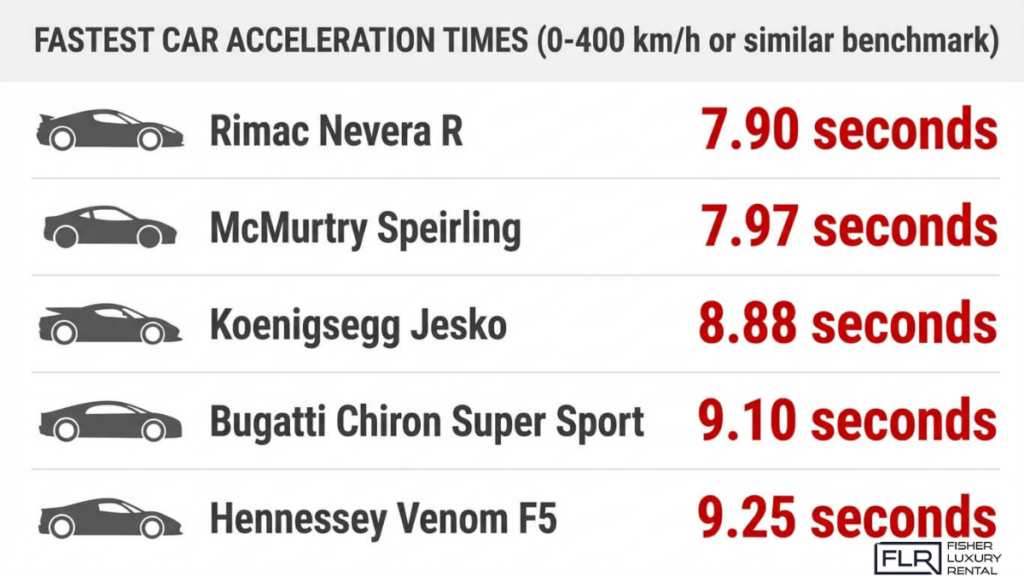
Electric hypercars now hold the top spots on the quarter-mile leaderboard. The Rimac Nevera R leads with a 7.90-second pass at 185.3 mph, while the McMurtry Spéirling follows at 7.97 seconds using active ground-effect fans for traction. The Koenigsegg Jesko Absolut holds the fastest time for any internal combustion production car at 8.88 seconds.
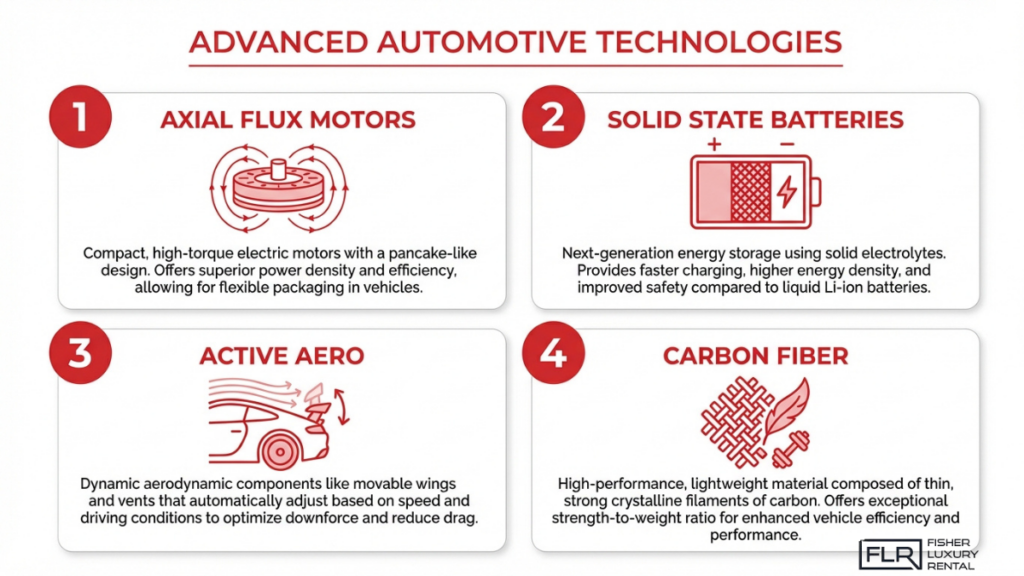
Axial flux motors, solid-state batteries targeting energy densities above 400 Wh/kg, and carbon fiber lightweighting strategies have collectively reshaped what production cars can achieve from a standstill. Active aerodynamics and torque vectoring systems that adjust power delivery 100 times per second give these cars grip that earlier generations simply could not produce.
Ranking these cars requires more than raw elapsed time. Trap speed, launch consistency, environmental conditions like altitude and air density, and timing methodology all influence where a car falls on the list.
Speed alone does not define the best exotic car. Hybrid models like the Bugatti Tourbillon pair a V16 engine with electric motors to deliver both straight-line violence and grand touring refinement, proving that comfort and performance can coexist.
For enthusiasts who want to feel this acceleration rather than read about it, rental programs and professional track day experiences now put sub-11-second quarter-mile cars within reach without the commitment of ownership.
Which Exotic Cars Set the Quickest Quarter-Mile Records in 2026?
The exotic cars setting the quickest quarter-mile records in 2026 include the Rimac Nevera R, McMurtry Spéirling, and Koenigsegg Jesko Absolut. Below, we cover how these times are measured, the technology behind them, and which brands lead the field.
How Are Quarter-Mile Times Measured for Exotic Cars?
Quarter-mile times for exotic cars are measured using photocell infrared beams positioned at multiple intervals along a sanctioned drag strip. Modern precision timing systems record elapsed time (ET) at the start, 60-foot, 330-foot, eighth-mile, 1,000-foot, and quarter-mile marks, while trap speed is calculated as an average over the final 66 feet of the run.
For official world record attempts, the process becomes more rigorous. According to Dewesoft, manufacturers use high-frequency GPS-based data loggers and industrial-grade VBOX systems recording at 100 Hz, often requiring two-way runs to account for wind and gradient. Standard systems also incorporate a 12-inch “rollout” allowance before the clock starts, which subtracts roughly 0.2 to 0.3 seconds from a true standing start. Understanding these protocols matters, because without standardized measurement, comparing times across different venues would be meaningless.
What Recent Technological Advancements Have Influenced Quarter-Mile Performance?
The recent technological advancements that have influenced quarter-mile performance span drivetrain architecture, battery chemistry, aerodynamics, and materials science. Four key innovations stand out:
- Next-generation axial flux motors from developers like YASA deliver significantly higher torque density and power-to-weight ratios than traditional radial flux designs, enabling the instant thrust hypercars need off the line.
- All-solid-state batteries target energy densities exceeding 400 Wh/kg, producing lighter packs with faster discharge rates for explosive acceleration.
- Active aerodynamics systems, like those on the Aston Martin Valhalla, use movable front and rear wings to dynamically balance downforce and drag during high-speed runs.
- Advanced lightweighting with high-strength steel and carbon fiber composites has reduced vehicle mass by an average of 12% compared to 2020 levels, according to a study published in MDPI Materials.
Collectively, these advances explain why 2026 quarter-mile records have dropped well below eight seconds for the first time in production car history.
Which Exotic Car Brands Dominate the Quarter-Mile Scene in 2026?
The exotic car brands dominating the quarter-mile scene in 2026 are Rimac, McMurtry, Koenigsegg, Bugatti, Aspark, and Pininfarina. The Rimac Nevera R holds the outright production car record at 7.90 seconds with a 185.3 mph trap speed, driven by a four-motor AWD system that adjusts torque to each wheel 100 times per second. Close behind, the McMurtry Spéirling achieved 7.97 seconds using active ground-effect fans for traction.
Among combustion-powered cars, the Koenigsegg Jesko Absolut recorded 8.88 seconds at 180.8 mph, making it the fastest ICE production car over the distance. The Bugatti Tourbillon pairs an 8.3-liter V16 with three electric motors for 1,800 total horsepower. Meanwhile, the Aspark Owl set a Guinness World Record for fastest average quarter-mile speed by an electric car at 198.12 mph, and the Pininfarina Battista runs the quarter in the mid-8-second range.
Electric powertrains clearly dominate the top positions, though hybrid and pure ICE contenders remain fiercely competitive just behind them. With measurement standards and technology now established, the next step is comparing these leaders head to head.
How Do the Leading Exotic Cars Compare in Quarter-Mile Acceleration and Speed?
The leading exotic cars compare through differences in powertrain type, total horsepower, and trap speed across the quarter-mile. Below, each top performer’s specs, electric and hybrid results, and the factors shaping their times are broken down.
What Are the Key Specs for Each Top-Performing Exotic Car?
The key specs for each top-performing exotic car center on powertrain output, quarter-mile elapsed time, and trap speed. According to Rimac Automobili, the 2026 Nevera R set a production car record of 7.90 seconds at 185.3 mph using a four-motor AWD system with torque vectoring that adjusts power to each wheel 100 times per second.
| Car | Powertrain | Quarter-Mile ET | Trap Speed |
| Rimac Nevera R | Quad-motor EV | 7.90 s | 185.3 mph |
| McMurtry Spéirling | EV with ground-effect fans | 7.97 s | N/A |
| Koenigsegg Jesko Absolut | Twin-turbo ICE | 8.88 s | 180.8 mph |
| Pininfarina Battista | Quad-motor EV | Mid-8 s | N/A |
| Bugatti Tourbillon | Hybrid V16 (1,800 hp) | Est. sub-9 s | N/A |
| Aspark Owl | EV | Record run | 198.12 mph avg. |
The gap between the fastest EV and the fastest ICE car now exceeds a full second, which signals a clear shift in quarter-mile dominance.
How Do Electric and Hybrid Exotic Cars Perform in the Quarter-Mile?
Electric and hybrid exotic cars perform exceptionally in the quarter-mile, claiming the top positions in 2026. The Rimac Nevera R leads all production cars at 7.90 seconds, while the Pininfarina Battista, sharing the same underlying EV platform, runs in the mid-8-second range with a verified 0-60 mph time of 1.79 seconds.
Hybrid powertrains are closing the gap. The Bugatti Tourbillon combines an 8.3-liter naturally aspirated V16 producing 1,000 hp with three electric motors adding 800 hp for a total system output of 1,800 hp. That configuration targets 0-62 mph in 2.0 seconds. Instant electric torque off the line gives these drivetrains a fundamental launch advantage that even the most powerful combustion engines struggle to match.
What Factors Most Influence an Exotic Car’s Quarter-Mile Time?
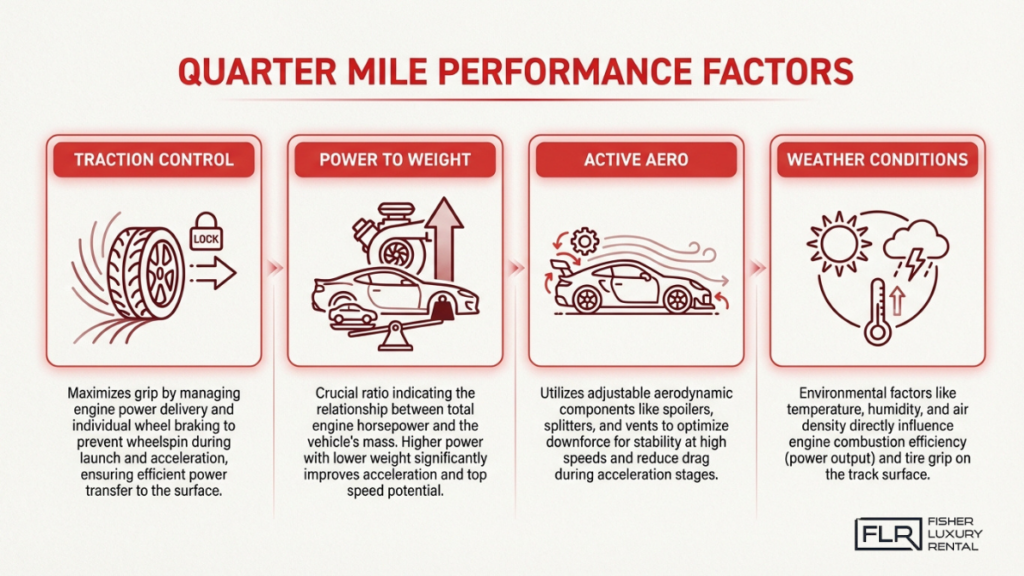
The factors that most influence an exotic car’s quarter-mile time are traction, power delivery, vehicle weight, and environmental conditions.
- Traction and torque vectoring determine how effectively power reaches the pavement. Independent per-wheel adjustments, like those in the Nevera R, prevent wheelspin during launches.
- Power-to-weight ratio is improved through carbon fiber composites and advanced high-strength steel. According to a study published in MDPI Materials, lightweighting strategies have reduced vehicle mass by an average of 12% compared to 2020 levels.
- Active aerodynamics use movable wings to balance downforce and drag during acceleration.
- Atmospheric conditions directly affect ICE performance; naturally aspirated engines lose approximately 3% power for every 1,000 feet of elevation gain, and rising temperatures reduce air density, limiting available oxygen for combustion.
For pure EVs, battery discharge rate matters more than altitude. Solid-state battery technology targeting energy densities above 400 Wh/kg promises lighter packs with faster power delivery. Understanding these variables clarifies why identical cars can post different times on different days.
What Are the Criteria for Ranking Exotic Cars by Quarter-Mile Performance?
The criteria for ranking exotic cars by quarter-mile performance center on elapsed time and trap speed, measured under standardized conditions. The following subsections explain why the quarter-mile matters and which complementary metrics complete the picture.
Why Is the Quarter-Mile Metric Important for Exotic Car Enthusiasts?
The quarter-mile metric is important for exotic car enthusiasts because it captures a vehicle’s total acceleration capability in a single, repeatable number. Unlike top speed runs that require miles of open road, the quarter-mile condenses launch grip, power delivery, and aerodynamic efficiency into roughly 1,320 feet of measurable performance.
This standardized distance allows direct comparisons across drivetrain types, whether electric, hybrid, or pure internal combustion. As Mate Rimac stated during the 2025 Nevera R record announcement, “traction and power delivery are everything” when chasing quarter-mile times.
For enthusiasts evaluating hypercars, elapsed time reveals how effectively a manufacturer translates raw horsepower into forward motion. Trap speed, recorded across the final 66 feet, adds context by showing how much velocity the car carries at the finish. Together, these two numbers tell a more honest story than horsepower figures alone.
What Other Performance Metrics Matter Besides Quarter-Mile Times?
The other performance metrics that matter besides quarter-mile times include:
- 0-60 mph time measures initial launch and low-speed traction, often separating electric and combustion powertrains most dramatically.
- Trap speed indicates how fast a car crosses the quarter-mile finish line, revealing sustained power output beyond the initial launch.
- 60-foot time isolates tire grip and launch control effectiveness in the first critical moments off the line.
- Power-to-weight ratio accounts for how efficiently a car converts horsepower into acceleration, since lightweighting strategies have reduced vehicle mass by an average of 12% compared to 2020 levels according to a study published in MDPI Materials.
- Braking distance reflects a car’s ability to manage the speed it generates, a critical safety consideration at 180+ mph trap speeds.
No single number defines a hypercar’s true capability. Evaluating quarter-mile elapsed time alongside these complementary metrics reveals whether a car is genuinely fast or simply optimized for one narrow test.
Which 2026 Exotic Cars Offer the Best Balance of Speed, Luxury, and Usability?
The 2026 exotic cars that offer the best balance of speed, luxury, and usability are models like the Bugatti Tourbillon and Pininfarina Battista, which pair blistering quarter-mile performance with refined interiors and daily drivability. Below, we explore what makes a hypercar practical and where comfort tradeoffs emerge.
What Makes an Exotic Car Both Fast and Practical for Everyday Use?
An exotic car is both fast and practical for everyday use when it combines extreme powertrain output with livable comfort features, compliant suspension modes, and usable cargo space. The 2026 Bugatti Tourbillon exemplifies this balance; its hybrid V16 powertrain produces 1,800 total system horsepower yet is engineered to reach 0-100 km/h in 2.0 seconds while maintaining a luxurious grand touring cabin, according to Bugatti Automobiles. Similarly, the Pininfarina Battista delivers a verified 0-60 mph time of 1.79 seconds on a refined EV platform shared with the Rimac Nevera, wrapping that acceleration in hand-finished Italian interiors.
Key traits that separate usable hypercars from pure track machines include:
- Adjustable drive modes that soften suspension and throttle response for city driving.
- Sufficient ground clearance to navigate speed bumps and parking garage ramps.
- Modern infotainment, climate control, and noise insulation suited to longer journeys.
- Electric or hybrid drivetrains that allow quiet, low-speed cruising without mechanical harshness.
For most buyers, the best daily exotic is one that feels docile at 30 mph yet devastating at full throttle.
Are There Tradeoffs Between Comfort and Quarter-Mile Performance?
Yes, there are tradeoffs between comfort and quarter-mile performance, though 2026 engineering has narrowed the gap significantly. Vehicles optimized purely for elapsed time, such as the McMurtry Spéirling with its 7.97-second quarter-mile, sacrifice cabin refinement and luggage space entirely to minimize weight and maximize aerodynamic grip through active ground-effect fans.
Common tradeoffs include:
- Stiffer chassis tuning improves launch traction but transmits more road imperfections to occupants.
- Lightweight carbon fiber body panels reduce mass, sometimes at the cost of sound insulation.
- Ultra-wide performance tires generate significant road noise during highway cruising.
- Stripped interiors in track-focused models eliminate amenities like advanced infotainment and plush seating.
According to a 2021 MDPI Materials study, automotive lightweighting strategies have increased carbon fiber composite use, reducing vehicle mass by an average of 12% compared to 2020 levels. That weight savings directly benefits acceleration but can compromise ride quality when comfort-oriented materials are removed. Hybrid grand tourers like the Bugatti Tourbillon manage this tension best by using electrification to add power without subtracting refinement.
Understanding these tradeoffs helps enthusiasts choose between raw quarter-mile dominance and a more balanced ownership experience.
How Can Enthusiasts Experience the Performance of the Fastest Exotic Cars?
Enthusiasts can experience the performance of the fastest exotic cars through rental programs, track day events, and professional driving experiences. The following sections cover ownership alternatives and key rental considerations.
What Options Exist for Driving High-Performance Exotic Cars Without Ownership?
The options for driving high-performance exotic cars without ownership include:
- Exotic car rentals: Specialty rental companies offer models like the McLaren 720S and Corvette C8 Z06, both capable of sub-11-second quarter-mile times in factory configuration.
- Track day experiences: Exclusive 2026 track day programs allow enthusiasts to drive hypercars under professional instruction, often utilizing data analysis tools to compare driver performance against established benchmarks, according to Catapult.
- Supercar tour events: Organized driving tours pair curated routes with high-performance vehicles for multi-day experiences.
- Manufacturer experience centers: Some brands operate dedicated facilities where guests sample their latest models on closed circuits.
For most enthusiasts, renting remains the most accessible path to genuine quarter-mile-level performance without a seven-figure commitment.
What Should Renters Consider Before Choosing a Quarter-Mile Leader?
Renters should consider several factors before choosing a quarter-mile leader:
- Insurance and deposit requirements: High-performance exotics carry larger security deposits and may require supplemental coverage.
- Driver eligibility: Many rental providers enforce minimum age limits, license verification, and driving record checks for their fastest models.
- Powertrain familiarity: Electric hypercars deliver instant torque, which demands different throttle discipline than turbocharged or naturally aspirated alternatives.
- Rental terms and mileage caps: Quarter-mile-capable cars often come with daily mileage restrictions that can affect extended driving plans.
- Track access versus street use: Some rentals permit track use; others restrict vehicles to public roads only.
Matching the rental to your intended experience, whether a scenic canyon drive or a controlled launch at a drag strip, ensures you get the most from these extraordinary machines.
How Does Fisher Luxury Rental Let Drivers Experience Today’s Fastest Exotic Cars?
Fisher Luxury Rental lets drivers experience today’s fastest exotic cars by offering a curated fleet of high-performance models available for daily rental. The following sections cover which fleet vehicles deliver quarter-mile performance and the key takeaways from 2026’s speed records.
Can Fisher Luxury Rental Help You Drive Exotic Cars Similar to the 2026 Quarter-Mile Leaders?
Yes, Fisher Luxury Rental can help you drive exotic cars similar to the 2026 quarter-mile leaders. The fleet includes the Corvette C8 Z06 and McLaren 720S, both capable of sub-11-second quarter-mile times in factory configuration. While hypercars like the Rimac Nevera R run the quarter-mile in 7.90 seconds, these rental options deliver a genuine taste of that acceleration tier without the seven-figure commitment.
Fisher Luxury Rental also offers the Ferrari 488 Spider, Lamborghini Huracan Spyder, and Audi R8 Spyder, each engineered with mid-engine layouts and advanced traction systems derived from the same performance philosophy powering 2026’s record holders. For most enthusiasts, the visceral difference between a 9-second and an 8-second quarter-mile is far less noticeable than the leap from a standard car to any of these exotics.
What Are the Key Takeaways About the Fastest Exotic Cars and Their Quarter-Mile Times for 2026?
The key takeaways about the fastest exotic cars and their quarter-mile times for 2026 center on three shifts:
- Electric and hybrid powertrains now dominate the top of the leaderboard, with the Rimac Nevera R holding the production car record at 7.90 seconds.
- The Koenigsegg Jesko Absolut remains the fastest ICE production car over the quarter-mile at 8.88 seconds, proving combustion engines still compete at elite levels.
- Technologies such as torque vectoring, active aerodynamics, and carbon fiber lightweighting have compressed the gap between hypercars and accessible exotics.
Renting a performance car from Fisher Luxury Rental is one of the most direct ways to feel how these engineering advances translate to real-world acceleration, without navigating ownership costs or waitlists.