
Ford exotic cars are limited-production, high-performance vehicles that combine race-bred engineering with extreme scarcity to rival the world’s most prestigious supercar brands. The Ford GT lineup, spanning from the original GT40 to the modern twin-turbocharged GT, defines this legacy.
This guide covers which Ford models qualify as exotic, how Ford’s performance stacks up against traditional supercar makers, why limited-production Ford vehicles hold such strong collector value, what the driving and ownership experience involves, and how exotic car rentals make these machines accessible.
The Ford GT40 and its modern successors anchor Ford’s exotic identity. Only 105 GT40s were produced between 1964 and 1969, while the second-generation Ford GT delivered 647 to 660 horsepower through a twin-turbocharged EcoBoost V6 before production ended in 2023. These cars earned their exotic status on the track and in the factory through deliberate restriction of build numbers.
While the Ford GT remains rare, enthusiasts can experience similar supercar performance through curated rental fleets. Fisher Luxury Rental specializes in providing access to comparable exotic vehicles including Ferrari, Lamborghini, and McLaren models in Phoenix and Portland.
Low production runs drive extraordinary collector demand. Original GT40s now sell for millions at auction, and modern GTs have shown consistent annual appreciation since launch. Ownership stories and rising valuations reinforce these cars as both performance machines and financial assets.
For enthusiasts who want the supercar experience without long-term ownership, specialty rental providers like Fisher Luxury Rental offer access to comparable exotic vehicles from brands including Lamborghini, Ferrari, McLaren, and Porsche.
Which Ford Models Are Considered Exotic and High-Performance?
Ford models considered exotic and high-performance include the GT40, the 2005–2006 Ford GT, and the second-generation Ford GT (2017–2022). Each model combines limited production, racing heritage, and supercar-level specifications.
What Defines an Exotic Car Within the Ford Lineup?
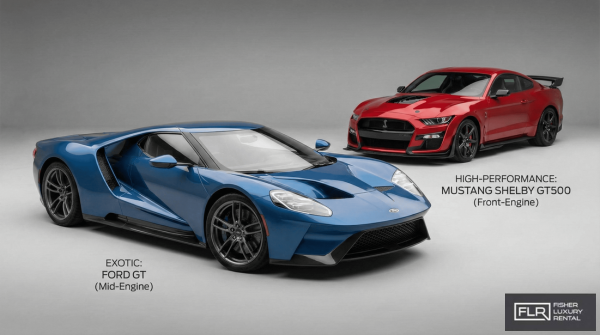
An exotic car within the Ford lineup is defined by three core characteristics: limited production numbers, mid-engine or race-derived architecture, and performance specifications that rival established supercar manufacturers such as Ferrari and Lamborghini. The Ford GT40, with only 105 units produced between 1964 and 1969, set this standard by combining lightweight construction (1,800 to 2,300 lb curb weight) with V8 power ranging from 255 to 427 CID. Ford’s exotic models also share an exclusivity factor that separates them from high-performance trims like the Mustang Shelby GT500. Where a Shelby reaches mass production, a Ford GT requires an application process and meets strict allocation limits. That distinction between “fast” and “exotic” is what elevates these vehicles into collector territory.
How Do Ford GT Models Achieve Their Performance Capabilities?
Ford GT models achieve their performance capabilities through race-bred engineering, advanced materials, and aerodynamic design purpose-built for speed. The second-generation Ford GT uses a 3.5L twin-turbocharged EcoBoost V6 producing 647 to 660 hp and 550 lb-ft of torque, reaching a top speed of 216 mph. According to a 2018 MotorTrend first test, the modern GT accelerates from 0 to 60 mph in 3.0 seconds and completes the quarter-mile in 10.8 seconds at 134 mph. A carbon fiber monocoque chassis and active aerodynamics, including a deployable rear wing, keep weight low while maximizing downforce at high speeds. Rather than relying on displacement alone, Ford chose forced induction and lightweight construction to extract maximum output per pound. This philosophy delivers a power-to-weight ratio that puts the GT squarely among the world’s elite mid-engine supercars.

What Rare or Limited Edition Ford Models Exist?
Rare and limited edition Ford models exist across multiple generations of GT production, along with several special-edition variants:
- The Ford GT40 (1964–1969) totaled just 105 units across Mk I, Mk II, Mk III, and Mk IV variants.
- The first-generation modern Ford GT (2005–2006) was limited to 4,038 units.
- The second-generation Ford GT (2017–2022) maintained strict allocation, with final production ending in 2023.
- The 2020 Ford GT Liquid Carbon Edition featured exposed carbon fiber bodywork and extremely limited availability.
- The 2006 Ford GT Heritage Edition paid tribute to the original GT40’s Le Mans livery.
A 2006 Heritage Edition sold for $742,500 at Barrett-Jackson in 2025, illustrating how scarcity drives collector demand. For anyone drawn to Ford’s exotic legacy, understanding these production figures reveals why each model commands such attention in the collector market.
How Does Ford’s Performance Compare to Other Exotic Brands?
Ford’s performance compares favorably to other exotic brands through direct supercar rivalry, advanced powertrain technology, and a decorated racing history. The following sections cover track comparisons, technological advantages, and major recognitions.
In What Ways Does the Ford GT Rival Supercars Like Ferrari or Lamborghini?
The Ford GT rivals supercars like Ferrari and Lamborghini by matching or exceeding their track performance despite its unconventional powertrain. According to a FastestLaps.com head-to-head comparison, the Ford GT outperformed the Ferrari 488 GTB at Willow Springs with a faster lap time and higher lateral acceleration, a key measure of cornering grip. The Ferrari posted slightly quicker straight-line acceleration, yet the GT’s superior handling and 216 mph top speed close that gap decisively.
What makes this rivalry remarkable is that the GT achieves these results with a twin-turbocharged V6 rather than the naturally aspirated V8 or V12 engines traditional to Italian supercar makers. For enthusiasts who assume exotic performance requires a European badge, the Ford GT proves otherwise.
How Does Ford’s Use of Technology Enhance Its Vehicles’ Performance?
Ford’s use of technology enhances its vehicles’ performance through lightweight construction, forced induction, and aerodynamic engineering. The second-generation Ford GT pairs a 3.5L twin-turbocharged EcoBoost V6 with a carbon fiber monocoque chassis, producing 647 to 660 hp while keeping curb weight remarkably low. This power-to-weight advantage translates directly to a 3.0-second 0-60 mph time and a 10.8-second quarter-mile at 134 mph, as documented in a 2018 MotorTrend first test.
Rather than relying on large-displacement engines alone, Ford leverages turbocharging and active aerodynamics to extract maximum output from smaller, lighter packages. This engineering philosophy prioritizes real-world track performance over spec-sheet displacement figures, a strategy that consistently surprises competitors still anchored to traditional approaches.
What Awards or Recognitions Have Ford Exotic Cars Received?
The awards and recognitions Ford exotic cars have received span both motorsport dominance and collector market validation. The Ford GT40 secured four consecutive 24 Hours of Le Mans victories from 1966 to 1969, ending Ferrari’s six-year winning streak and cementing Ford’s reputation in endurance racing. Additional wins at the Daytona 24 Hours and the 12 Hours of Sebring further reinforced that legacy.
On the collector side, auction results serve as their own form of industry recognition. A 1966 Ford GT40 MkII Factory Lightweight sold for $12,375,000 at Mecum in 2026, placing it among the most valuable American cars ever auctioned. When the market consistently values a car at eight figures, it confirms a level of prestige that rivals any European marque.
With this competitive standing established, the question becomes why limited production amplifies these cars’ desirability even further.
Why Are Limited-Production Ford Models So Sought After?
Limited-production Ford models are so sought after because scarcity, racing heritage, and proven investment returns create intense collector demand. The factors driving this desirability include collectibility criteria, the direct relationship between production numbers and value, and the personal stories of owners who have experienced these rare machines.
What Factors Make a Ford Model Collectible or Valuable?
The factors that make a Ford model collectible or valuable include racing provenance, limited production runs, historical significance, and consistent market appreciation. A car tied to a milestone, such as the GT40’s four consecutive Le Mans victories from 1966 to 1969, carries a narrative that elevates its worth beyond mechanical specifications alone.
Special editions amplify this effect. The 2006 Ford GT Heritage Edition, for example, sold for $742,500 at a Barrett-Jackson auction in 2025, demonstrating how commemorative variants command premiums over standard models. Condition, documented ownership history, and originality of components also play critical roles in determining value at auction.
For collectors weighing Ford exotics against traditional European marques, the combination of American racing legacy and extreme rarity makes these cars uniquely compelling.
How Do Production Numbers Affect the Value of Ford Exotics?
Production numbers affect the value of Ford exotics by establishing a fixed supply ceiling that intensifies competition among collectors as demand grows. The original Ford GT40 totaled just 105 units between 1964 and 1969, which is why a 1966 GT40 MkII Factory Lightweight commanded $12,375,000 at a Mecum auction in 2026.
Even modern Ford GTs, produced in larger but still restricted quantities, appreciate significantly. According to CLASSIC.COM market data, first-generation Ford GT models have delivered an approximate 9.5% annual rate of return since their initial purchase. That figure outpaces many traditional investment vehicles, reinforcing why low production numbers transform these cars from depreciating assets into appreciating collectibles.
What Are Some Notable Stories from Owners of Rare Ford Cars?
Some notable stories from owners of rare Ford cars reveal deep emotional connections alongside financial rewards. The second-generation Ford GT required buyers to submit applications directly to Ford, and chosen owners agreed to restrictions preventing immediate resale. This process underscored how ownership carried a sense of personal distinction and brand loyalty that few other manufacturers demanded.
The 2020 Ford GT Liquid Carbon Edition, which sold for $1,760,000 at Barrett-Jackson in 2025, exemplifies how special-edition models become centerpieces of private collections. Owners of these vehicles often describe a stewardship mentality, viewing themselves as custodians of automotive history rather than simple car owners.
Understanding what drives this collector passion helps frame the broader experience of engaging with Ford’s high-performance legacy firsthand.
What Should Potential Renters or Buyers Know About Ford Exotic Cars?
Potential renters or buyers should know that Ford exotic cars deliver a race-bred driving experience, demand specialized maintenance, and require careful planning before renting. The following sections cover driving feel, upkeep needs, and rental considerations.
What Is the Driving Experience Like Behind the Wheel of a Ford Exotic?
The driving experience behind the wheel of a Ford exotic is defined by race-derived engineering translated to road use. The modern Ford GT reaches 60 mph in 3.0 seconds and achieves a top speed of 216 mph, placing it firmly among the world’s fastest supercars. According to a 2018 MotorTrend first test, professional driver Randy Pobst praised the GT’s unusual stability for a mid-engine car, noting it lacks the traditional twitchiness drivers expect from that layout. That composure at high speed, combined with 647 to 660 horsepower from a twin-turbocharged EcoBoost V6, creates a cockpit experience that feels more like a purpose-built racer than a luxury cruiser. For many drivers, this intensity is exactly what sets Ford’s exotics apart from more comfort-oriented supercars.

What Maintenance or Care Is Required for High-Performance Ford Models?
The maintenance required for high-performance Ford models goes beyond standard service intervals. Carbon-ceramic brakes, lightweight body panels, and forced-induction engines all need specialist attention. Turbocharger systems, like the twin-turbo setup in the Ford GT, require frequent inspection of boost lines, intercoolers, and oil feeds. Tire compounds designed for high lateral loads wear faster than standard rubber, and suspension geometry must be checked regularly to preserve handling precision. Only technicians trained in exotic vehicle service should perform this work. Skipping or delaying maintenance on these cars risks both safety and the long-term value of the vehicle, especially given that limited-production Ford models appreciate significantly over time.
What Should You Consider Before Renting a Ford Exotic Car?
You should consider insurance requirements, security deposits, age restrictions, and driving skill level before renting a Ford exotic car. Key factors include:
- Most exotic rentals require supplemental insurance beyond standard coverage.
- Security deposits for high-value vehicles can be substantial, reflecting replacement part costs.
- Many rental companies set minimum age requirements, typically 25 or older.
- Prior experience with high-horsepower, rear-wheel-drive or mid-engine vehicles helps ensure a safe drive.
- Reviewing mileage caps and excess-mile fees prevents unexpected charges.
Fisher Luxury Rental addresses this growing demand by maintaining a curated fleet of top-trim exotic and luxury vehicles, ensuring enthusiasts in Phoenix and Portland have access to world-class driving experiences without the complexities of ownership. Understanding these details before signing a rental agreement leads to a smoother, more enjoyable exotic car experience.
How Can Fisher Luxury Rental Provide Access to Exotic Car Experiences?
Fisher Luxury Rental provides access to exotic car experiences through a curated fleet of high-end supercars and luxury vehicles. Below, we cover the specific models available and the key takeaways from Ford’s exotic car legacy.
What Ford or Comparable Exotic Models Are Available Through Fisher Luxury Rental?
The Ford or comparable exotic models available through Fisher Luxury Rental include supercars from Lamborghini, Ferrari, McLaren, and Porsche. Fisher Luxury Rental operates locations in Phoenix, Arizona and Portland, Oregon, specializing in top-trim exotic vehicles.
The current fleet features models that rival Ford’s exotic legacy in performance and exclusivity:
- Lamborghini Huracan Spyder Convertible
- Ferrari 488 Spider
- Ferrari California T Convertible
- McLaren 720S
- Porsche 911 Carrera S
- Corvette C8 Z06
While Fisher Luxury Rental does not currently list a Ford GT in the rental fleet, the company actively celebrates Ford’s high-performance heritage. According to Mordor Intelligence, the global luxury car rental market reached USD 51.82 billion in 2025 and is projected to grow to USD 74.41 billion by 2031. For enthusiasts inspired by Ford’s supercar legacy, experiencing comparable exotics from Fisher Luxury Rental is the most accessible way to get behind the wheel of a world-class machine.
What Are the Key Takeaways About Ford Exotic Cars: High-Performance and Limited Models We Covered?
The key takeaways about Ford exotic cars are that limited production, racing dominance, and engineering innovation define Ford’s place among the world’s elite supercar manufacturers.
- The Ford GT40 won four consecutive 24 Hours of Le Mans titles (1966 to 1969) with only 105 units ever produced.
- The modern Ford GT delivers 647 to 660 hp, reaches 216 mph, and hits 60 mph in 3.0 seconds.
- Ford GT values continue appreciating, with original GT40s commanding over $12 million at auction.
- Ford’s exotics compete directly with Ferrari and Lamborghini on both the track and in the collector market.
Whether exploring Ford’s heritage or driving a comparable supercar firsthand, Fisher Luxury Rental can help turn that passion into an unforgettable experience.