
Aston Martin is a British automotive manufacturer that straddles the line between luxury grand tourer and exotic car, with its classification depending on the specific model, context, and criteria applied.
This guide covers the defining characteristics of exotic vehicles, Aston Martin’s position within the automotive brand hierarchy, how specific models earn or miss the exotic label, direct comparisons with established exotic marques, and what this classification means for renters and enthusiasts.
Exotic car status hinges on price, performance, production volume, and brand reputation. Aston Martin checks several of these boxes; it produces just 6,030 units annually (fewer than Ferrari or Lamborghini), prices its vehicles from $194,500 into the mid-six figures, and requires specialized insurance coverage alongside its Italian competitors.
Within the broader brand hierarchy, Aston Martin sits above mainstream luxury marques like Bentley and Rolls-Royce in performance orientation, yet below Ferrari and Lamborghini in raw speed metrics and resale strength. Experts consistently classify its flagship Vanquish as a “Super GT” rather than a pure supercar, emphasizing refined drivability over extreme performance.
Individual models earn different labels. The V12-powered Vanquish and limited-edition One-77 carry stronger exotic credentials, while the Vantage and DBX707 lean closer to high-performance luxury. Classic models like the DB4 GT Zagato command multi-million-dollar collector prices, reinforcing the brand’s exotic heritage even as contemporary models face steeper depreciation than Italian equivalents.
When compared directly to Ferrari, Lamborghini, and McLaren, Aston Martin offers a more approachable entry point with wider rental availability, lower daily rates, and less restrictive ownership terms. For renters and enthusiasts, this accessibility makes Aston Martin a compelling way to experience exotic-level craftsmanship, performance, and exclusivity without the barriers typical of traditional exotics.
What Qualifies a Car as an Exotic Vehicle?
A car qualifies as an exotic vehicle based on its price, performance capabilities, production volume, and brand prestige. These factors work together, though each carries different weight depending on the context.
How Do Price, Performance, and Rarity Influence Exotic Status?
Price, performance, and rarity influence exotic status by establishing measurable thresholds that separate exotic vehicles from standard luxury cars. Exotic cars generally start from around $200,000 and can reach well into the millions, reflecting their specialized production. Performance characteristics include striking designs, high-speed capabilities, and engineering focused on driving dynamics rather than everyday comfort. Production volume is a key differentiator for exotic classification; limited-run manufacturing preserves exclusivity and signals that a vehicle exists outside mainstream automotive categories. When all three factors converge at high levels, industry consensus typically recognizes the vehicle as exotic.
Are Exotic Cars Different from Luxury Cars?
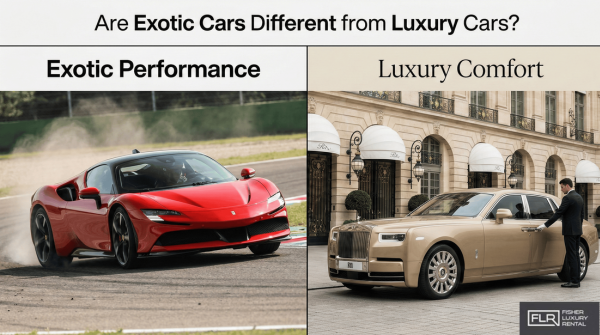
Exotic cars are different from luxury cars in both design philosophy and production approach. The core distinctions include:
- Exotic cars emphasize performance and limited production, while luxury cars emphasize comfort and prestige.
- Exotic brands like Ferrari, Lamborghini, and McLaren engineer vehicles for thrill-seekers; luxury brands like Rolls-Royce, Maybach, and Bentley prioritize a serene ride with plush interiors.
- Price overlap exists in the $200,000 to $500,000 range, yet the consumer experience diverges sharply.
Some vehicles straddle both categories. According to Car and Driver (2021), certain models qualify for luxury or exotic car insurance, sometimes called a specialty or collectors auto policy. Aston Martin, for example, occupies a middle ground between luxury and exotic segments, offering a broader model range that includes sports cars and SUVs alongside high-performance flagships.
What Role Does Brand Reputation Play in Exotic Classification?
Brand reputation plays a defining role in exotic classification because market perception often determines where a manufacturer sits in the hierarchy. Ferrari is positioned as the ultimate exotic supercar brand, while Lamborghini is positioned as the aggressive, visually striking exotic brand. These identities, built over decades, create pricing power and collector demand that reinforce exotic status.
For brands occupying less clear-cut territory, reputation cuts both ways. High total ownership costs that approach or exceed true exotic brands can signal exotic positioning, yet broader rental market appeal suggests a more accessible tier. Understanding how brand perception, pricing, and production intersect helps clarify whether a specific manufacturer earns the exotic label.
Where Does Aston Martin Fit in Automotive Brand Hierarchy?
Aston Martin fits in the automotive brand hierarchy as a refined bridge between mainstream luxury marques and pure exotic manufacturers. Its classification, distinguishing traits, and model evolution reveal a nuanced position.
Is Aston Martin Considered a Luxury, Sports, or Exotic Car Maker?
Aston Martin is considered a luxury, sports, and exotic car maker simultaneously, with its classification shifting depending on the specific model and context. The Vanquish, with its 5.2-liter twin-turbo V12, earns exotic credentials, while the DBX 707 SUV leans toward ultra-luxury performance. Insurance companies reflect this duality; some classify Aston Martin alongside Bentley and Rolls-Royce under luxury policies, while others group it with Ferrari and Lamborghini in exotic specialty coverage.
Consumers echo this ambiguity. As one enthusiast put it: “Aston Martins are GT luxury cruisers that are sporty.” According to MotorTrend’s 2025 review, the Vanquish successfully bridges the gap between luxury and performance. This classification flexibility is precisely what makes the brand distinctive rather than confused.
What Sets Aston Martin Apart from Other High-End Brands?
What sets Aston Martin apart from other high-end brands is its “Super GT” philosophy, prioritizing refined drivability over raw extremes. Top Gear’s Ollie Marriage explicitly categorizes the Vanquish as a Super GT rather than a pure supercar, distinguishing it from rivals like the Lamborghini Revuelto.
Heritage strengthens this separation. The V8 Vantage (2005) became Aston Martin’s best-selling model, while the limited-edition One-77 hypercar showcased design innovation. Classic models hold exceptional collector value; a 1955 DB3S sold for $5,500,000 at Gooding & Co. in 2023.
Financially, however, contemporary models face steeper depreciation. A used 2020 DB11 trades between $165,000 and $195,000, down from approximately $230,000 new. For renters and enthusiasts, this depreciation creates opportunity rather than concern.
How Have Aston Martin’s Models Evolved Over Time?
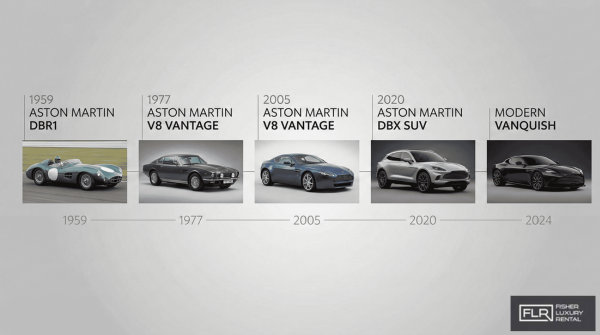
Aston Martin’s models have evolved from pre-war racing machines into a diverse lineup spanning grand tourers, sports cars, and SUVs. David Brown’s 1947 acquisition and simultaneous purchase of Lagonda created the legendary DB series, beginning with the DB1 in 1948. The 1959 Le Mans victory with the DBR1 cemented racing pedigree, and the V8 Vantage (1977) at 170 mph earned the brand recognition as Britain’s first supercar maker.
Modern evolution accelerated with the DBX in 2020, marking Aston Martin’s entry into the SUV segment. Today, pricing spans from the Vantage at $194,500 to the Vanquish at approximately €330,000. Ferrari commands a 65% price premium over Aston Martin, while Lamborghini’s average price sits nearly identical at €289,000, though Lamborghini’s entry-level models command higher prices, suggesting stronger brand value perception at the lower end.
Understanding Aston Martin’s hierarchy position clarifies what to expect when specific models are classified as exotic.
Which Aston Martin Models Are Most Commonly Labeled as Exotic?
Aston Martin models most commonly labeled as exotic include the Vanquish, Vantage, and DB11. Expert opinions and industry classifications vary by model, while collectors distinguish sharply between classic and contemporary offerings.
Are Recent Aston Martin Models Regarded as Exotic by Experts?
Recent Aston Martin models are regarded as exotic by some experts, though the classification remains inconsistent across the automotive industry. According to Car and Driver (2021), Aston Martin models qualify for luxury or exotic car insurance, placing them in the same specialized categories as Ferrari and Lamborghini.
Current models that carry exotic credentials include:
- Vanquish: 835 PS twin-turbo V12 flagship starting around $415,000
- Vantage: 670 HP entry-level sports car starting at $194,500
- DBX 707: 707 HP ultra-luxury performance SUV
- Valhalla: V8 mid-engine hybrid supercar
Insurance costs comparable to Italian competitors reinforce this classification. However, depreciation remains a known issue for modern Aston Martin models, and the brand has posted significantly lower margins with losses in recent years. This financial reality tempers the exotic label for some analysts, even as the cars themselves meet performance and exclusivity thresholds.
How Do Collectors and Enthusiasts View Aston Martin’s Status?
Collectors and enthusiasts view Aston Martin’s status as split between eras. Classic models command strong appreciation in the collector market; a 1955 DB3S sold for $5,500,000 at Gooding & Co. in 2023, and DB4 GT Zagato examples reach the $3 to $5 million range.
Contemporary models tell a different story. Enthusiast communities generally position modern Aston Martins above mainstream luxury sports cars yet below Ferrari and Lamborghini in desirability. Higher depreciation and weaker resale values reduce collector enthusiasm for current production vehicles. For most buyers weighing long-term value, this gap makes pre-owned Aston Martins appealing as accessible exotics rather than investment-grade collectibles.
Understanding how experts and collectors classify these models helps frame what to expect when comparing Aston Martin against traditional exotic brands.
How Does Aston Martin Compare to Other Exotic Car Brands?
Aston Martin compares favorably in craftsmanship and heritage but trails Ferrari, Lamborghini, and McLaren in raw performance metrics and resale strength. The following sections break down competitive positioning, key differences, and accessibility.
How Does Aston Martin Stack Up Against Ferrari, Lamborghini, or McLaren?
Aston Martin stacks up against Ferrari, Lamborghini, and McLaren as a credible competitor with distinct trade-offs in production scale, financial performance, and driving character.
In 2024, Aston Martin produced 6,030 units and generated approximately €1,395 million in revenue, roughly 21% of Ferrari’s €6,677 million. Both Ferrari and Lamborghini maintain operating margins above 27%, while Aston Martin struggles with profitability. Depreciation further separates the brands: Aston Martin loses 20–25% of value over three years, compared to approximately 15% for Ferrari and 18% for Lamborghini.
| Metric | Aston Martin (2024) | Ferrari (2024) | Lamborghini (2024) |
| Annual Production | 6,030 units | 13,752 units | 10,687 units |
| Revenue | €1,395M | €6,677M | €3,090M |
| 3-Year Depreciation | 20–25% | ~15% | ~18% |
In a Top Gear comparison of the Vanquish, Ferrari 12Cilindri, and Lamborghini Revuelto, reviewer Ollie Marriage noted the Vanquish delivers “bottomless torque” and “weightless acceleration,” yet classified it as a “Super GT” rather than a pure supercar. Car and Driver’s “Best Exotic Sports Cars” ranking excludes Aston Martin entirely, while EVO positions it as a legitimate V12 competitor alongside Ferrari and Lamborghini. The classification depends heavily on which criteria matter most.

What Are the Key Differences Between Aston Martin and Traditional Exotics?
The key differences between Aston Martin and traditional exotics center on philosophy, market perception, and financial trajectory. Ferrari and Lamborghini prioritize controlled production growth with increasing volumes, while Aston Martin faces declining sales despite already lower output. Ferrari and Lamborghini command stronger brand equity, reflected in higher resale values and stronger collector demand for contemporary models.
Aston Martin emphasizes grand touring refinement over extreme performance. Its parts are less readily available than Ferrari or Lamborghini components, resulting in higher service costs and longer lead times. Classic and vintage Aston Martins maintain strong collector demand, but contemporary models face challenges establishing equivalent enthusiasm. For buyers who value understated presence over aggressive styling, that philosophical gap is precisely the appeal.
Is Aston Martin More Accessible Than Other Exotic Brands?
Yes, Aston Martin is more accessible than other exotic brands in several measurable ways. The brand is widely available in exotic rental fleets at $700–$1,800 per day, while Ferrari and Lamborghini remain restricted to specialty-only providers at significantly higher rates. Insurance and liability requirements are less restrictive than for Italian exotics, with fewer mileage limitations.
According to Hagerty’s depreciation analysis, Aston Martin and McLaren “depreciate by anywhere from a fifth to a quarter” over three years, significantly more than Ferrari and Lamborghini, which reflects a market positioning one tier below established exotics. With an average used price of $144,202 (438% above the average vehicle), Aston Martin remains exclusive while offering a more approachable entry point. Jalopnik described the V8 Vantage as “The Best Used Exotic Car,” originally designed to compete with the Porsche 911 Carrera S rather than pure supercars.
Fisher Luxury Rental’s fleet includes both Aston Martin-tier vehicles and higher-performance Italian exotics like the Ferrari 488 Spider and Lamborghini Huracan Spyder, allowing drivers to compare these different exotic philosophies firsthand in Phoenix and Portland. Understanding this accessibility shapes what to expect when exploring exotic car rentals firsthand.
Why Does the Classification of Aston Martin Matter to Renters and Enthusiasts?
The classification of Aston Martin matters to renters and enthusiasts because it directly affects rental availability, insurance requirements, and the driving experience itself. Whether Aston Martin is categorized as exotic or luxury shapes expectations, costs, and access.
Does An Aston Martin Rental Offer an Exotic Driving Experience?
An Aston Martin rental offers an exotic driving experience defined by refined performance and exclusivity rather than raw speed. Produced in limited numbers, Aston Martin vehicles emphasize driving dynamics designed to provide an exhilarating, connected feel behind the wheel.
What distinguishes this experience is the brand’s focus on refinement over extreme performance metrics. Specialty exotic rental companies, peer-to-peer platforms like Turo, and traditional rental fleets all classify Aston Martin alongside exotic offerings. Rental companies also report that Aston Martin attracts a broader demographic, including business travelers and special occasion renters seeking a less ostentatious alternative. For anyone who values engagement and aesthetic appeal over sheer aggression, few rentals deliver a more satisfying combination of performance and elegance.
Are Insurance or Rental Terms Different for Exotic Cars Like Aston Martin?
Insurance and rental terms are different for exotic cars like Aston Martin, though the specifics depend on the model and provider. Aston Martin qualifies for exotic car insurance, confirming industry recognition of its exotic status. However, insurers classify Aston Martin vehicles in multiple ways depending on the specific model; some fall under specialty exotic policies while others are grouped with luxury categories.
Rental companies like Fisher Luxury Rental in Phoenix and Portland offer exotic experiences across multiple price points, from entry-level exotics to flagship supercars like the McLaren 720S at $1,299 per day and Ferrari 488 Spider at $1,499 per day. According to industry data, rental and insurance classifications collectively position Aston Martin as an exotic car with lower market desirability and investment value than established Italian exotics. This intermediate positioning often means more favorable rental terms for drivers, making Aston Martin one of the smartest entry points into the exotic segment.
How Can You Experience Aston Martin and Other Exotic Cars Through Fisher Luxury Rental?
You can experience Aston Martin and other exotic cars through Fisher Luxury Rental by browsing the curated fleet of luxury and high-performance vehicles available in Phoenix and Portland. Below, learn how Fisher Luxury Rental connects you with exotic driving experiences and the key classification takeaways from this guide.
Can Fisher Luxury Rental Help You Drive an Aston Martin or Other Exotic Car?
Yes, Fisher Luxury Rental can help you drive an Aston Martin or other exotic car through a premium fleet that includes some of the most sought-after nameplates in the industry. Fisher Luxury Rental offers vehicles such as the Lamborghini Huracan Spyder, Ferrari 488 Spider, McLaren 720S, and Porsche 911 Carrera S, all maintained in top-trim condition. Aston Martin models are widely available through exotic rental companies across North America, and the exotic rental market continues to grow as more drivers seek accessible ways to experience these vehicles firsthand. Fisher Luxury Rental aims to deliver an exhilarating and memorable driving experience, whether for a special occasion, weekend getaway, or fulfilling an automotive passion.
What Are the Key Takeaways About Aston Martin’s Exotic Car Classification?
The key takeaways about Aston Martin’s exotic car classification center on the brand’s unique position straddling luxury and exotic categories. Aston Martin qualifies as an exotic car based on limited production, high performance, and elevated pricing, yet its emphasis on grand touring refinement distinguishes it from more aggressive competitors like Ferrari and Lamborghini. The brand occupies a unique position in the rental market as both a luxury and exotic offering, making it one of the most approachable entry points into the exotic segment.
Core classification insights include:
- Aston Martin meets exotic criteria through limited annual production, specialty insurance requirements, and placement in exotic rental fleets.
- The brand prioritizes driving refinement and aesthetic elegance over raw speed, positioning it as a “Super GT” rather than a pure supercar.
- Higher depreciation and broader rental availability distinguish Aston Martin from Italian exotics that command stricter exclusivity.
- Insurance companies, rental fleets, and collectors all recognize Aston Martin’s exotic status, even as market accessibility sets it apart.
For drivers who want to experience exotic performance wrapped in understated British sophistication, renting through Fisher Luxury Rental is one of the most direct ways to get behind the wheel.