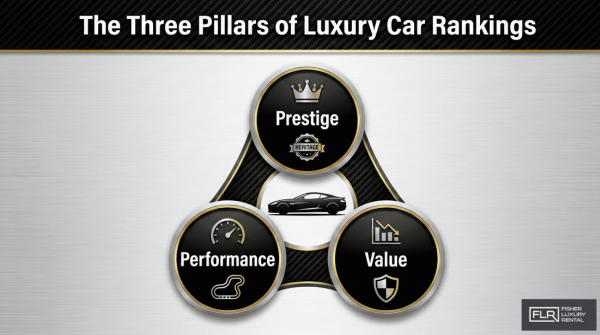
Luxury car brand rankings measure how automakers compare across prestige, performance, and long-term value. These three pillars shape every buying and renting decision, yet no single brand dominates all three equally.
This guide covers brand prestige and how it is measured, performance benchmarks and engineering innovation, ownership costs and real-world value, the brands that balance all three pillars, current market trends and the rise of electric luxury, and how renting offers a direct path to experiencing top-ranked vehicles.
Prestige stems from brand heritage, cultural influence, and independent valuations. German marques like Mercedes-Benz and Porsche consistently lead global brand-value indexes, while Ferrari’s rapid valuation growth signals that exclusivity still commands a premium.
Performance spans raw acceleration, track capability, and driving dynamics. Porsche and Mercedes-AMG push boundaries with sub-two-second sprint times and competitive Nürburgring records, and electrification is redefining what luxury speed feels like across every segment.
Value extends well beyond the sticker price. Depreciation rates, maintenance costs, and reliability ratings vary dramatically; Porsche and Lexus hold their value and dependability leads, while some European rivals carry significantly higher decade-long service expenses.
Balancing all three pillars reveals that no brand wins everywhere. Exotic marques may dominate prestige yet lag in cost efficiency, while established luxury lines trade some exclusivity for broader reliability and resale strength.
The market itself is shifting. Consumer preferences now lean toward experiences over ownership, the luxury EV segment is growing rapidly, and regional sales dynamics continue to reshape which brands lead globally.
We built this guide so you can explore each ranking category in depth, compare the data, and discover how a rental experience through Fisher Luxury Rental lets you test these brands firsthand.
What Factors Determine the Prestige of a Luxury Car Brand?
The factors that determine the prestige of a luxury car brand include industry awards, brand heritage, and cultural impact. Each of these elements shapes how consumers, collectors, and analysts rank one marque above another.
How Do Industry Awards Influence Perceived Prestige?
Industry awards influence perceived prestige by providing third-party validation that separates subjective opinion from measurable brand strength. Rankings from organizations such as Interbrand, Brand Finance, and J.D. Power create standardized benchmarks that consumers and investors reference when evaluating luxury automakers.
These accolades carry weight because they assess criteria like brand value, reliability, and customer satisfaction using transparent methodologies. According to Brand Finance’s 2025 report, Dior earned the highest Brand Strength Index score among all luxury and premium brands at 93.5 out of 100, illustrating how rigorous scoring frameworks quantify prestige across industries.
For automakers, consistent award recognition compounds over time. A single dependability honor may generate momentary attention, but repeated top finishes build a reputation that becomes inseparable from the brand itself. This is why brands that invest in long-term quality tend to accumulate the most meaningful accolades.
Why Is Brand Heritage Important in Measuring Prestige?
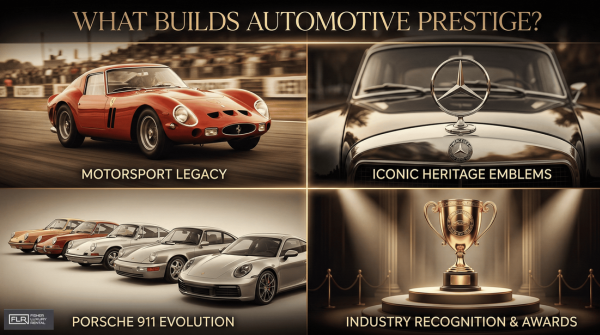
Brand heritage is important in measuring prestige because it signals decades or centuries of accumulated expertise, craftsmanship, and cultural relevance. Marques like Porsche, Ferrari, and Mercedes-Benz derive much of their authority from motorsport legacies, engineering firsts, and iconic model lineages that newer competitors cannot replicate overnight.
Heritage also creates emotional connection. When a buyer chooses a brand with a storied racing pedigree or a history of coachbuilding excellence, they are purchasing membership in a narrative larger than any single vehicle. This intangible value directly supports higher pricing power and stronger resale performance.
That said, heritage alone is not enough. Brands that rest on legacy without innovating risk losing relevance, particularly as electrification reshapes what performance and luxury mean to younger buyers.
What Role Do Celebrity Endorsements and Cultural Impact Play?
Celebrity endorsements and cultural impact play a significant role in elevating a luxury car brand’s visibility and aspirational appeal. When high-profile figures are associated with a particular marque, that association transfers social capital to the brand, reinforcing its position as a status symbol.
Cultural presence extends beyond individual endorsements. Films, music, motorsport sponsorships, and social media all shape public perception of which brands represent the pinnacle of automotive luxury. Ferrari’s appearances in cinema and Porsche’s endurance racing legacy, for example, have cemented both brands in popular consciousness far beyond traditional advertising.
This cultural resonance is difficult to manufacture artificially, which makes it one of the most durable competitive advantages a luxury brand can hold. Understanding these prestige factors provides essential context for evaluating how top brands perform on the road.
How Is Performance Measured Among Top Luxury Car Brands?
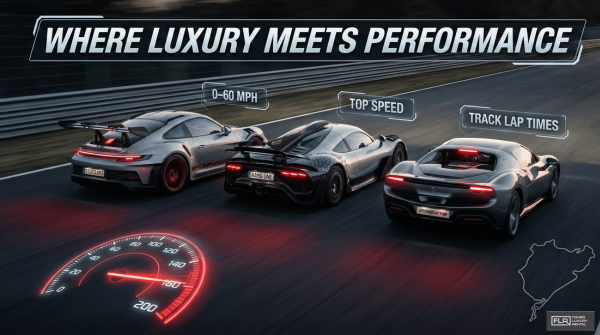
Performance among top luxury car brands is measured through acceleration benchmarks, track lap times, and driving dynamics. The following subsections cover engine technology, handling differences, and the latest performance innovations.
Which Brands Are Known for Superior Engine Technology?
The brands known for superior engine technology include Porsche, Mercedes-AMG, and Ferrari. Porsche engineers its flat-six and turbocharged powertrains for precision across the 911 lineup, while Mercedes-AMG develops handcrafted V8 and hybrid-electric engines for its GT series. Ferrari builds naturally aspirated V12 and twin-turbo V8 engines that prioritize high-revving power delivery. According to Big Garage’s Nürburgring Nordschleife lap records, the Mercedes-AMG ONE and Porsche GT2 RS MR rank among the top contenders for fastest production car times. BMW M division and Lamborghini also push engine boundaries with high-output twin-turbo configurations. Each brand’s engineering philosophy reflects distinct performance priorities, from raw power to refined efficiency.
How Does Driving Dynamics Differ Across Leading Brands?
Driving dynamics differ across leading brands based on suspension tuning, weight distribution, drivetrain layout, and steering calibration. Porsche emphasizes rear-engine balance and precise steering feel, delivering a connected, driver-focused experience. Mercedes-AMG prioritizes grand touring comfort blended with aggressive power delivery through adaptive air suspension systems. BMW M models use a front-engine, rear-drive layout that favors balanced weight distribution and sharp turn-in response. Ferrari and Lamborghini calibrate mid-engine platforms for maximum grip and cornering agility. These differences mean each brand rewards a distinct driving style. For buyers in the Asia-Pacific market, automakers increasingly tailor suspension and ride comfort settings to regional road conditions and preferences, recognizing that driving dynamics expectations vary globally.
What Are the Latest Innovations in Luxury Vehicle Performance?
The latest innovations in luxury vehicle performance center on electrification and hybrid powertrain integration. Porsche’s Taycan Turbo GT achieves 0-60 mph in 1.9 seconds using dual electric motors, demonstrating that EVs now outpace traditional combustion engines in straight-line acceleration. Mercedes-AMG pairs turbocharged engines with electric motors in its E Performance line for instant torque and reduced turbo lag. Ferrari’s SF90 Stradale combines a V8 with three electric motors, producing over 980 horsepower. Luxury automakers are developing compelling electric vehicles that meet both performance and luxury expectations, while active aerodynamics and torque vectoring systems further sharpen handling precision. For enthusiasts who want to experience these performance innovations firsthand, Fisher Luxury Rental maintains a fleet of current-generation vehicles including the Porsche 911 Carrera S and McLaren 720S, allowing drivers to compare electrified and traditional powertrains across Phoenix and Portland routes.
With performance benchmarks established, the next consideration is how these brands compare in long-term value and ownership costs.
How Do Luxury Car Brands Compare in Terms of Value?
Luxury car brands compare in terms of value through three key metrics: total cost of ownership, depreciation rates, and ongoing maintenance expenses. The following subsections break down each factor across major brands.
What Is the Cost of Ownership for Major Luxury Car Brands?
The cost of ownership for major luxury car brands varies significantly depending on the manufacturer. Depreciation, insurance, maintenance, and repair expenses all contribute to the total figure, and some brands carry far steeper long-term costs than others.
According to Consumer Reports’ 2025 analysis of 10-year maintenance and repair costs, Land Rover tops the list at over $19,000, followed by Porsche at $18,249, Mercedes-Benz at $15,986, and BMW at $14,939. Audi and Volvo fall in the mid-range, while Lincoln and Buick remain considerably more affordable to maintain. For buyers weighing prestige against practicality, these differences can reshape what “value” truly means in the luxury segment.
How Do Depreciation Rates Affect Long-Term Value?
Depreciation rates affect long-term value by determining how much of a vehicle’s purchase price is lost over time. Depreciation is the single largest cost of new car ownership, often exceeding maintenance and fuel expenses combined.
The spread across luxury brands is dramatic:
| Brand | Average 5-Year Depreciation |
| Porsche (911) | 19.5% |
| Lexus | 35.9% |
| Mercedes-Benz | 45.9% |
| BMW | 47.9% |
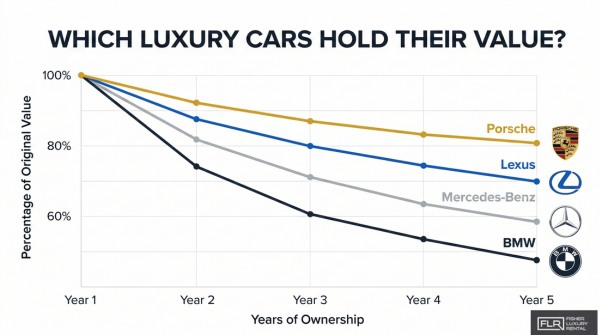
A Porsche 911 retains roughly 80% of its value after five years, while a comparable BMW loses nearly half. This makes model selection just as important as brand selection when evaluating true ownership costs. Buyers who prioritize resale value should consider depreciation curves before committing to any luxury purchase.
Are Maintenance and Service Costs Consistent Across Brands?
No, maintenance and service costs are not consistent across luxury car brands. European manufacturers, in particular, carry notably higher long-term repair expenses compared to their American and Japanese counterparts.
Brands such as Porsche, Mercedes-Benz, and BMW tend to have higher maintenance and repair costs, which can also impact their overall reliability perception. The gap between the most and least expensive brands to maintain spans more than $11,000 over a decade. Japanese luxury brands like Lexus consistently rank among the least costly to service, which partly explains their strong dependability ratings. Understanding these cost disparities before purchasing or leasing helps set realistic expectations for the total ownership experience.
Which Luxury Car Brands Excel Across All Three: Prestige, Performance, and Value?
The luxury car brands that excel across all three categories, prestige, performance, and value, are Porsche, Lexus, and Mercedes-Benz. Each balances these pillars differently, as the subsections below explore through exotic versus established brand dynamics and regional popularity shifts.
How Do Rankings Differ for Exotic vs. Established Luxury Brands?
Rankings differ for exotic vs. established luxury brands primarily in how each category weights prestige against everyday value. Exotic brands like Ferrari command extraordinary prestige; Interbrand’s 2025 Best Global Brands report valued Ferrari at $15.4 billion with a 17.8% year-over-year increase, the strongest growth among all luxury automakers. However, exotic marques typically carry higher maintenance costs and steeper depreciation on most models, which weakens their value scores.
Established luxury brands, such as Porsche and Lexus, spread their strength more evenly. Porsche delivers elite performance while holding value exceptionally well, with the 911 depreciating only 19.5% over five years according to CarEdge data. Lexus ranks highest in J.D. Power’s Vehicle Dependability Study, making it the strongest value proposition among luxury brands. For buyers who want all three pillars rather than peak prestige alone, established brands consistently outperform exotics in combined rankings.
Does Regional Popularity Influence Brand Rankings?
Yes, regional popularity influences brand rankings significantly because consumer preferences, infrastructure, and cultural values vary across markets. According to Precedence Research, Europe accounts for 40% of global luxury car sales, while the Asia-Pacific region is the fastest-growing luxury market. These regional dynamics shape which brands dominate specific rankings.
In the U.S. market, BMW led luxury sales in 2025 with 388,897 vehicles sold, surpassing Mercedes-Benz at 343,200 units. German brands dominate North America and Europe, yet Lexus consistently outperforms them in reliability-focused markets where ownership costs carry more weight. A brand that ranks first in prestige globally may rank lower in value-conscious regions, and vice versa. This is why no single ranking tells the full story; regional context determines which combination of prestige, performance, and value matters most to buyers.
What Are the Most Popular Luxury Car Brands for 2025?
The most popular luxury car brands for 2025 include Mercedes-Benz, BMW, Porsche, Ferrari, and Audi. Consumer preferences, electrification, and brand value shifts are reshaping which names lead the market.
How Have Consumer Preferences Shifted in Recent Years?
Consumer preferences in the luxury car segment have shifted toward prioritizing premium experiences over material goods. Younger buyers show greater openness to electric vehicles, though overall EV adoption in the luxury segment remains relatively low. According to a 2025 report by BCG and duPont REGISTRY Group, reliability concerns and charging infrastructure gaps continue to limit wider luxury EV adoption.
Several trends define this shift:
- Buyers increasingly value experiential luxury, such as travel and social moments, over traditional ownership.
- Hybrids are generally viewed as more reliable than pure EVs and plug-in hybrids.
- Digital channels play a growing role in the luxury car purchase journey.
For brands built on heritage and craftsmanship, adapting to these preference shifts without diluting their identity is arguably the biggest strategic challenge of the decade.
Which Newcomers Are Gaining Prestige or Value Recognition?
The newcomers gaining prestige or value recognition in the luxury market are primarily electric vehicle manufacturers and brands making aggressive EV pivots. The global luxury EV market is projected to grow at a CAGR of over 15% between 2025 and 2032, according to Fortune Business Insights, signaling strong momentum for electrified entrants.
Ferrari stands out among established names repositioning for growth; Interbrand’s Best Global Brands 2025 ranked Ferrari with a brand value of $15.4 billion, reflecting a 17.8% year-over-year increase. Meanwhile, traditional leaders like Mercedes-Benz and BMW experienced brand value declines of 15% and 10%, respectively. This divergence suggests that exclusivity and scarcity still command premium recognition, even as the broader market evolves toward electrification and digital-first customer experiences.
How Should You Experience Luxury Car Brand Excellence with a Rental Service?
You should experience luxury car brand excellence with a rental service by driving top-tier vehicles from brands ranked highest in prestige, performance, and value, without the long-term costs of ownership. The following sections cover how Fisher Luxury Rental elevates that experience and the key takeaways from luxury brand rankings.
Can Renting an Exotic or Luxury Vehicle from Fisher Luxury Rental Enhance Your Brand Experience?
Yes, renting an exotic or luxury vehicle from Fisher Luxury Rental can enhance your brand experience by providing direct access to the world’s most prestigious marques. Consumer preferences are shifting toward premium experiences over material ownership, and renting aligns perfectly with this trend. According to Brand Finance’s 2025 report, the luxury and premium sector reached a record $317.0 billion in brand value, yet consumer priorities are moving toward “meaningful social moments over material goods.”
Fisher Luxury Rental offers top-trim models from brands that dominate global prestige rankings, including:
- Lamborghini Huracan Spyder
- Ferrari 488 Spider and California T
- Porsche 911 Carrera S
- McLaren 720S
- Mercedes G-Wagon and S580
Renting eliminates depreciation, maintenance costs that can reach thousands over a decade, and reliability concerns associated with long-term exotic ownership. For most enthusiasts, a rental delivers the full sensory impact of a luxury brand without the financial burden that erodes value over time.
What Are the Key Takeaways About Luxury Car Brands Ranked by Prestige, Performance & Value?
The key takeaways about luxury car brands ranked by prestige, performance, and value center on three findings:
- Prestige remains concentrated among German and Italian brands. Porsche holds the top luxury brand value at $41.1 billion, while Mercedes-Benz and BMW lead global sales volume.
- Performance benchmarks continue advancing. Electric and hybrid powertrains are redefining speed and driving dynamics across the luxury segment.
- Value depends on total cost of ownership. Depreciation, maintenance, and reliability vary dramatically between brands, making rental an increasingly practical way to experience multiple marques.
The luxury automotive sector is evolving rapidly, with electrification and experience-driven consumer behavior reshaping how people engage with these brands. For anyone seeking to explore prestige, performance, and value firsthand, Fisher Luxury Rental provides that opportunity across its fleet in Phoenix and Portland.