

The rarest exotic cars ever produced are ultra-limited vehicles defined by single- or double-digit production runs, groundbreaking engineering, and market values reaching tens of millions of dollars. Models like the Ferrari 250 GTO (36 built), the McLaren F1 (106 produced), and the Bugatti Type 57SC Atlantic (only 4 ever made) represent the absolute pinnacle of automotive achievement.
This guide covers the most iconic rare exotic cars and what sets them apart, the factors that drive their extraordinary value, the collector market and preservation landscape, modern limited-edition hypercars, and how enthusiasts can experience these vehicles firsthand.
The roster of history’s rarest exotics spans decades of innovation. The Ferrari 250 GTO commands prices exceeding $50 million at auction thanks to its racing pedigree and hand-hammered aluminum bodywork shaped at Carrozzeria Scaglietti. The McLaren F1 pioneered the carbon-fiber monocoque chassis in a road car, and its central driving position remains unmatched in automotive design.
Rarity alone does not create value. Production numbers, provenance, originality, historical significance, and design excellence all converge to determine what collectors will pay. A well-documented ownership chain or a notable racing history can add millions to a car’s worth.
The collector car market remains robust, with RM Sotheby’s surpassing $1 billion in annual sales and online auctions now moving over 50,000 vehicles per year. Preservation demands climate-controlled storage, specialized technicians, and restoration costs that can rival the original purchase price.
Modern manufacturers like Bugatti, Pagani, and Koenigsegg now engineer exclusivity from the outset, limiting production to dozens of units and offering bespoke customization programs with multi-year waiting lists.
For those who want to experience exotic performance without ownership, the luxury car rental industry provides access to world-class vehicles from companies like Fisher Luxury Rental, which maintains a curated fleet of Lamborghini, Ferrari, McLaren, and other high-performance models.
Which Exotic Cars Are Considered the Rarest Worldwide?
The rarest exotic cars worldwide are defined by extremely limited production numbers, historical significance, and astronomical market values. Below, we examine what sets them apart, what makes specific models exceptional, and how many survive today.
What Distinguishes These Rare Exotic Cars From Other Luxury Vehicles?
These rare exotic cars are distinguished from other luxury vehicles by three converging factors: ultra-limited production, hand-built craftsmanship, and technological innovation that redefined automotive engineering. While a standard luxury vehicle may be produced in tens of thousands, the rarest exotics exist in quantities of fewer than 100, sometimes fewer than five.
Labor-intensive manufacturing processes are a primary differentiator. These cars are often hand-built by skilled artisans using advanced materials such as carbon fiber, titanium, and magnesium. The McLaren F1, for instance, was the first production road car to feature a carbon-fiber monocoque chassis, a technology derived from Formula One that delivered exceptional rigidity at minimal weight. Major auction houses such as RM Sotheby’s, Gooding & Company, and Barrett-Jackson serve as the primary platforms for trading these vehicles, and their results act as a barometer of each car’s standing. For collectors, the distinction is clear: rarity alone is not enough without the engineering pedigree to back it up.

What Makes Cars Like the Ferrari 250 GTO and McLaren F1 So Exceptional?
Cars like the Ferrari 250 GTO and McLaren F1 are so exceptional because each represents a major technological milestone paired with significant racing heritage. Historical significance commands a premium in the collector market; the story behind the car, its past owners, and its role in automotive history all contribute to its value.
The McLaren F1 pioneered carbon-fiber construction and featured a central driving position flanked by two passenger seats, producing 618 horsepower from a naturally aspirated BMW V12. The Ferrari 250 GTO dominated 1960s sports car racing with only 36 units ever built. Both models sit at the intersection of competition success and road-car desirability, which is precisely why they consistently set auction records. In my experience analyzing this market, no other vehicles blend racing DNA and collectibility quite as effectively as these two icons.
How Many of These Rare Exotic Cars Exist Today?
The number of these rare exotic cars that exist today varies by model, though surviving examples are remarkably few. The Ferrari 250 GTO has all 36 original units accounted for, each featuring a hand-hammered aluminum body shaped by craftsmen at Carrozzeria Scaglietti. The Bugatti Type 57SC Atlantic is even scarcer; only four were ever made and just three are known to survive.
According to Wikipedia’s production records, a total of 106 McLaren F1s were produced across all variants, and most remain in private collections. Even modern hypercars maintain this scarcity by design. The Bugatti Chiron is assembled by a team of 20 technicians in Molsheim, France, with each car taking approximately six months to build. Such painstaking hand-assembly ensures that production totals stay low, preserving exclusivity for decades to come.

With surviving numbers this small, understanding what drives their extraordinary value becomes essential.
What Are the Key Factors That Make Exotic Cars Rare and Valuable?
The key factors that make exotic cars rare and valuable include limited production numbers, historical significance, provenance, unique design, and originality of condition. Each factor compounds the others, creating the extraordinary desirability collectors pursue.
How Do Limited Production Numbers Affect Exotic Car Rarity?
Limited production numbers affect exotic car rarity by restricting supply far below collector demand, which drives both exclusivity and long-term value appreciation. When a manufacturer caps output at a few dozen or hundred units, each example becomes inherently scarce.
Pagani exemplifies this approach. According to MyStart, Pagani produces fewer than 100 cars annually, with the Pagani Huayra limited to just 100 units total. This low volume enables extraordinary customization and attention to detail, making each car essentially unique.
For collectors, fewer units in existence means fewer opportunities to acquire one. This supply constraint is arguably the single most powerful driver of exotic car valuation.
Why Do Historical Significance and Provenance Matter for Exotic Cars?
Historical significance and provenance matter for exotic cars because they establish authenticity, document a vehicle’s story, and directly influence market value. A car’s past transforms it from a mechanical object into a cultural artifact.
Provenance encompasses original purchase documents, service records, and a clear chain of ownership. Cars previously owned by celebrities or racing drivers often command higher prices. These records verify that a vehicle is genuine, not a replica or heavily altered example.
Racing heritage adds another layer. Vehicles tied to major motorsport victories or technological milestones carry a narrative that resonates deeply with serious collectors, elevating desirability well beyond what specifications alone can justify.
Does Unique Design or Customization Influence a Car’s Rarity?
Unique design or customization does influence a car’s rarity, often significantly. Distinctive styling separates iconic models from forgettable ones, while bespoke options ensure no two examples are identical.
Cars that retain their original engine, chassis, and bodywork are more valuable than heavily restored or modified examples. Concours-quality vehicles, meticulously maintained and preserved, fetch the highest prices among collectors.
Factory-level customization programs offered by manufacturers such as Pagani and Bugatti allow buyers to personalize paint, interior trim, and performance settings. These one-of-one configurations mean that even within an already limited production run, individual cars stand apart. Design, in this context, functions as both an artistic statement and a rarity multiplier.
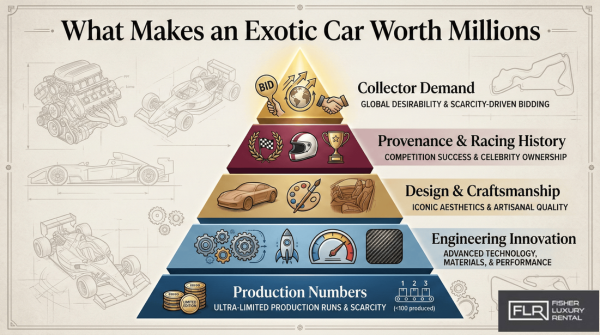
Understanding these value drivers helps explain why certain exotic cars appreciate so dramatically over time.
Which Manufacturers Are Known for Producing the Rarest Exotic Cars?
The manufacturers known for producing the rarest exotic cars include heritage marques like Ferrari, Lamborghini, and Bugatti, alongside modern hypercar specialists such as Pagani and Koenigsegg. These brands operate on a model of extreme exclusivity, producing highly customized vehicles for a select clientele.
What Are the Most Exclusive Ferrari, Lamborghini, and Bugatti Models?
The most exclusive Ferrari, Lamborghini, and Bugatti models are those produced in extremely limited numbers, often combining racing pedigree with iconic design. Ferrari’s 250 GTO stands as the benchmark, while Bugatti and Lamborghini each have flagship models that define collector desirability.
- The Ferrari 250 GTO, with only 36 units ever built, is widely regarded as the world’s most valuable car. A 1962 example sold for $51.7 million at RM Sotheby’s in November 2023, according to Car and Driver.
- The Bugatti Chiron had a total production run of 500 units, all sold out before production ended in 2024. Special editions pushed exclusivity further: the Chiron Pur Sport was limited to 60 units, and the one-off La Voiture Noire sold for a reported $18.7 million.
- The Lamborghini Miura remains one of the most sought-after design icons among collectors, prized for its mid-engine layout and striking aesthetics.
For collectors, the intersection of limited production, racing heritage, and timeless design is what elevates these specific models above anything else in each brand’s lineup.
Which Lesser-Known Brands Have Produced Ultra-Rare Exotic Cars?
Lesser-known brands that have produced ultra-rare exotic cars include Pagani, Koenigsegg, and several smaller coachbuilders whose output barely reached double digits. These manufacturers prioritize bespoke craftsmanship over volume, creating some of the scarcest vehicles on the planet.
Pagani produces fewer than 100 cars annually, with the Huayra limited to just 100 units. Koenigsegg operates at an even smaller scale; the Agera RS, for instance, was restricted to 25 units. Both brands offer extensive customization programs, making each car virtually unique. The demand for these vehicles far exceeds supply, resulting in multi-year waiting lists and an invitation-only allocation process.
What makes these niche manufacturers particularly compelling is their willingness to push engineering boundaries without the constraints of mass production. When a brand builds only 25 examples of a car, every component can be optimized to a degree that larger manufacturers simply cannot replicate.
With manufacturers spanning decades of history and innovation, the collector market surrounding these vehicles has developed its own complex ecosystem of auctions and private sales.
How Do Collectors and Museums Acquire and Preserve Rare Exotic Cars?
Collectors and museums acquire rare exotic cars through major auction houses, private sales, and dealer networks, then preserve them using specialized techniques. The subsections below cover the maintenance challenges these vehicles present and how auctions and private transactions shape market dynamics.
What Challenges Are Involved in Maintaining Rare Exotic Cars?
The challenges involved in maintaining rare exotic cars include sourcing authentic parts, finding qualified technicians, and managing restoration costs that can exceed the vehicle’s original purchase price. A full concours-quality restoration can cost upwards of $100,000, and for models as scarce as the Ferrari 250 GTO, costs climb into the millions.
Preservation demands equally specialized attention. Climate-controlled storage prevents corrosion, while regular mechanical exercise keeps engines and drivetrain components in working order. Museums and collectors also use specialized conservation products to protect original finishes and interiors.
Finding technicians who understand vintage manufacturing methods remains one of the greatest obstacles. Programs like Ferrari’s Classiche department address this gap by offering factory-level restoration with verified original parts. For most collectors, the difficulty is not just financial; it is logistical, requiring a global network of specialists and parts suppliers to keep these vehicles in peak condition.
How Do Auctions and Private Sales Impact the Market for Rare Exotic Cars?
Auctions and private sales impact the market for rare exotic cars by establishing public price benchmarks, driving competition among buyers, and creating liquidity in a segment where transactions are otherwise opaque.
Major auction houses dominate this space. According to a 2025 report by Robb Report, RM Sotheby’s reported over $1 billion in total car sales that year, with 135 cars selling for over $1 million each. Gooding & Company, now partnered with Christie’s, recorded over $234 million in 2025 sales. These results confirm sustained demand at the highest tier of the collector car market.
Private sales, meanwhile, can push values even higher. A 1963 Ferrari 250 GTO sold privately for a reported $70 million in 2018, while a 1962 example later brought $51.7 million at RM Sotheby’s in November 2023.
The market is also shifting digitally. Online auctions now account for over 50,000 collector vehicle sales per year, and no-reserve formats are gaining popularity; Barrett-Jackson’s 2026 Scottsdale auction achieved $195.2 million with a 100% no-reserve docket. For anyone watching this space, the combination of traditional auction prestige and digital accessibility is broadening the buyer pool while keeping top-tier prices remarkably resilient.
Are There Notable Modern Examples of Rare Exotic Cars?
Notable modern examples of rare exotic cars include limited-edition hypercars from Bugatti, Pagani, and Koenigsegg. These manufacturers engineer exclusivity from the outset through capped production runs and specialized construction methods.
What Recent Limited-Edition Supercars Have Become Instant Classics?
Recent limited-edition supercars that have become instant classics include models deliberately restricted to tiny production volumes, such as:
- Bugatti Chiron Pur Sport: Limited to 60 units within the Chiron’s total 500-unit run, which sold out years before production ended in 2024.
- Bugatti La Voiture Noire: A one-off creation that sold for a reported $18.7 million.
- Pagani Huayra: Restricted to just 100 units, with each car offering nearly limitless bespoke customization.
- Koenigsegg Agera RS: Capped at only 25 units, combining record-breaking performance with extreme scarcity.
Demand for these hypercars far outstrips supply, creating multi-year waiting lists and invitation-only allocation processes. Unlike vintage rarities that became scarce over decades, these modern machines are engineered for instant collectibility. For enthusiasts who want to get behind the wheel of high-performance exotics without navigating those waiting lists, rental experiences offer a compelling alternative.
How Do Modern Manufacturing Techniques Contribute to Exotic Car Rarity?
Modern manufacturing techniques contribute to exotic car rarity by requiring labor-intensive, highly specialized processes that severely limit output. Unlike mass-produced vehicles, hypercars are hand-assembled by small teams using advanced materials such as carbon fiber, titanium, and magnesium. The Bugatti Chiron, for instance, is built by a team of 20 technicians in Molsheim, France, with each car requiring approximately six months to complete.
These painstaking methods trace back to traditions like the hand-hammered aluminum bodywork of the Ferrari 250 GTO, shaped panel by panel at Carrozzeria Scaglietti. Although today’s manufacturers leverage more sophisticated tooling, the reliance on skilled artisans remains central. This combination of cutting-edge materials and meticulous hand-assembly ensures that each vehicle is practically unrepeatable, which is precisely what makes modern hypercars so collectible.
How Can Enthusiasts Experience Rare Exotic Cars Without Owning Them?
Enthusiasts can experience rare exotic cars without owning them through luxury car rentals, automotive museums, driving events, and car shows. The sections below explore why renting appeals to so many fans and what these rental experiences deliver.
Why Might Someone Choose to Rent an Exotic Car Instead of Buying?
Someone might choose to rent an exotic car instead of buying because ownership costs for high-performance vehicles extend far beyond the sticker price. Insurance premiums, climate-controlled storage, specialized maintenance, and rapid depreciation on certain models create ongoing financial demands that most enthusiasts prefer to avoid.
Renting eliminates these burdens while preserving the core experience: the sound, the speed, and the visceral connection to world-class engineering. According to Mordor Intelligence and Fortune Business Insights, the global luxury car rental market is projected to reach between $55 billion and $70 billion in the coming years, with a compound annual growth rate of around 6 to 10 percent. That trajectory reflects a clear shift toward access over ownership, particularly among younger demographics who prioritize experiences.
For most car fans, a single weekend behind the wheel of a Lamborghini or Ferrari delivers more lasting satisfaction than years of garage payments ever could.
What Experiences Do Luxury Car Rentals Offer for Rare Exotic Car Fans?
Luxury car rentals offer rare exotic car fans the opportunity to drive models from marquees like Lamborghini, Ferrari, and McLaren on real roads, not just admire them behind velvet ropes. Rental companies curate fleets that span convertible grand tourers, mid-engine supercars, and performance SUVs, each maintained to exacting standards.
Common rental experiences include:
- Weekend getaways through scenic highways in a convertible exotic
- Special occasion rentals for weddings, anniversaries, or milestone celebrations
- Corporate events where a high-performance vehicle elevates the experience
- First-time exotic drives for enthusiasts testing a dream car before committing to ownership
Companies like Fisher Luxury Rental have built their model around this shift, maintaining top-trim exotic vehicles and offering flexible rental periods for special occasions, weekend getaways, and first-time exotic driving experiences. Rental rates range from a few hundred to several thousand dollars per day depending on the vehicle and duration, making supercar access surprisingly attainable compared to multi-million-dollar purchase prices.
For enthusiasts who study the rarest cars ever produced, renting a modern exotic offers the closest connection to that engineering lineage without the collector-grade commitment.
How Can You Experience World-Class Exotic Cars Through Fisher Luxury Rental?
You can experience world-class exotic cars through Fisher Luxury Rental by renting high-performance models from brands like Lamborghini, Ferrari, and McLaren. The following sections detail the available fleet and summarize the key insights from the world’s rarest exotic cars.
What Rare and High-Performance Exotic Car Rentals Are Available from Fisher Luxury Rental?
The rare and high-performance exotic car rentals available from Fisher Luxury Rental include some of the most iconic nameplates in automotive history. Fisher Luxury Rental operates in Phoenix, Scottsdale, Portland, and Vancouver, offering top-trim models maintained to exacting standards.
The current fleet includes:
- Lamborghini Huracan Spyder Convertible
- Ferrari 488 Spider
- McLaren 720S
- Ferrari California T Convertible
- Corvette C8 Z06
- Audi R8 Spyder Convertible
- Porsche 911 Carrera S
Fisher Luxury Rental also provides white glove delivery service, bringing the vehicle directly to you. While owning a Ferrari 250 GTO or Bugatti Type 57SC Atlantic remains out of reach for nearly everyone, getting behind the wheel of a modern Ferrari or McLaren offers a genuine taste of that same engineering lineage. For most enthusiasts, renting is the smartest way to experience exotic performance without the six- or seven-figure commitment.
What Are the Main Takeaways About the Most Rare Exotic Cars Ever Produced?
The main takeaways about the most rare exotic cars ever produced center on three defining factors: extreme scarcity, historical significance, and unmatched craftsmanship.
- The Ferrari 250 GTO, with only 36 examples built between 1962 and 1964, remains the most desirable collector car in the world.
- Only 106 McLaren F1s were produced, including 64 road cars and 28 GTR race variants, cementing its status as the ultimate analog supercar.
- The Bugatti Type 57SC Atlantic is one of the rarest cars ever created; only four were made, and just three survive today.
- The Jaguar D-Type won Le Mans three consecutive years from 1955 to 1957, with only 71 units ever produced.
- The Mercedes-Benz 300SL Gullwing introduced the first production fuel injection system, and only 29 aluminum-bodied examples were built.
According to RM Sotheby’s auction records, a 1955 Jaguar D-Type sold for $21.78 million in 2016, a record for a British automobile at that time. Preservation and restoration of these vehicles demand deep expertise in original manufacturing techniques and materials. These cars endure because they represent irreplaceable milestones in engineering, design, and motorsport heritage, and their value will only grow as fewer pristine examples remain.