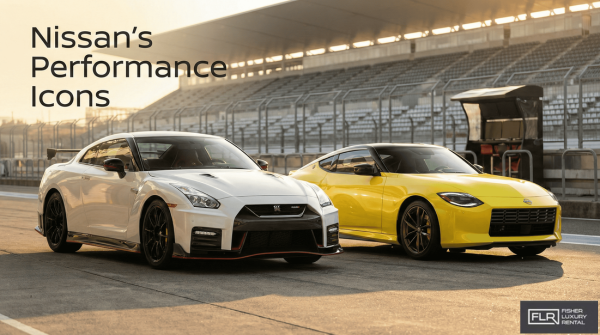
Nissan exotic cars are high-performance vehicles built on decades of Japanese engineering innovation, headlined by the legendary GT-R and the revitalized Z-series. These models deliver supercar-level speed and precision at price points that consistently undercut European rivals.
This guide covers Nissan’s flagship exotic models and their defining features, the signature technologies powering their performance, their motorsports heritage and cultural impact, everyday usability and practicality, and what to know about driving or renting one.
The GT-R, nicknamed “Godzilla,” produces up to 600 horsepower from its hand-assembled twin-turbocharged V6 and reaches 60 mph in 2.7 seconds in NISMO trim. The newer Z-series delivers 400 to 420 horsepower through a driver-focused, rear-wheel-drive platform with an available manual transmission.
Nissan’s proprietary technologies set these cars apart from competitors. The ATTESA E-TS all-wheel-drive system shifts torque between axles in milliseconds, while adaptive Bilstein DampTronic suspension lets drivers toggle between comfort cruising and track-ready firmness.
Racing success validates the engineering. NISMO racing teams have captured multiple Super GT championships, won the Bathurst 12 Hour, and dominated international GT3 competition. The original Skyline GT-R was so fast in Australian touring car racing that organizers banned it from competition.
Both models serve as capable daily drivers with solid reliability ratings and maintenance costs well below those of comparable European exotics. The Z-series can achieve up to 30 mpg, proving that performance and practicality coexist in Nissan’s lineup.
Renting offers the most accessible path to experiencing these machines firsthand. We explore what the driving experience feels like and how enthusiasts can access exotic car rentals.
Which Nissan Cars Are Considered Exotic and High-Performance?
Nissan’s exotic and high-performance cars are the GT-R and the Z-series. These two models define Nissan’s presence in the supercar and sports car segments through twin-turbocharged power, advanced drivetrain technology, and motorsport-derived engineering.
What Features Define Nissan’s High-Performance Exotic Models?
The features that define Nissan’s high-performance exotic models are twin-turbocharged V6 engines, race-inspired drivetrain systems, and hand-built craftsmanship. The GT-R produces 565 horsepower from its 3.8-liter VR38DETT engine in standard form, while the NISMO variant reaches 600 horsepower and 481 lb-ft of torque. Each VR38DETT engine is hand-assembled by a single master craftsman, known as a Takumi.
The Nissan Z delivers 400 horsepower from its 3.0-liter twin-turbocharged V6, with the NISMO version producing 420 horsepower and 384 lb-ft of torque. Key performance features across both models include:
- Twin-turbocharged V6 engines engineered for rapid throttle response
- ATTESA E-TS all-wheel drive on the GT-R, providing up to 50% front torque transfer on demand
- Available 6-speed manual transmission on the Z for a driver-focused experience
- NISMO-tuned variants with enhanced power, suspension, and aerodynamics
According to Nissan USA’s official specifications, the GT-R achieves a 0-60 mph time of 2.9 seconds in standard trim and 2.7 seconds in NISMO configuration. Few vehicles at any price point match that combination of hand-built precision and outright acceleration.

How Do Nissan’s Exotic Models Compare to Other Luxury Brands?
Nissan’s exotic models compare to other luxury brands by delivering competitive performance at a significantly lower price point. The GT-R NISMO, priced at $217,635, matches or exceeds the acceleration of cars costing $280,000 or more.
| Vehicle | Horsepower | 0-60 mph | Approximate Price |
| Nissan GT-R NISMO | 600 hp | 2.7s | $217,635 |
| Porsche 911 Turbo S | 640 hp | 2.6s | $200,000+ |
| Ferrari F8 Tributo | 710 hp | 2.9s | $280,000+ |
| McLaren 720S | 710 hp | 2.8s | $300,000+ |
| Chevrolet Corvette Z06 | 670 hp | 2.6s | $110,000+ |
As Motor Trend noted in its 2023 review, “When it made its debut, the Nissan GT-R was an underdog. It embarrassed supercars that were twice its price.” Although its platform has aged, the GT-R’s all-wheel-drive traction advantage remains a differentiator against rear-wheel-drive competitors in real-world conditions. The Z-series occupies a different competitive tier, starting under $43,000 while offering 400 horsepower against rivals like the Toyota Supra and Ford Mustang. For enthusiasts who prioritize raw performance per dollar over brand prestige, Nissan’s lineup remains one of the strongest value propositions in the high-performance segment.

With performance credentials established, Nissan’s signature technologies reveal how that speed is engineered.
What Are the Signature Technologies in Nissan’s High-Performance Cars?
The signature technologies in Nissan’s high-performance cars are the VR38DETT engine, the ATTESA E-TS all-wheel-drive system, and adaptive suspension systems. These core innovations define how the GT-R and Z-series deliver exotic-level speed, grip, and control.
How Does Nissan’s Engine Technology Contribute to Exotic Performance?
Nissan’s engine technology contributes to exotic performance through hand-built precision and forced induction engineering. The VR38DETT, a 3.8-liter twin-turbocharged V6, powers the GT-R with 565 horsepower in standard form and 600 horsepower in the NISMO variant. Each engine is assembled by a single Takumi master craftsman in a clean room at Nissan’s Yokohama plant. Design features include a closed-deck aluminum block, plasma-sprayed cylinder bores for reduced friction, and twin IHI turbochargers integrated into the exhaust manifolds to minimize turbo lag. According to a 2026 HotCars analysis, some tuners have achieved over 1,000 horsepower on the VR38DETT’s stock internals. The Z-series uses the VR30DDTT, a 3.0-liter twin-turbo V6 producing 400 horsepower standard and 420 horsepower in NISMO trim.
What Role Does Nissan’s Advanced Suspension and Drive Systems Play?
Nissan’s advanced suspension and drive systems play a critical role in translating raw engine power into controllable, confident handling. The ATTESA E-TS all-wheel-drive system uses a rear-mounted transaxle layout to optimize weight distribution. Under normal conditions, it sends 100 percent of torque to the rear wheels, then redirects up to 50 percent to the front axle within milliseconds when sensors detect traction loss. According to DSPORT Magazine’s technical breakdown, this electronic torque split capability is what gives the GT-R its legendary grip in both straight-line launches and high-speed cornering.
The GT-R’s Bilstein DampTronic suspension offers three selectable modes: Normal, Comfort, and Race. Each mode continuously adjusts damper settings based on speed and lateral forces. The Z-series pairs a double-wishbone front suspension with a multi-link rear setup, while its NISMO version adds stiffer springs and anti-roll bars for sharper track response. These systems explain why Nissan’s performance cars inspire driver confidence across conditions, from daily commutes to circuit sessions.
How Have Nissan Exotic Cars Performed in Motorsports and Pop Culture?
Nissan exotic cars have built a legendary presence through decades of racing dominance and widespread media visibility. The following subsections cover key racing achievements and notable appearances in entertainment.
Which Racing Achievements Have Cemented Nissan’s High-Performance Reputation?
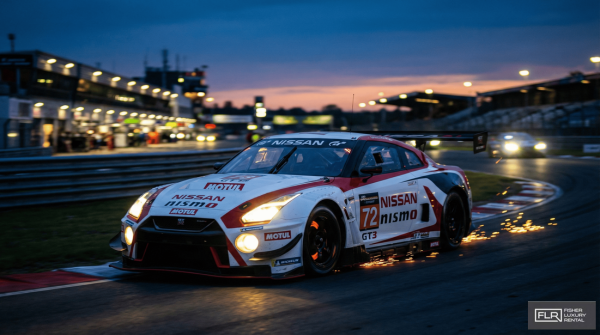
The racing achievements that cemented Nissan’s high-performance reputation span decades of GT racing dominance across multiple continents. NISMO, Nissan’s motorsports division, has campaigned the GT-R to victories in some of the world’s most demanding series.
In the Super GT series, the GT-R won seven of nine races during its 2008 inaugural GT500 season, securing the drivers’ championship. NISMO teams captured both drivers’ and teams’ titles in 2011, 2012, 2014, and 2015. Globally, the GT-R NISMO GT3 won the Bathurst 12 Hour endurance race in 2015 and claimed the Blancpain Endurance Series Pro Class drivers’ title the same year.
According to the official NISMO history page, the Skyline GT-R (R32) achieved overall victory at the Spa 24-hour race and multiple Japan Touring Car Championship titles in the early 1990s. The R32 was eventually banned from Australian touring car racing for being too dominant. Few production-based racing platforms have ever forced regulators to intervene; that distinction alone speaks to the GT-R’s engineering superiority.
How Have Nissan Exotic Cars Been Featured in Media and Entertainment?
Nissan exotic cars have been featured in media and entertainment as symbols of accessible supercar performance, reinforcing the brand’s cultural significance beyond the racetrack. The GT-R’s “Godzilla” nickname, earned through its overwhelming motorsport dominance, became a defining identity that transcended automotive circles and entered mainstream pop culture vocabulary.
Video game franchises have played a major role in elevating awareness. The GT-R and Z-series are staples in racing titles that introduce millions of players to high-performance driving. Film and television have similarly showcased these models as aspirational machines capable of competing with European exotics at a fraction of the cost.
This media presence amplifies what the track record already proves: Nissan’s performance credentials are genuine. For enthusiasts who discover the GT-R or Z through entertainment, the transition from virtual admiration to real-world driving creates lasting demand for hands-on exotic car experiences.
How Do Nissan Exotic Cars Balance Performance with Everyday Usability?
Nissan exotic cars balance performance with everyday usability through adaptive driving technologies, refined interiors, and reliable engineering. The following subsections cover comfort and technology features, then examine daily driving practicality.
What Comfort and Technology Features Are Offered in Nissan’s Exotic Lineup?
The comfort and technology features offered in Nissan’s exotic lineup include adaptive suspension systems, driver-selectable modes, and premium cabin appointments. The GT-R’s Bilstein DampTronic suspension provides three settings: Normal, Comfort, and R (Race), continuously adjusting damper firmness based on speed and lateral forces.
Both the GT-R and Z deliver key usability features:
- A dual-clutch six-speed transmission in the GT-R offers smooth shifts comparable to Porsche’s PDK system.
- The Nissan Z provides an available 6-speed manual for drivers who prefer direct mechanical engagement.
- Climate control, premium audio, and modern infotainment are standard across both lineups.
According to Kelley Blue Book consumer reviews, 78% of 2021 GT-R owners gave the car a five-star rating, praising both acceleration and surprising daily comfort. For a supercar that reaches 60 mph in 2.9 seconds, that level of owner satisfaction signals genuinely livable refinement.
How Practical Are Nissan’s High-Performance Models for Daily Driving?
Nissan’s high-performance models are practical for daily driving thanks to manageable maintenance costs, strong reliability, and reasonable fuel efficiency. The GT-R earns a reliability rating of 4.3 out of 5, and many owners use it as a primary vehicle. Annual maintenance costs range between $920 and $1,500, which is notably lower than European supercar alternatives like Ferrari or McLaren.
The Nissan Z adds further practicality:
- Fuel efficiency reaches up to 30 mpg with the automatic transmission.
- Some markets offer a 10-year fixed-price servicing plan for predictable ownership costs.
- The Z’s starting price under $50,000 makes it one of the most accessible twin-turbo sports cars available.
Ownership costs such as tires (approximately $1,200 per year) and brake pads (around $1,400 per replacement) are worth factoring in, but these figures remain well below typical supercar service bills. This combination of durability and affordability is what makes Nissan’s performance cars genuinely viable as everyday drivers, not just weekend toys.
With daily usability covered, prospective drivers may also want to understand what renting or driving these models actually feels like.
What Should Prospective Renters Know About Driving or Renting Nissan Exotic Cars?
Prospective renters should know that Nissan exotic cars deliver a unique blend of raw performance and accessible driving dynamics. The following subsections cover the driving experience itself and key rental considerations.
What Is It Like to Drive a Nissan Exotic Car?
Driving a Nissan exotic car is an experience defined by immediate power delivery, precise handling, and technology derived directly from motorsports. The GT-R’s ATTESA E-TS all-wheel-drive system shifts up to 50% of torque to the front wheels in milliseconds, creating a sense of planted confidence that few rear-wheel-drive supercars can match. Its Bilstein DampTronic suspension lets drivers toggle between Comfort and Race modes, adapting the ride in real time.
The Nissan Z offers a different but equally engaging character. With rear-wheel drive and an available 6-speed manual transmission, it rewards drivers who enjoy direct mechanical feedback. According to Kelley Blue Book consumer data, 78% of GT-R owners gave the car a five-star rating, praising its exhilarating acceleration alongside surprising daily comfort. For anyone accustomed to European exotics, the visceral turbo response from Nissan’s twin-turbo V6 engines feels distinctly different, more immediate and less filtered.
What Additional Considerations Exist for Renting a Nissan Exotic Model?
Additional considerations for renting a Nissan exotic model include insurance classification, maintenance awareness, and rental market availability. Most insurance companies classify the GT-R as a supercar, which means higher premium rates than standard performance vehicles. NISMO variants carry even steeper coverage costs due to their elevated power output and value.
Renters should also understand basic operational differences. The GT-R’s launch control system generates extreme acceleration forces; first-time drivers benefit from familiarizing themselves with its drive mode settings before pushing hard. Tire and brake wear runs higher than on typical sports cars, so rental agreements may include specific policies on component condition.
While the GT-R may be harder to find, providers like Fisher Luxury Rental in Phoenix, Scottsdale, Portland, and Vancouver maintain curated fleets of high-performance exotics including Lamborghini, Ferrari, McLaren, and Porsche models that deliver comparable supercar experiences. Checking fleet listings in advance and confirming vehicle-specific insurance coverage are practical steps before booking.
With these rental factors in mind, exploring the right provider can simplify the entire experience.
How Can You Experience High-Performance Nissan and Other Exotic Cars with Fisher Luxury Rental?
You can experience high-performance Nissan and other exotic cars with Fisher Luxury Rental by booking from a curated fleet of supercars and luxury vehicles. The sections below cover the rental experience and key article takeaways.
Can Fisher Luxury Rental Help You Access Unforgettable Exotic Car Experiences?
Yes, Fisher Luxury Rental can help you access unforgettable exotic car experiences through a premium fleet that includes models from Lamborghini, Ferrari, Porsche, and McLaren. Fisher Luxury Rental operates in Phoenix, Scottsdale, Portland, and Vancouver (WA), offering top-trim vehicles paired with a focus on quality and customer service.
The available fleet spans a wide performance range:
- Lamborghini Huracan Spyder Convertible
- Ferrari 488 Spider
- McLaren 720S
- Porsche 911 Carrera S
- Corvette C8 Z06
According to Fortune Business Insights, the global luxury car rental market exceeded $52 billion in 2025, with projected growth surpassing $125 billion by 2034. This surge reflects rising demand for supercar experiences without the long-term costs of ownership, such as insurance, maintenance, and depreciation. For enthusiasts drawn to high-performance machines like those in Nissan’s lineup, renting offers the thrill of exotic driving on your own terms.
What Are the Key Takeaways About Nissan Exotic Cars: High-Performance Models Explained We Covered?
The key takeaways about Nissan exotic cars covered in this article center on engineering excellence, competitive value, and real-world usability.
- The Nissan GT-R delivers 565 to 600 horsepower through its hand-built VR38DETT engine, achieving 0-60 mph in as little as 2.7 seconds in NISMO form.
- The Nissan Z provides 400 to 420 horsepower at a starting price under $50,000, making it one of the most accessible high-performance sports cars available.
- Signature technologies like the ATTESA E-TS all-wheel drive and Bilstein DampTronic suspension translate motorsports engineering into daily-drivable performance.
- NISMO’s racing legacy, including Super GT championships and GT3 victories, directly informs the development of Nissan’s road cars.
- Ownership costs for the GT-R remain more manageable than European supercar alternatives, with reliability rated 4.3 out of 5.
Whether considering ownership or exploring the exotic rental market, Nissan’s performance models offer a compelling blend of heritage, technology, and driving engagement that few manufacturers can match.