Famous Ferrari models are production and racing cars from Maranello that have achieved iconic status through a combination of rarity, engineering innovation, motorsport dominance, and cultural influence. Ferrari’s legendary status spans over seven decades, from hand-built V12 grand tourers to hybrid hypercars producing nearly 1,000 hp.
This guide covers what defines a Ferrari as legendary, the most iconic classic and modern models, Ferrari’s influence on global exotic car culture, and how to experience these cars firsthand.
Legendary status among Ferraris comes from a convergence of racing pedigree, limited production numbers, and design innovation. Models like the 250 GTO, with only 36 units ever built, and the F40, the last car personally approved by Enzo Ferrari, earn their reputations through documented competition history and engineering firsts that reshaped what road cars could achieve.
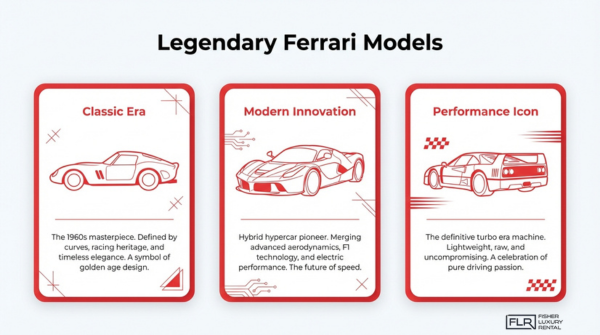
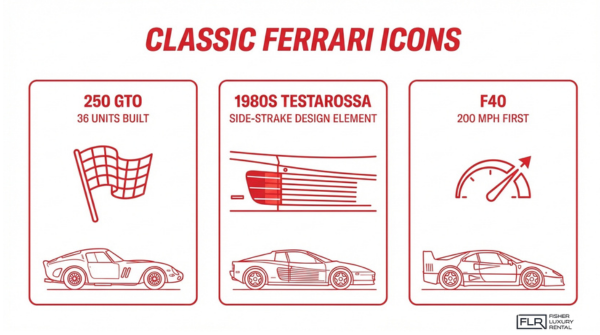
Classic Ferraris like the 250 GTO, Testarossa, and F40 each represent a defining era. The 250 GTO dominated early 1960s GT racing and now commands tens of millions at auction. The Testarossa became a cultural symbol of 1980s excess through its Pininfarina side-strake design and pop culture visibility. The F40 was the first production car to break 200 mph, using composite bodywork and twin-turbocharged power that set new benchmarks for raw performance.
Modern Ferraris carry that legacy forward through Formula 1 technology transferred directly to road cars. The Enzo introduced carbon-ceramic brakes and an F1-style gearbox. The LaFerrari combined a V12 with hybrid electric power for 963 total hp. The 488 Pista pushed V8 turbocharged performance to record Fiorano lap times using race-derived aerodynamics and electronic systems.
Ferrari’s influence extends beyond the cars themselves into global supercar culture, dedicated collector communities, prestigious concours events, and a brand loyalty rate where the majority of new buyers are returning customers. We explore how this culture shaped the entire exotic car segment.
For enthusiasts who want to move beyond reading about these legendary machines, we break down what the driving experience is actually like and how Fisher Luxury Rental provides access to iconic Ferrari models.
What Defines a Ferrari as “Legendary” Among Car Enthusiasts?
A Ferrari earns “legendary” status through the convergence of racing heritage, engineering innovation, limited production, and cultural impact. The following section explores how these factors have built Ferrari’s unrivaled reputation.
How Has Ferrari’s Heritage and Innovation Shaped Its Reputation?
Ferrari’s heritage and innovation have shaped its reputation by linking every road car directly to decades of motorsport dominance and boundary-pushing engineering. Technologies such as the E-Diff, F1-Trac, and active aerodynamics originated in Ferrari’s Formula 1 program before migrating to production models, according to a comparative study published in the International Journal of Livelihood Research.
This pipeline from racetrack to road creates a lineage no competitor replicates at the same depth. Limited production runs, from just 36 units of the 250 GTO to 499 examples of the LaFerrari, reinforce exclusivity while preserving collector demand. Combined with Pininfarina’s six-decade design partnership and record auction results, these elements fuse performance credibility with cultural prestige. Few automakers can claim that level of integration between competition success, technological transfer, and deliberate scarcity.
Understanding this foundation clarifies why specific models, from classics to modern hypercars, have achieved iconic status.
Which Classic Ferrari Models Remain the Most Iconic Today?
The classic Ferrari models that remain the most iconic today are the 250 GTO, the Testarossa, and the F40. Each represents a distinct era of Ferrari excellence, from racing dominance to cultural stardom to raw performance engineering.
What Makes the Ferrari 250 GTO a Timeless Collectible?
The Ferrari 250 GTO is a timeless collectible because of its extreme rarity, racing pedigree, and unmatched desirability among collectors. Ferrari manufactured only 36 units between 1962 and 1964, originally built for homologation into the FIA’s Group 3 Grand Touring Car category. Its front-mounted 60° V12 engine displaces 2,953 cc and produces 300 hp at 7,400 rpm. According to CarBuzz, the 250 GTO is considered the most desirable collector car in the world, with its value driven by rarity, racing success, and its status as the pinnacle of front-engine V12 Ferraris. Few automobiles command this level of reverence across both motorsport historians and investment-grade collectors.
Why Is the Ferrari Testarossa a Symbol of the 1980s Supercar Era?
The Ferrari Testarossa is a symbol of the 1980s supercar era because it merged cutting-edge engineering with an instantly recognizable design that defined the decade’s automotive aesthetic. Pininfarina designed the Testarossa with large side intakes and long side strakes, features introduced to meet aerodynamic requirements that became the model’s visual signature. Under the bodywork sat a 4,943 cc 180° V12 (technically not a true boxer engine, as opposing cylinders shared the same crankpins) producing 287 kW at 6,300 rpm and a 290 km/h top speed. According to We Are Curated, the Testarossa’s prominent role in the television series “Miami Vice” cemented its status as a cultural icon and significantly boosted its global popularity. That combination of pop culture exposure and genuine performance made it the poster car of an entire generation.
How Did the Ferrari F40 Redefine Automotive Performance?
The Ferrari F40 redefined automotive performance by becoming the first production car to officially break the 200 mph barrier, reaching a claimed top speed of 324 km/h (201 mph) with 0 to 100 km/h acceleration in 4.1 seconds. Ferrari produced 1,315 units, each powered by a 2,936 cc twin-turbocharged V8 generating 478 hp at 7,000 rpm. The F40 was also the first Ferrari production car to use mainly composite materials for its body panels, which consisted of only eleven pieces. According to Classicmobilia, the F40’s body construction used large single-unit front and rear sections to minimize weight and maximize rigidity. For any serious collector or enthusiast, the F40 represents the purest distillation of Enzo Ferrari’s philosophy: performance above all else.
With these classic models defining Ferrari’s golden eras, several modern Ferraris now carry the torch as future legends.
Which Modern Ferrari Cars Are Regarded as Future Legends?
The modern Ferrari cars regarded as future legends are the Enzo, LaFerrari, and 488 Pista. Ferrari’s racing heritage is directly applied to these road cars through technologies such as the E-Diff, F1-Trac, and active aerodynamics, all originally developed for its Formula 1 program.

Why Do the Ferrari Enzo and LaFerrari Stand Out in the Brand’s Recent History?
The Ferrari Enzo and LaFerrari stand out in the brand’s recent history because each served as the ultimate technological flagship of its era, translating Formula 1 engineering directly into a limited-production road car.
The Ferrari Enzo, introduced in 2002, featured a 5,998 cc V12 engine producing 660 hp and a top speed exceeding 350 km/h. Its carbon-fiber and honeycomb sandwich chassis, 150-millisecond F1-style gearbox shifts, and carbon-ceramic brakes (a first for a Ferrari road car) made the engineering case unmistakable. With only 400 units produced, collector demand has surged; according to Hagerty, a Ferrari Enzo sold for $17.8 million in early 2026.
The LaFerrari, Maranello’s first HY-KERS hybrid, combined an 800 hp V12 with a 120 kW electric motor for a total output of 963 hp. It slashed more than 5 seconds off the Enzo’s Fiorano lap record at launch. Ferrari produced only 499 coupes, with the chassis hand-laminated from four types of carbon fiber inside the Scuderia Ferrari racing department. Few modern cars embody the bridge between racetrack and road as convincingly as these two flagships.
How Has the Ferrari 488 Pista Pushed the Boundaries of Technology and Speed?
The Ferrari 488 Pista has pushed the boundaries of technology and speed by combining the most powerful V8 in Ferrari’s history with race-derived dynamic control systems. Its 3.9L twin-turbocharged V8 produces 711 horsepower and 568 lb-ft of torque. According to the reference book Ferrari: 75 Years, the 488 Pista recorded a Fiorano lap time of 1 minute and 21.5 seconds, making it the fastest V8-powered Ferrari at its 2018 launch.
The car’s Side Slip Control (SSC) 6.0 system integrates three key technologies:
- E-Diff3 for electronic differential management
- F1-Trac for traction control calibration
- Ferrari Dynamic Enhancer (FDE) for lateral stability
This level of integrated electronic control, filtered down from the Scuderia’s race program, represents exactly the kind of engineering density that distinguishes future collectibles from ordinary sports cars. With Ferrari targeting 60% hybrid and electric coverage across its portfolio, the 488 Pista may well mark the final chapter of the naturally aspirated-feeling turbo V8 era.
How Has Ferrari Influenced Exotic Car Culture Worldwide?
Ferrari has influenced exotic car culture worldwide by establishing the blueprint for supercar performance, exclusivity, and brand loyalty that every competitor follows. Below, we examine how Ferrari inspires rival manufacturers and how its passionate community celebrates these legendary cars.
In What Ways Do Ferrari Models Inspire Other Supercar Makers?
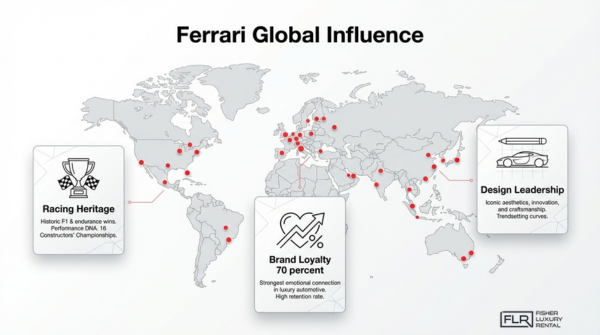
Ferrari models inspire other supercar makers by setting benchmarks in performance engineering, design language, and scarcity-driven brand strategy. Ferrari’s business model is characterized by scarcity marketing, purposely producing fewer cars than the market demands to maintain high resale values and brand exclusivity. This approach, pioneered in Maranello, has become the template that brands such as McLaren, Pagani, and Bugatti now replicate with their own limited production runs.
Ferrari’s mid-engine layout, sequential gearbox technology, and active aerodynamics have all migrated into competing platforms. When Ferrari introduced carbon-ceramic brakes and hybrid powertrains on its flagship models, rivals accelerated their own development timelines to keep pace. The result is an entire supercar segment that continuously evolves because Ferrari keeps raising the standard.
How Do Ferrari Owners and Fans Celebrate These Legendary Cars?
Ferrari owners and fans celebrate these legendary cars through dedicated clubs, concours events, authorized ownership programs, and a deeply loyal community. According to ProQuest equity research, more than 70% of new Ferrari owners are existing customers, reflecting one of the highest brand loyalty rates in the automotive industry.
Ownership extends well beyond the purchase itself. Ferrari’s ownership costs include not only the acquisition price but also authorized service and long-term value planning, both essential for maintaining a vehicle’s provenance and market value. Owners invest in preservation because these cars appreciate significantly over time, transforming driving passion into financial stewardship.
Fans who do not own a Ferrari still participate actively through social media communities, vintage rallies, and experiences like exotic car rentals. This inclusive enthusiasm, spanning collectors and first-time drivers alike, is what keeps Ferrari’s cultural influence growing across generations.
With Ferrari’s cultural impact firmly established, understanding what to consider before experiencing one firsthand becomes the natural next step.
What Should You Consider Before Experiencing a Legendary Ferrari?
Before experiencing a legendary Ferrari, you should consider what the driving experience actually involves and which model best matches your goals. The following sections cover what it feels like behind the wheel and how to select the right Ferrari for your needs.
What Is It Like to Drive or Rent an Iconic Ferrari Model?
Driving or renting an iconic Ferrari model is an immersive encounter with decades of racing heritage, design craftsmanship, and mechanical precision. Every element, from the throttle response to the exhaust note, reflects engineering refined across generations of motorsport.
What sets the experience apart is Ferrari’s deep integration of brand heritage into every touchpoint. According to a study on Italian car brands published via DiVA Portal, Ferrari’s brand identity is more deeply woven into its after-sales services and authorized dealer network than competitors like Lamborghini, which rely more heavily on founder-driven narratives. That attention to the complete ownership and driving journey means even a short rental carries a sense of occasion that few other marques replicate.
Whether you slip into a mid-engine V8 or a front-engine grand tourer, the sensation is unmistakably Ferrari: precise steering, progressive power delivery, and a cabin designed to keep the driver connected to the road.
How Can You Choose the Right Ferrari for Your Dream Experience?
You can choose the right Ferrari for your dream experience by matching the model’s character to your priorities, whether that is raw speed, open-air cruising, or iconic styling. Consider the following factors:
- Driving setting: Track days favor lightweight, high-downforce models like the 488 Pista, while coastal drives suit convertibles such as the California T.
- Experience level: Newer turbocharged Ferraris offer electronic stability aids that help less experienced drivers stay confident at speed.
- Passenger needs: Two-seat berlinettas maximize performance, whereas grand touring models provide more cabin comfort for longer journeys.
- Era and character: Classic naturally aspirated V12 models deliver a visceral, analog feel, while modern hybrids add instant electric torque.
For most enthusiasts exploring a Ferrari for the first time, starting with a model that balances accessibility and performance yields the most rewarding experience. Understanding these priorities before booking ensures the car you choose delivers exactly the thrill you are looking for.
How Can You Experience a Famous Ferrari Model With Fisher Luxury Rental?
You can experience a famous Ferrari model with Fisher Luxury Rental by choosing from a curated fleet of exotic cars available in Phoenix and Portland. Below, explore the rental options and key takeaways from the legendary models covered throughout this guide.
What Ferrari Rental Options Does Fisher Luxury Rental Offer for Car Enthusiasts?
Fisher Luxury Rental offers car enthusiasts direct access to iconic Ferrari models, including the Ferrari California T Convertible and the Ferrari 488 Spider. These represent two distinct eras of Ferrari engineering: the grand touring elegance of the California T and the mid-engine performance lineage that traces back to models like the 488 Pista, of which only approximately 2,000 units were produced.
According to Fortune Business Insights, the global luxury car rental market was valued at USD 52.82 billion in 2025 and is projected to grow to USD 125.98 billion by 2034. That trajectory reflects surging demand for high-performance driving experiences without the commitment of ownership.
Fisher Luxury Rental makes these experiences accessible through straightforward daily rentals:
- The Ferrari California T Convertible starts at $599 per day.
- The Ferrari 488 Spider rents for $1,499 per day.
For most enthusiasts, renting remains the most practical path to experiencing Ferrari’s engineering heritage firsthand, especially when collector-grade models like the F40 have appreciated roughly 400% over 15 years.
What Are the Key Takeaways About Famous Ferrari Models: Top Legendary Cars of All Time We Covered?
The key takeaways about famous Ferrari models are that rarity, racing DNA, and technological innovation define every legendary car in the Prancing Horse’s lineage. From the 250 GTO’s 36-unit production run to the LaFerrari’s hybrid powertrain, each model pushed boundaries while preserving Maranello’s core identity.
The most actionable insights from this guide include:
- Ferrari’s classics, such as the 250 GTO, Testarossa, and F40, earned legendary status through limited production, motorsport success, and cultural impact.
- Modern flagships like the Enzo, LaFerrari, and 488 Pista carry forward Formula 1 technology into road-legal platforms.
- Ownership costs and exclusivity make renting a compelling alternative for experiencing these machines.
- Fisher Luxury Rental bridges the gap between Ferrari’s storied heritage and real-world access, offering models like the Ferrari 488 Spider and California T across Phoenix and Portland.
Whether your interest is in the raw analog character of Ferrari’s classic era or the precision of its modern turbocharged V8s, the best way to understand what makes these cars legendary is to get behind the wheel.