
The top-selling luxury car brands in the United States are BMW, Lexus, Mercedes-Benz, and Audi. These brands dominate a market that generated $117.4 billion in revenue in 2024, with luxury vehicles accounting for over 12% of total U.S. auto sales.
This guide covers market sales leaders and how they compare, the factors driving luxury brand popularity, how individual brands like Mercedes-Benz, BMW, and Audi perform head-to-head, the rise of exotic marques in the U.S., future trends reshaping luxury auto sales, and how renting offers a direct path to experiencing these vehicles.
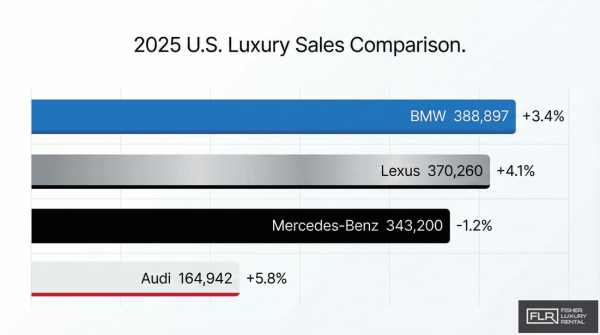
BMW leads U.S. luxury sales with 388,897 vehicles sold in 2025, followed closely by Lexus at 370,260 units and Mercedes-Benz at 343,200. Audi trails at 164,942 units after a significant year-over-year decline, making the race for market leadership tighter than ever.
Buyer motivations have shifted; the majority of luxury car purchasers prioritize driving enjoyment over status signaling. Performance, technology integration, and brand heritage all shape purchasing decisions, yet brand loyalty remains low across the segment.
Exotic brands like Ferrari, Lamborghini, and Porsche are posting record U.S. numbers. Porsche set an all-time U.S. sales record in 2025, while Ferrari and Lamborghini both grew deliveries steadily.
Electrification is redefining the competitive landscape. EVs now represent nearly a quarter of luxury sales, though adoption varies sharply by brand. Alongside this shift, digital retail models and flexible ownership alternatives (including subscriptions and rentals) are changing how consumers access luxury vehicles.
Which Luxury Car Brands Lead Sales in the U.S. Market?
BMW, Lexus, and Mercedes-Benz lead luxury car sales in the U.S. market, with BMW holding the top position in 2025. The following sections cover how top-selling status is determined, how annual sales figures compare, and which regions favor specific brands.
What Criteria Are Used to Determine Top-Selling Luxury Car Brands?
The criteria used to determine top-selling luxury car brands include total unit sales volume, year-over-year growth percentage, and overall market share within the luxury segment. Industry analysts also factor in revenue performance and the brand’s share of the total U.S. automotive market. In 2025, luxury brands accounted for 12.54% of the total U.S. automotive market, with combined sales reaching 2.1 million vehicles. Price tier matters as well; vehicles positioned between $100,000 and $170,000 represent one of the fastest-growing segments. Rankings typically reflect calendar-year delivery figures reported directly by automakers or compiled by sources such as J.D. Power and Cox Automotive.
How Do Sales Figures for Luxury Car Brands Compare Annually?
Sales figures for luxury car brands compare annually through reported delivery totals and growth rates. According to a 2026 BMW BLOG analysis of 2025 U.S. luxury car sales results, BMW led all luxury brands with 388,897 vehicles sold, a 4.7% year-over-year increase.
The top four luxury brands performed as follows in 2025:
|
Brand |
2025 U.S. Sales |
Year-over-Year Growth |
|
BMW |
388,897 |
+4.7% |
|
Lexus |
370,260 |
+7.1% |
|
Mercedes-Benz |
343,200 |
+1.0% |
|
Audi |
164,942 |
-16.0% |
Lexus posted the strongest growth at 7.1%, while Audi’s 16% decline signals shifting competitive dynamics worth watching closely.
What Regions in the United States Prefer Certain Luxury Brands?
Regions in the United States that prefer certain luxury brands tend to cluster around population density, climate, and local wealth concentration. Coastal markets, particularly California, New York, and Florida, consistently generate the highest luxury vehicle registrations due to larger affluent populations. Lexus and BMW perform especially well in Sun Belt states where year-round driving conditions favor convertibles and sport sedans. German brands like Mercedes-Benz and Audi have traditionally held strong footholds in the Northeast and Mid-Atlantic corridors. Meanwhile, SUV-heavy luxury lineups gain traction across the Mountain West and Pacific Northwest, where terrain and lifestyle demand versatile platforms. Understanding these regional patterns helps explain why national sales rankings only tell part of the story.
What Factors Drive the Popularity of Luxury Car Brands in America?
The popularity of luxury car brands in America is driven by a combination of performance, technology, brand heritage, and design. The following sections explore how each factor shapes buyer decisions.
How Do Performance and Technology Influence U.S. Luxury Car Buyers?
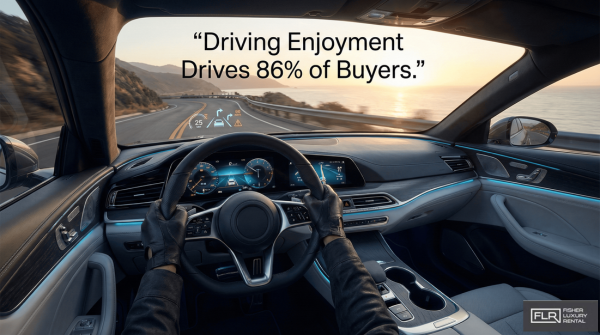
Performance and technology influence U.S. luxury car buyers by serving as the primary motivators behind purchase decisions. According to a 2025 McKinsey report on luxury car buyer behavior, 86% of luxury car buyers cite the enjoyment of driving as their top purchase motivation, while only 36% are driven by the desire to showcase status. This finding reframes how brands should prioritize their investments: powertrain refinement, handling dynamics, and in-cabin technology matter far more than badge prestige alone.
Brand loyalty remains surprisingly low in this segment. Only 37% of luxury car buyers say they would repurchase from the same brand, which means each model cycle is essentially a fresh competition. Brands that deliver superior driving technology, such as adaptive suspension, advanced driver-assistance systems, and seamless infotainment, earn consideration regardless of past ownership history. For buyers evaluating their next vehicle, the driving experience itself consistently outweighs any other single factor.
What Role Do Brand Reputation and Heritage Play in Sales?
Brand reputation and heritage play a defining role in luxury car sales by establishing the trust and aspirational value that justify premium pricing. The 2025 U.S. sales results illustrate this clearly:
|
Brand |
2025 U.S. Sales |
Year-over-Year Growth |
|
BMW |
388,897 |
+4.7% |
|
Lexus |
370,260 |
+7.1% |
|
Mercedes-Benz |
343,200 |
+1.0% |
|
Audi |
164,942 |
-16.0% |
BMW’s consistent leadership reflects decades of cultivating its “Ultimate Driving Machine” identity. Lexus, built on a reputation for reliability inherited from Toyota’s engineering legacy, achieved record-breaking volume. Meanwhile, Audi’s sharp decline suggests that heritage alone cannot sustain momentum when product strategy falters. Reputation opens the door, but each generation of vehicles must reaffirm the promise that heritage originally established.
How Important Are Design and Comfort Features for American Buyers?
Design and comfort features are critically important for American buyers because they shape the daily ownership experience beyond raw performance specs. Interior material quality, seat ergonomics, cabin noise isolation, and exterior styling all influence whether a luxury vehicle feels worth its price. American consumers increasingly expect lounge-like interiors with premium leather, configurable ambient lighting, and panoramic glass roofs as standard rather than optional.
Comfort-oriented technology, such as massaging seats, multi-zone climate control, and heads-up displays, has shifted from differentiator to baseline expectation across the segment. Brands that treat design as a holistic sensory experience, not just an aesthetic exercise, tend to command stronger loyalty and higher transaction prices.
With buyer motivations now clearly mapped, the next section examines how individual brands translate these factors into market performance.
How Do Specific Brands Like Mercedes-Benz, BMW, and Audi Perform in the U.S.?
Mercedes-Benz, BMW, and Audi each perform differently in the U.S. luxury market, with BMW currently leading in total sales volume. The sections below examine what distinguishes each brand’s market position.
What Sets Mercedes-Benz Apart in the U.S. Luxury Market?
Mercedes-Benz is set apart in the U.S. luxury market by its blend of prestige, comfort, and a comprehensive lineup spanning sedans, SUVs, and performance AMG models. In 2025, Mercedes-Benz sold 343,200 units in the U.S., reflecting a modest 1% year-over-year increase.
However, the brand’s electric vehicle strategy has faced headwinds. According to a 2025 BMW BLOG analysis of U.S. luxury car sales data, Mercedes-Benz experienced a 23% decline in battery electric vehicle sales in 2024, the steepest drop among the top three German luxury brands. While the brand’s traditional combustion and hybrid models continue to anchor its reputation, this EV slowdown suggests Mercedes-Benz must accelerate its electrification efforts to maintain long-term competitiveness.
Where Does BMW Stand Among Top U.S. Luxury Car Brands?
BMW stands as the top-selling luxury brand in the United States. In 2025, BMW sold 388,897 vehicles, a 4.7% year-over-year increase that secured its position above Lexus and Mercedes-Benz.
A key factor behind this leadership is BMW’s balanced approach to electrification. The brand achieved a 12% increase in battery electric vehicle sales in 2024, outpacing both Mercedes-Benz and Audi in EV momentum. Performance, design, and brand heritage remain crucial pillars for sustained luxury success, yet BMW’s willingness to invest aggressively in electric models while maintaining strong combustion offerings gives it a strategic advantage. For buyers who value both driving dynamics and forward-looking technology, BMW currently occupies the strongest position among German luxury competitors.
How Does Audi Compete with Other Leading Luxury Brands?
Audi competes with other leading luxury brands through its Quattro all-wheel-drive technology, refined interior design, and a focus on digital innovation. Despite these strengths, Audi sold 164,942 vehicles in the U.S. in 2025, a 16% year-over-year decrease that placed it well behind BMW, Lexus, and Mercedes-Benz.
Part of Audi’s competitive strategy involves adapting to shifting retail expectations. According to a 2025 Boston Consulting Group report, 80% of luxury car buyers browse vehicles online weekly, and 75% are open to purchasing entirely online. Audi’s integration of digital configurators and streamlined online experiences reflects this shift. Still, the significant sales decline signals that digital retail alone cannot offset product cycle gaps or broader market pressures. Recovering momentum will require Audi to sharpen both its EV portfolio and its value proposition against increasingly aggressive competitors.
With individual brand performance in focus, the exotic luxury segment reveals a different competitive dynamic entirely.
Which Exotic Luxury Car Brands Are Gaining Popularity in the U.S.?
Exotic luxury car brands like Ferrari, Lamborghini, and Porsche are gaining popularity in the U.S. through record-setting sales and strong profitability. The sections below examine brand performance and the demographics fueling this demand.
How Are Brands Like Lamborghini, Ferrari, and McLaren Performing?
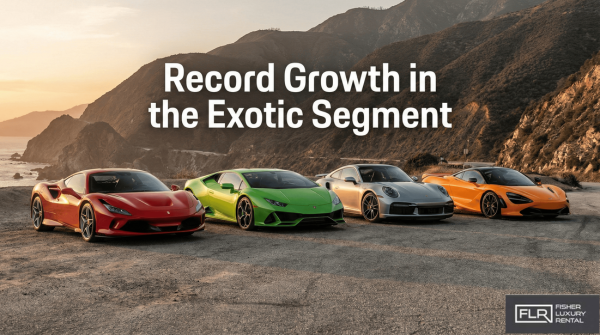
Brands like Lamborghini, Ferrari, and McLaren are performing exceptionally well in the U.S. market. The exotic and ultra-luxury segments have demonstrated remarkable strength, with multiple marques achieving record sales. According to Ferrari’s 2024 financial results, Ferrari shipped 13,752 units globally, a 0.7% increase, with net revenues reaching €6.68 billion. Lamborghini’s U.S. sales grew by 1.2% in 2025, with 2,915 units delivered. Porsche set a new all-time U.S. sales record that same year, delivering 76,219 vehicles.
While McLaren does not publish granular U.S. figures in the same way, the brand remains a fixture in the ultra-luxury performance segment. This sustained momentum across exotic marques signals that buyer appetite for limited-production, high-performance vehicles continues to outpace broader market trends.
What Demographics Are Most Drawn to Exotic Luxury Brands?
The demographics most drawn to exotic luxury brands skew toward high-net-worth individuals, typically aged 35 to 55, with strong disposable income and a passion for automotive performance. Unlike mainstream luxury buyers, exotic car purchasers often prioritize the driving experience itself over practicality. A 2025 McKinsey study found that 86% of luxury car buyers cite the enjoyment of driving as their primary purchase motivation, a mindset even more pronounced among exotic buyers.
Fisher Luxury Rental serves this demographic directly offering vehicles like the Lamborghini Huracan Spyder and Ferrari 488 Spider that provide the authentic exotic experience millennials seek before making a six-figure purchase commitment.
With exotic brands reaching new buyers through flexible ownership and rental models, understanding future market trends becomes equally important.
What Trends Influence Future Sales of Luxury Car Brands in the United States?
Future sales of luxury car brands in the United States are influenced by electrification strategies and evolving access models like leasing and rentals. These two forces are reshaping how consumers discover, evaluate, and commit to premium vehicles.
How Are Electric and Hybrid Models Affecting Luxury Brand Sales?
Electric and hybrid models are affecting luxury brand sales by accelerating brand repositioning and creating sharp winners and losers in the market. EVs accounted for 23% of total luxury sales in Q1 2025, making electrification the single largest disruption facing premium automakers. However, the transition has been uneven across brands; BMW posted a 12% increase in battery electric vehicle sales in 2024, while Mercedes-Benz and Audi saw BEV declines of 23% and 8%, respectively.
Bold electrification bets are also redefining brand identity. According to Luxury Society, Jaguar’s November 2024 brand transformation, repositioning itself as a luxury lifestyle brand around its new electric GT, generated over 15 million Google searches in its first month and secured over 32,000 pre-orders. That kind of conviction signals where the market is heading. Brands willing to fully commit to an electric future, rather than hedging with incremental updates, are capturing outsized consumer attention and purchase intent.
What Impact Do Leasing and Rental Options Have on Brand Popularity?
Leasing and rental options have a significant impact on brand popularity because they remove the financial barrier that prevents many consumers from experiencing top-tier luxury vehicles. Peer-to-peer platforms and premium rental services function as powerful brand discovery channels, letting drivers form emotional connections with vehicles before making a purchase decision. According to a BENlabs case study, Turo’s influencer-driven campaign delivered a 305% lift in brand awareness and a 40% increase in purchase intent, demonstrating how rental access converts curiosity into genuine brand affinity.
This shift matters for luxury automakers because every rental becomes an extended test drive. When someone spends a weekend behind the wheel of a Lamborghini Huracan or a Porsche 911, the experience creates a lasting impression that traditional advertising cannot replicate. Fisher Luxury Rental offers direct access to top-performing models from BMW, Mercedes-Benz, Lamborghini, Ferrari, and Porsche. Each rental functions as an extended test drive, allowing you to evaluate driving dynamics, technology integration, and real-world performance across competing brands.
How Can Renting a Luxury or Exotic Car Enhance Your Experience with Top Brands?
Renting a luxury or exotic car enhances your experience with top brands by providing direct access to high-performance vehicles without the commitment of ownership. The sections below cover Fisher Luxury Rental’s fleet and key takeaways from the brands we explored.
What Luxury and Exotic Car Rental Services Does Fisher Luxury Rental Offer?
Fisher Luxury Rental offers a curated fleet of top-trim luxury and exotic vehicles available for daily rental in Phoenix, AZ and Portland, OR. The lineup spans several of the top-selling brands covered in this article, including:
- Lamborghini Huracan Spyder Convertible
- Ferrari 488 Spider and Ferrari California T Convertible
- McLaren 720S
- Porsche 911 Carrera S and Porsche Macan
- Mercedes G-Wagon and Mercedes S580
- Audi R8 Spyder Convertible
- Corvette C8 Z06, Stingray, and Convertible
According to a 2025 McKinsey report, 86% of luxury car buyers cite driving enjoyment as their primary motivation rather than status. Renting from Fisher Luxury Rental lets you experience that driving enjoyment firsthand across multiple brands before making any purchase decision. For enthusiasts who want to compare how a Ferrari handles against a Lamborghini or a Porsche, rental access eliminates the barrier of a six-figure commitment.
What Are the Key Takeaways About Top-Selling Luxury Car Brands in the United States We Covered?
The key takeaways about top-selling luxury car brands in the United States are:
- BMW leads U.S. luxury sales, followed closely by Lexus and Mercedes-Benz.
- Driving enjoyment, not status, is the primary motivator for luxury car buyers.
- Exotic brands like Ferrari, Lamborghini, and Porsche continue setting sales records.
- Electric vehicles now represent a growing share of luxury sales, reshaping brand strategies.
- Flexible access models, including rentals and subscriptions, are transforming how consumers experience luxury vehicles.
Whether you are researching your next purchase or simply want an unforgettable weekend, Fisher Luxury Rental provides the opportunity to get behind the wheel of these top-performing brands firsthand.