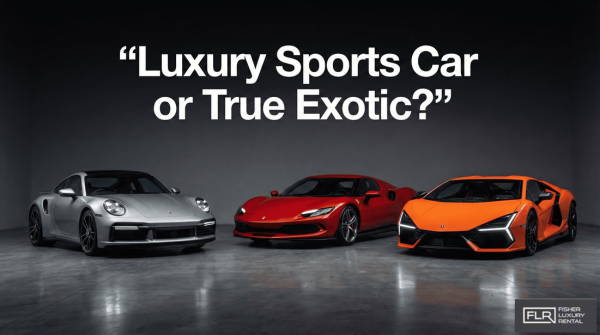
Porsche is a premium luxury sports car brand, not a traditional exotic car manufacturer. While select Porsche models rival the rarest exotics in performance and exclusivity, the brand’s high production volume, accessible entry-level pricing, and focus on everyday usability place it in a category of its own.
This guide covers what defines an exotic car, Porsche’s brand evolution, which models cross into exotic territory, how Porsche compares to Ferrari and Lamborghini, and what shapes the brand’s classification among enthusiasts and owners.
Exotic car status hinges on rarity, extreme performance, striking design, and high price points. Brands like Ferrari and Lamborghini maintain strict production caps to preserve exclusivity, while Porsche delivered over 279,000 vehicles globally in 2025. That scale gap is the primary reason most experts separate Porsche from the exotic segment.
Porsche’s identity has shifted significantly since the 356 debuted in 1948. Expansion into SUVs and sedans broadened market reach, yet the 911’s six-decade design lineage and motorsport dominance keep the brand rooted in performance credibility.
Certain models do earn exotic credentials. The 918 Spyder, limited to 918 units, and the 911 Turbo S Exclusive Series, capped at 500, match or exceed exotic rivals in both rarity and raw capability. The current 911 Turbo S produces 701 horsepower and reaches 60 mph in 2.4 seconds.
Compared head-to-head with Lamborghini and Ferrari, Porsche’s top trims deliver comparable performance at lower price points, while its entry-level Cayenne starts well below any exotic competitor. This pricing strategy captures a broader luxury audience but distances the brand from ultra-exclusive territory.
Enthusiast opinion remains divided along regional and cultural lines, though Porsche consistently ranks as the world’s most valuable luxury automotive brand. That blend of accessibility, performance, and prestige defines where Porsche truly fits.
What Qualifies a Car as Exotic?
A car qualifies as exotic when it combines rarity, exceptional performance, striking design, and a high price point. The following sections break down how experts define the category, what features separate exotics from standard luxury vehicles, and where supercars and sports cars fit into the hierarchy.
How Do Industry Experts Define an Exotic Car?
Industry experts define an exotic car as a rare, high-performance vehicle built in limited numbers with distinctive styling and premium craftsmanship. According to Hagerty, a leading authority in the collector car market, exotic cars are “rare or limited-production vehicles with distinctive styling that are designed for high-performance or luxury.” The core criteria most experts agree on include:
- Rarity and exclusivity through low production volumes and strict manufacturing caps.
- Exceptional performance measured in horsepower, acceleration, and handling precision.
- High price points reflecting advanced engineering, premium materials, and hand-built construction.
- Distinctive design language that separates these vehicles visually from anything mass-produced.
No single authority owns the definition, but these four pillars consistently appear across industry classifications.
What Features Typically Distinguish Exotic Cars from Other Luxury Vehicles?
The features that typically distinguish exotic cars from other luxury vehicles are production scarcity, unconventional design, and an uncompromising focus on performance over practicality. Striking, often aerodynamically sculpted bodywork sets exotics apart at first glance; these cars are engineered to turn heads, not blend into traffic.
Production volume is perhaps the sharpest dividing line. In 2025, Porsche delivered 279,449 vehicles globally, according to Porsche Newsroom. That figure dwarfs output from brands like Ferrari and Lamborghini, which cap annual deliveries in the low thousands or tens of thousands. This scale difference is why most experts classify Porsche as a premium luxury sports car brand rather than a true exotic manufacturer, even though select Porsche models rival exotics in every other dimension.
How Are Exotic Cars Different from Supercars and Sports Cars?
Exotic cars are different from supercars and sports cars in scope, exclusivity, and origin. A sports car prioritizes driving dynamics and may come from any mainstream manufacturer at accessible price points. A supercar pushes performance to extremes with top-tier horsepower, speed, and engineering. An exotic car meets supercar-level performance while also demanding rarity, foreign or unusual provenance, and head-turning design that feels otherworldly.
Some overlap exists. Most exotic cars are supercars, but not all supercars qualify as exotic. A high-volume performance model can deliver supercar speed without the exclusivity that defines the exotic tier. Understanding these distinctions clarifies why brands like Porsche sit in a nuanced middle ground between categories.
How Has Porsche’s Brand Evolved Over Time?
Porsche’s brand has evolved from a small sports car manufacturer into a global luxury powerhouse. The sections below trace when Porsche became synonymous with luxury and performance, its key historical milestones, and how its reputation has shifted in recent decades.
When Did Porsche Become Associated with Luxury and Performance?
Porsche became associated with luxury and performance through a decades-long trajectory rooted in motorsport success and engineering excellence. The brand’s origins with the 356 in 1948 established its reputation for precision, while the 911’s debut in 1963 cemented a performance DNA that has endured for over six decades. These early wins on the racetrack translated directly into consumer prestige.
That association has only strengthened over time. In 2025, Brand Finance named Porsche the world’s most valuable luxury and premium brand for the eighth consecutive year, with a brand value of $41.1 billion. Few automotive brands have managed to sustain this level of recognition across such a long period, which speaks to how deeply performance credibility and luxury perception are woven into Porsche’s identity.
What Are the Milestones in Porsche’s Automotive History?
The milestones in Porsche’s automotive history mark a brand that consistently redefined its own boundaries. Key turning points include:
- The Porsche 356 launched in 1948, establishing the company as a dedicated sports car manufacturer.
- The Porsche 911 debuted in 1963, creating a design and engineering icon that remains central to the brand’s identity.
- The Cayenne SUV expanded Porsche into an entirely new segment, broadening market reach significantly.
- The Panamera sedan further diversified the lineup, blending four-door practicality with sports car performance.
Each expansion was strategic. Rather than diluting the brand, these moves funded continued motorsport development and high-performance engineering at the top of the range.
How Has Porsche’s Reputation Shifted in Recent Decades?
Porsche’s reputation has shifted from niche sports car maker to diversified luxury brand. The introduction of SUVs and sedans initially drew criticism from purists who feared the brand was abandoning its roots. In practice, these models fueled the financial growth that supports Porsche’s most ambitious performance cars.
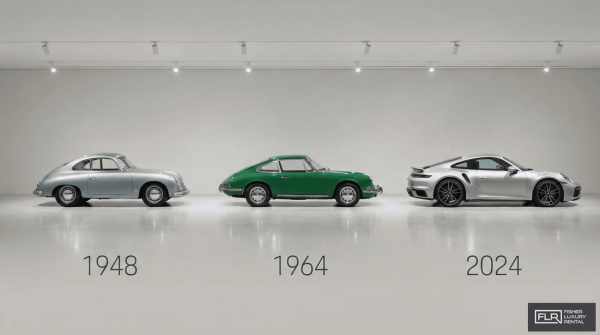
This broader lineup now positions Porsche uniquely in the market; it competes simultaneously as a high-volume luxury manufacturer and a producer of limited-edition collector vehicles. The result is a reputation that balances accessibility with exclusivity, something traditional exotic brands do not attempt. Understanding this evolution clarifies why Porsche’s exotic classification remains so debated, especially when examining specific models.
Which Porsche Models Are Typically Classified as Exotic?
Only certain Porsche models earn exotic classification. The distinction depends on production volume, pricing, and performance relative to the broader lineup. Below, each factor is explored across entry-level accessibility, standout high-performance models, and the role of limited editions.
Are All Porsche Vehicles Considered Exotic or Only Certain Models?
Not all Porsche vehicles are considered exotic; only select high-performance and limited-production models qualify. Porsche’s entry-level offerings are far more accessible than those of traditional exotic brands, which separates much of the lineup from exotic territory.
The 2025 Porsche Cayenne starts at $89,900, according to Porsche’s current model configurator. That price is a fraction of a Ferrari 296 GTB at $342,205 or a Lamborghini Revuelto at $608,358. Models like the Cayenne, Macan, and base Panamera serve the luxury SUV and sedan markets rather than the exotic segment. This broad accessibility is precisely what keeps Porsche’s volume models out of the exotic conversation, even though they carry the same badge as the brand’s rarest creations.
What Makes Models Like the Porsche 911 Turbo S or 918 Spyder Stand Out?
Models like the Porsche 911 Turbo S and 918 Spyder stand out through extreme performance, strict production limits, and hand-crafted exclusivity. The 918 Spyder was limited to just 918 units, while the 911 Turbo S Exclusive Series capped production at 500 units, according to Porsche Newsroom.
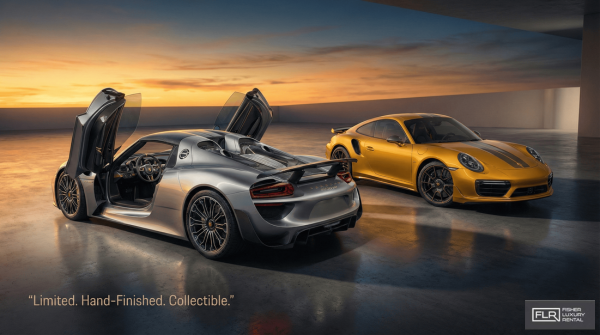
For those looking to experience this level of performance firsthand, Fisher Luxury Rental offers the Porsche 911 Carrera S starting at $499 per day in Phoenix and Portland, providing access to Porsche’s flagship sports car without the commitment of ownership. Recent additions like the 911 Dakar and 911 S/T further demonstrate Porsche’s capacity for low-volume, highly collectible models. Many of these vehicles are hand-finished in Porsche’s Exclusive Manufaktur facility, elevating craftsmanship to a level that genuine exotic buyers expect.
How Do Limited Editions and High-Performance Trims Impact Exotic Status?
Limited editions and high-performance trims impact exotic status by drastically reducing availability and increasing desirability. When Porsche restricts a model to several hundred units, it creates the same scarcity dynamic that defines Ferrari and Lamborghini releases.
These constrained production runs achieve several things:
- They command significantly higher prices than standard 911 variants.
- They attract serious collectors who value exclusivity over daily usability.
- They generate waitlists and secondary-market premiums that mirror exotic buying behavior.
- They showcase bespoke craftsmanship through Porsche’s Exclusive Manufaktur process.
For most enthusiasts, Porsche’s limited trims represent the clearest bridge between premium sports car and true exotic. The performance and rarity are undeniable; the broader brand simply operates on a different scale than its lower-volume competitors.
How Does Porsche Compare to Other Exotic Car Brands?
Porsche competes with Ferrari, Lamborghini, and McLaren on performance, yet differs sharply in production scale, pricing, and exclusivity. The following subsections break down these comparisons.
How Does Porsche Stand Against Lamborghini, Ferrari, and McLaren?
Porsche stands against Lamborghini, Ferrari, and McLaren as a performance equal but a volume outlier. Ferrari, Lamborghini, and McLaren maintain strict production caps to preserve exclusivity, while Porsche’s output dwarfs all three combined. According to a 2026 JBR Capital market analysis, Porsche holds over 30% of the luxury car market, a share built on volume that inherently dilutes the rarity central to exotic status.
That production gap tells the real story:
- Porsche delivered 279,449 vehicles in 2025.
- Ferrari delivered 13,640 vehicles in 2025.
- Lamborghini delivered 10,747 vehicles in 2025.
- McLaren delivered an estimated 3,200 vehicles in 2024.
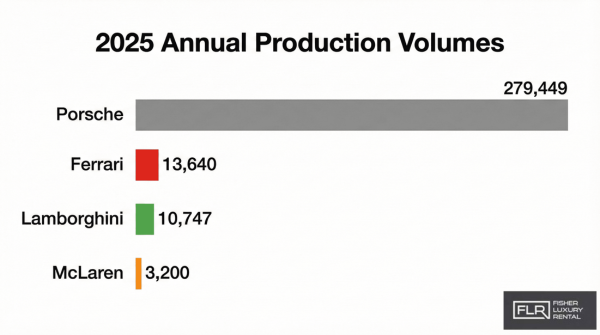
Fisher Luxury Rental bridges this accessibility gap by offering top-trim Porsche models alongside competitors like the McLaren 720S ($1,299/day) and Ferrari 488 Spider ($1,499/day), allowing drivers to directly compare how Porsche’s performance philosophy differs from traditional exotic brands.
What Are the Key Differences in Performance, Price, and Exclusivity?
The key differences in performance, price, and exclusivity between Porsche and traditional exotics center on accessibility. Porsche matches or beats exotic rivals in acceleration and top speed, yet its entry-level pricing starts far lower. A Porsche Cayenne begins at $89,900, while the Ferrari 296 GTB starts at $342,205 and the Lamborghini Revuelto at $608,358.
| Attribute | Porsche 911 Turbo S | Ferrari 296 GTB | Lamborghini Revuelto |
| Entry Price Range | $89,900 (Cayenne base) | $342,205 | $608,358 |
| Horsepower | 701 hp | 819 hp | 1,015 hp |
| 0-60 mph | 2.4s | ~2.9s | ~2.5s |
Porsche delivers exotic-level performance at a significantly lower cost of entry, which broadens its audience but distances it from the ultra-exclusive pricing territory that defines true exotics.
How Does Consumer Perception Affect Porsche’s Exotic Status?
Consumer perception affects Porsche’s exotic status by reinforcing its identity as a premium luxury brand rather than a niche exotic marque. In 2025, Brand Finance named Porsche the world’s most valuable luxury and premium brand for the eighth consecutive year, with a brand value of $41.1 billion. The brand scored 9.7 out of 10 in reputation and 9.6 out of 10 in reliability.
These scores reflect widespread admiration, yet they also signal mass-market desirability rather than rarefied exclusivity. Consumers associate Porsche with attainable aspiration; they associate Ferrari and Lamborghini with unattainable dream machines. That perceptual divide, more than any spec sheet, shapes how buyers classify each brand.
Understanding where Porsche fits among exotics matters most when you consider rarity and production volume as defining factors.
What Role Does Rarity and Exclusivity Play in Defining Exotic Cars?
Rarity and exclusivity serve as foundational criteria in defining exotic cars, separating limited-production machines from mass-market luxury vehicles. Production volume and personalization options both shape how the market perceives exotic status.
How Important Is Production Volume to Exotic Status?
Production volume is one of the most important factors in determining exotic status. Low annual output creates scarcity, which drives desirability and reinforces the perception that a vehicle belongs to an elite tier. Ferrari, Lamborghini, and McLaren maintain strict production caps specifically to preserve this exclusivity.
According to 2025 delivery data from Porsche Newsroom, Porsche delivered 279,449 vehicles globally that year, while Ferrari produced 13,640 and Lamborghini delivered 10,747. That gap illustrates why production scale alone can disqualify a brand from exotic classification, even when its top models rival exotics in every other dimension. For brands straddling the line, volume remains the single clearest dividing factor.
Do Customization Options Influence Perceived Exclusivity?
Customization options influence perceived exclusivity by allowing buyers to create vehicles that feel singular, even within a larger production run. Bespoke paint colors, hand-stitched interiors, and personalized trim packages transform a factory car into something closer to a one-of-one creation.
Programs like Porsche’s Exclusive Manufaktur hand-finish limited-edition models with unique specifications, bridging the gap between series production and true exotic rarity. When combined with low unit counts, extensive personalization elevates a vehicle’s collectibility and emotional value. For many enthusiasts, the ability to specify every detail signals the kind of craftsmanship they associate with exotic ownership. Customization alone does not create exotic status, but it amplifies whatever exclusivity already exists in the production numbers.
Beyond production caps, understanding the driving experience itself reveals another layer of what separates Porsche from traditional exotic brands.
How Do Driving Experience and Brand Image Influence Porsche’s Classification?
Porsche’s classification depends heavily on how the car feels behind the wheel and how the brand is perceived globally. The following sections explore Porsche’s driving characteristics and the heritage that shapes its image.
What Driving Characteristics Set Porsche Apart?
The driving characteristics that set Porsche apart are its rear-engine balance, precise steering feedback, and a chassis tuned for driver engagement over raw spectacle. Where traditional exotics prioritize dramatic acceleration and sensory overload, Porsche delivers a more communicative, connected feel through the steering wheel, pedals, and seat. The 911’s flat-six engine, mounted behind the rear axle, creates a distinctive weight distribution that rewards skilled inputs. This philosophy produces a car that feels like an extension of the driver rather than a machine to simply be fast in. For many enthusiasts, that level of involvement elevates Porsche beyond its production numbers into territory few competitors occupy.
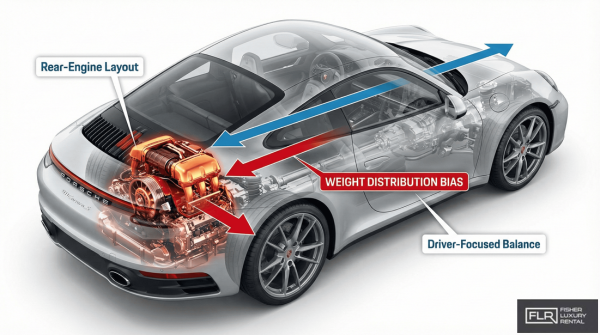
How Do Heritage, Motorsport, and Design Impact Porsche’s Image?
Heritage, motorsport, and design impact Porsche’s image by anchoring the brand in decades of competitive credibility and iconic styling. Porsche’s history stretches from the 356 in 1948 through over six decades of 911 evolution, creating a design lineage instantly recognizable worldwide. Motorsport victories at Le Mans, the Targa Florio, and in Formula E reinforce an engineering-first reputation that exotic rivals built through similar racing pedigree. According to Brand Finance’s 2025 ranking, Porsche holds the title of the world’s most valuable luxury and premium brand for the eighth consecutive year, with a brand value of $41.1 billion. That combination of racing heritage, evolutionary design consistency, and measurable brand equity positions Porsche alongside exotics in cultural prestige, even when production volume tells a different story.
With brand perception established, understanding what enthusiasts and owners actually say adds real-world perspective to Porsche’s classification.
What Do Car Enthusiasts and Owners Say About Porsche as an Exotic Brand?
Car enthusiasts and owners remain divided on Porsche’s exotic status. Online communities generally view specific models as exotic while classifying the broader brand as premium luxury, and regional preferences shape these opinions further.
How Do Online Communities and Forums View Porsche’s Exotic Status?
Online communities and forums view Porsche’s exotic status as model-dependent rather than brand-wide. Enthusiast discussions consistently draw a line between high-volume models like the Cayenne or Macan and limited-production vehicles like the 918 Spyder or 911 GT variants. Forum participants frequently argue that a brand delivering 279,449 vehicles globally in 2025 cannot be considered exotic in the same way as Ferrari or Lamborghini, which cap production at roughly 13,600 and 10,700 units respectively.
Still, sentiment shifts dramatically when specific trims enter the conversation. The J.D. Power 2025 U.S. APEAL Study ranked Porsche as the number one premium brand for the second consecutive year, with the 911 scoring highest among all models. This recognition reflects the strong emotional connection owners express online. Most enthusiasts land on a practical consensus: Porsche builds some genuinely exotic cars within a lineup that is, as a whole, too accessible and widely produced to earn the exotic label outright.
Are There Regional or Cultural Differences in These Opinions?
There are notable regional and cultural differences in how people perceive Porsche’s exotic credentials. In North America, where Porsche delivered 86,229 vehicles in 2025, the brand’s visibility on everyday roads makes it feel less rare. American enthusiasts tend to classify Porsche as a premium sports car brand, reserving “exotic” for lower-volume Italian and British marques.
European markets, by contrast, often emphasize Porsche’s motorsport heritage and engineering precision over raw exclusivity. The brand’s roots in Stuttgart and its decades of Le Mans dominance carry significant cultural weight that elevates its perceived status beyond production numbers alone. In emerging luxury markets across Asia and the Middle East, where brand prestige and price point heavily influence classification, Porsche frequently occupies a space closer to exotic territory simply because ownership remains aspirational for a larger share of the population. These cultural lenses explain why the same vehicle can be perceived as a daily luxury driver in Scottsdale and as an exotic statement piece in other parts of the world.
How Should You Experience the Exotic Appeal of Porsche with a Premium Rental?
You should experience the exotic appeal of Porsche by renting a top-trim model that delivers the brand’s full performance and luxury potential. The sections below cover how Fisher Luxury Rental elevates that experience and the key takeaways on where Porsche truly fits.
Can Renting a Top-Trim Porsche from Fisher Luxury Rental Enhance Your Exotic Car Experience?
Yes, renting a top-trim Porsche from Fisher Luxury Rental can enhance your exotic car experience by placing you behind the wheel of the brand’s most thrilling configurations without the commitment of ownership. Porsche’s broader pricing structure captures a wide segment of the luxury market, yet its top-trim models deliver the visceral performance and prestige that define an exotic encounter. Fisher Luxury Rental stocks only top-trim vehicles, including the Porsche 911 Carrera S, so every rental reflects the elevated end of the lineup. According to the J.D. Power 2025 U.S. APEAL Study, Porsche ranked as the number one premium brand for the second consecutive year, with the 911 scoring highest of any model. A rental lets you feel exactly why that emotional connection exists, one drive at a time.
What Are the Key Takeaways About Whether Porsche Is an Exotic Car and Where the Brand Truly Fits?
The key takeaways are that Porsche is best classified as a premium luxury sports car brand rather than a traditional exotic manufacturer. Its high production volumes and accessible entry-level pricing separate it from Ferrari, Lamborghini, and McLaren, yet its top-tier and limited-edition models rival the rarest exotics in performance, craftsmanship, and desirability. According to a study by iSeeCars, the Porsche 911 holds the lowest 5-year depreciation of any car model at just 19.5%, reflecting exceptional brand strength and reliability. For anyone curious about where that line between luxury and exotic blurs, renting a top-trim Porsche through Fisher Luxury Rental is the most direct way to decide for yourself.