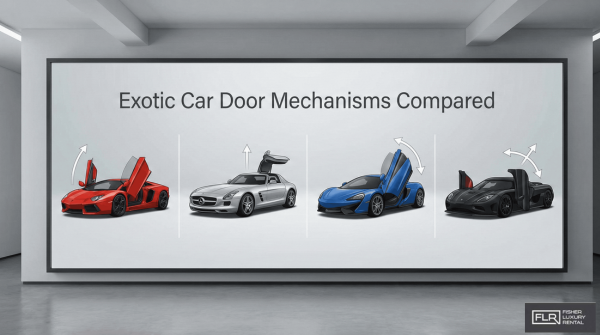
Exotic car doors are specialized entry systems engineered to solve specific design challenges in high-performance and luxury vehicles. Each type uses a distinct hinge placement and opening motion to address constraints like tight parking, low rooflines, wide chassis profiles, or aerodynamic demands.
This guide covers the major exotic door mechanisms, the engineering and history behind each design, additional unconventional styles, the reasons manufacturers choose these systems, and how to experience them firsthand through a luxury rental.
Scissor doors rotate vertically on a fixed hinge near the A-pillar, keeping the door within the car’s width as it sweeps upward. Lamborghini pioneered this design on the Countach in the early 1970s after Marcello Gandini first introduced the concept on the 1968 Alfa Romeo Carabo, and the mechanism remains a trademark of models like the Murciélago and Revuelto.
Gullwing doors hinge at the roofline and swing upward, a configuration Mercedes-Benz created for the 1952 300 SL because its tubular space frame made conventional doors impractical. Modern interpretations include Tesla’s double-hinged falcon-wing doors, which use ultrasonic sensors to adjust their arc in tight spaces.
Butterfly doors combine upward and outward motion through A-pillar hinges, offering wider openings than scissor doors while preserving a vehicle’s aerodynamic canopy. McLaren and Ferrari rely on this system across flagships like the P1, Senna, Enzo, and LaFerrari.
Beyond these three primary types, suicide (coach) doors open from rear-mounted hinges to create pillarless entryways on Rolls-Royce sedans, while Koenigsegg’s patented dihedral synchro-helix system sweeps doors outward and upward simultaneously, minimizing both vertical and horizontal clearance requirements. Swan doors and various concept designs push the boundaries even further.
These door systems exist because manufacturers balance engineering constraints, brand identity, safety regulations, and visual drama. We explore each mechanism in detail below so you can understand what sets every style apart.
What Makes Scissor Doors Unique Among Exotic Car Door Types?
Scissor doors are unique among exotic car door types because they rotate vertically from a fixed front hinge, staying within the vehicle’s width throughout their motion. Below, we cover their mechanical operation, the supercars that feature them, and their key advantages and disadvantages.
How Do Scissor Doors Operate Mechanically?
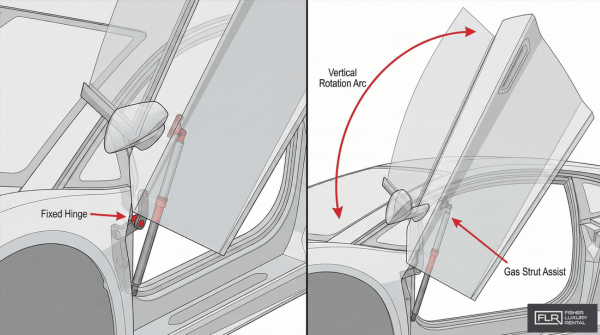
Scissor doors operate mechanically by rotating vertically around a fixed hinge located near the A-pillar. This hinge position allows the door to move straight up, remaining within the vehicle’s overall track width. Modern scissor doors are almost always power-assisted, utilizing gas-filled struts or nitrogen-charged pneumatic cylinders to counteract the door’s weight.
These systems are calibrated to provide balanced force throughout a typical 90-degree rotation. According to a 2025 Yahoo Autos report on supercar door types, some aftermarket systems offer up to a 130-degree opening angle for improved access. Because the hinge sits in a position analogous to a conventional door, engineers can more easily adapt the design for convertible variants.
Which Supercars Commonly Feature Scissor Doors?
Supercars that commonly feature scissor doors include a succession of Lamborghini flagship models, such as the Countach, Diablo, Murciélago, Reventón, and the modern Revuelto. Lamborghini has trademarked the design, making it central to the brand’s identity.
The concept originated on the 1968 Alfa Romeo Carabo, designed by Marcello Gandini at Bertone as a solution to extremely poor rear visibility. That practical innovation carried over to the Lamborghini Countach in the early 1970s, where the wide chassis and high sills made a vertically opening door the ideal engineering choice. For anyone curious about experiencing a Lamborghini’s scissor doors firsthand, a rental offers a more accessible path than ownership.
What Are the Pros and Cons of Scissor Doors?
The pros and cons of scissor doors reflect clear trade-offs between practicality and engineering cost. Key advantages and disadvantages include:
- Scissor doors excel in tight parking spaces because they do not swing outward.
- The front-hinge location allows compatibility with convertible model designs.
- Scissor doors reduce “dooring” risk to cyclists and allow the driver to operate the vehicle with the door open.
- Ceiling height in garages can restrict full vertical opening.
- Ingress and egress can be more difficult than with other door types due to high sills.
- Manufacturing costs for the specialized hinge mechanism are higher than for conventional doors.
- Emergency egress in a rollover event can be compromised.
Aftermarket scissor door conversion kits cost between $3,000 and $5,000 for professional installation, according to a 2022 Mid-Engine Corvette Forum discussion. For most enthusiasts, the factory-engineered system on a production supercar remains the safest and most reliable option.
Understanding scissor door mechanics sets the stage for comparing them against gullwing doors.
What Defines Gullwing Doors and Why Are They Famous?
Gullwing doors are roof-hinged panels that swing upward, mimicking a seagull’s outstretched wings. Their fame stems from dramatic aesthetics and engineering ingenuity across decades of iconic vehicles.
How Are Gullwing Doors Designed to Function?
Gullwing doors are designed to function through a roof-mounted hinge that allows each door to swing upward, often with a slight outward arc. This mechanism creates a large opening for easier ingress and egress, particularly in low-slung sports cars with high door sills. The original Mercedes-Benz 300 SL’s gullwing configuration was a direct engineering solution to its tubular space frame chassis, which made conventional doors impractical.
Tesla’s Model X evolved the concept further with double-hinged “falcon-wing” doors that articulate in two places. Ultrasonic sensors detect ceiling height and nearby obstacles, automatically adjusting the opening arc to avoid collisions. For anyone considering the exotic car experience, this sensor-equipped design represents how far gullwing engineering has advanced from purely mechanical roots.
Which Iconic Vehicles Use Gullwing Doors?
The iconic vehicles that use gullwing doors span seven decades of automotive history. The 1952 Mercedes-Benz 300 SL racing car was the first prominent application, with the production version arriving in 1954 to cement the design’s legendary status.
Notable gullwing-equipped vehicles include:
- Mercedes-Benz 300 SL (1954), the car that started it all
- Bricklin SV-1, an early successor in the 1970s
- DMC DeLorean, which famously resurrected the design in the 1980s
- Mercedes-Benz SLS AMG, a modern homage to the original 300 SL
- Tesla Model X, which brought falcon-wing doors to a family SUV
The Tesla Model X is particularly significant because it demonstrated gullwing-style doors in a family-oriented vehicle, expanding the design beyond high-performance sports cars. OEM gullwing installations typically command a premium of several thousand dollars, which contributes substantially to these vehicles’ sticker prices.

What Are the Advantages and Disadvantages of Gullwing Doors?
The advantages and disadvantages of gullwing doors reflect a clear set of engineering trade-offs between dramatic functionality and practical limitations.
| Feature | Advantages | Disadvantages |
| Parking | Requires minimal side clearance, ideal for tight spaces | Vertical clearance can be insufficient in low-ceilinged garages |
| Accessibility | Provides a large opening for easier entry and exit | Roof hinge eliminates convertible compatibility |
| Safety | Explosive bolts (SLS AMG) enable emergency egress | Rollover events can trap occupants if doors cannot open |
| Sealing | Standard when properly engineered | Water and snow sealing is more complex than conventional doors |
Among all exotic door types, gullwing doors offer arguably the best balance of tight-space parking ability and dramatic visual presence. However, the rollover entrapment risk remains their most serious drawback, one that only a few manufacturers have addressed with engineered failsafes. Understanding these trade-offs becomes especially valuable when comparing gullwing designs to butterfly doors, which handle clearance and accessibility quite differently.
How Do Butterfly Doors Differ from Other Exotic Door Styles?
Butterfly doors differ from other exotic door styles through their unique dual-axis hinge placement and combined upward-outward motion. The sections below cover their mechanism, the cars that use them, and their everyday practicality.
What Is the Mechanism Behind Butterfly Doors?
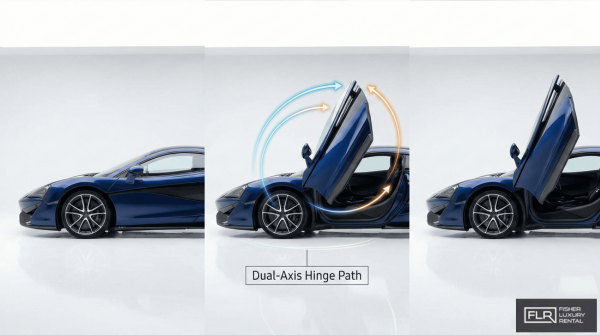
The mechanism behind butterfly doors is a dual-pivot hinge mounted along the A-pillar that moves the door both upward and outward simultaneously. This motion distinguishes them from scissor doors, which rotate vertically from a fixed bottom hinge, and gullwing doors, which swing upward from a roof-mounted hinge. Because the butterfly hinge must control travel on two axes, the engineering is inherently more complex.
According to Top Gear, the McLaren 12C advanced this mechanism by eliminating the top hinge, enabling frameless windows and making a convertible version feasible without compromising door function. For anyone who appreciates engineering elegance, this dual-axis system represents one of the most refined solutions in exotic car design.
Which Cars Typically Have Butterfly Doors?
Cars that typically have butterfly doors include flagship supercars and hypercars from McLaren and Ferrari. According to Top Gear, modern examples span the McLaren F1, P1, and Senna, alongside the Ferrari Enzo, LaFerrari, Mercedes-Benz SLR McLaren, and Maserati MC20.
The design’s origins trace back to the 1967 Alfa Romeo 33 Stradale, and it later proved its worth on Group C and IMSA GTP racing prototypes, where preserving the aerodynamic canopy during quick driver changes was a competitive advantage. The first mass-produced butterfly door car was the Toyota Sera, sold exclusively in Japan from 1990 to 1995. Today, butterfly doors signal a vehicle sits at the absolute peak of performance and exclusivity.
Are Butterfly Doors Practical for Everyday Use?
Butterfly doors are partially practical for everyday use, though they involve trade-offs compared to conventional doors. Key considerations include:
- Butterfly doors require more side clearance than scissor doors, making tight parking spots more challenging.
- The complex hinge mechanism demands regular maintenance, including hinge lubrication, gas strut inspection, and electronic sensor checks.
- Maintenance costs run significantly higher than for conventional doors, which partly explains why this design stays confined to the supercar segment.
Fisher Luxury Rental’s McLaren 720S provides an opportunity to experience this refined butterfly door mechanism firsthand, combining the dramatic visual impact with the practical accessibility advantages discussed here. For most drivers, the brief learning curve is well worth the dramatic experience these doors deliver when stepping out of a supercar.
What Are Additional Exotic Car Door Types Beyond Scissor, Gullwing, and Butterfly?
Additional exotic car door types beyond scissor, gullwing, and butterfly include dihedral synchro-helix doors, swan doors (suicide/coach doors), and various concept car designs. Each offers distinct engineering solutions and visual signatures.
What Are Dihedral Synchro-Helix Actuation Doors?
Dihedral synchro-helix actuation doors are a patented door system exclusively developed by Koenigsegg Automotive AB. The hinge mechanism sweeps the door outward and upward in a single fluid motion, rotating 90 degrees from closed to open. This articulation clears both the curb and the car’s body while minimizing vertical height requirements.
Christian von Koenigsegg conceived the system for the CC prototype in the mid-1990s, and according to a 2025 YouTube feature on Koenigsegg’s engineering, the Koenigsegg CC8S became the first production car equipped with these doors when it debuted in 2002. The design solved clearance limitations that plagued gullwing and scissor configurations. Every Koenigsegg produced since, from the Jesko to the Gemera, uses this system. For anyone who values engineering that refuses to accept conventional compromises, the dihedral synchro-helix door remains the most inventive production door mechanism ever built.

How Do Swan Doors Operate and Where Are They Used?
Swan doors, formally known as rear-hinged or coach doors, operate by swinging open from the front via hinges mounted at the rear edge of the doorframe. This reversal of conventional door orientation creates a wide, pillarless opening when paired with a front-hinged door.
Historically, rear-hinged doors appeared on vehicles like the Citroën Traction Avant and were common before World War II. According to eBay Motors, they were notoriously popular with gangsters in the 1930s because the design made it easier to push passengers from a moving vehicle. Today, Rolls-Royce has made coach doors a cornerstone of its design language, featuring them on the Phantom, Ghost, and Cullinan. Vehicles like the Mazda RX-8 and BMW i3 adapted smaller “freestyle” versions for rear-seat access in coupe-like bodies. Few door styles communicate luxury as immediately as the coach door.
What Other Unusual or Concept Car Door Designs Exist?
Other unusual or concept car door designs include the Vertical Lift System (VLS), hybrid-opening systems, and sensor-equipped smart doors. The VLS is a popular aftermarket scissor variant where the door opens slightly outward before moving upward, clearing the A-pillar and frame.
Future smart door concepts push even further. According to a 2026 report from Energies Media, engineers are addressing the “forgotten door” problem in autonomous vehicles through advanced sensor fusion and AI-powered control systems. Upcoming designs may recognize owners and open automatically, or adjust their angle based on proximity to obstacles. These innovations signal that exotic door engineering is evolving well beyond mechanical novelty into intelligent, adaptive systems.
With so many door types shaping the exotic car landscape, the reasoning behind each design reveals even more about their purpose.
Why Do Luxury and Exotic Cars Use These Unique Door Designs?
Luxury and exotic cars use unique door designs to solve engineering constraints, differentiate brands, and enhance the ownership experience. The reasons span performance, aesthetics, and safety considerations.
How Do Unique Door Types Enhance Performance or Aesthetics?
Unique door types enhance performance and aesthetics by reducing weight, preserving aerodynamic profiles, and creating unmistakable brand identity. Lightweight composite materials, such as carbon fiber, reduce door system mass and improve overall vehicle efficiency. Butterfly doors, for example, preserve the aerodynamic canopy of high-speed vehicles, while scissor doors keep the opening within the car’s track width.
Beyond function, these designs serve as powerful brand signatures. Lamborghini has trademarked its scissor door design and incorporated it across flagship models from the Diablo and Murciélago to the modern Revuelto, according to a 2025 report by Yahoo Autos. Suicide doors convey a unique, elegant look often associated with luxury and exclusivity. For most manufacturers in this segment, the door is not an afterthought; it is a defining statement that shapes how the entire vehicle is perceived.
Are There Safety or Accessibility Benefits to Exotic Car Doors?
There are both safety benefits and safety trade-offs with exotic car doors, depending on the design and installation quality. Factory-installed systems meet all federal safety standards, and insurance premiums for these vehicles are not typically higher than comparable models. However, vehicles modified with aftermarket kits may face higher premiums or claim denials, as modifications can compromise structural integrity, according to a 2026 report published by Alibaba.
Accessibility is one area where exotic doors genuinely excel. Suicide doors create large, pillarless openings for effortless rear-seat entry. Gullwing doors provide wide openings in low-slung sports cars. Dihedral synchro-helix doors minimize both horizontal and vertical clearance needs, making them practical in tight garages. That said, certain designs carry real risks: gullwing and scissor doors can be impossible to open in a rollover, and water and snow sealing grows more complex with roof-hinged mechanisms. Hybrid designs that blend elements of multiple systems are emerging, aiming to combine visual impact with superior functionality and safety.
How Should You Approach Choosing Exotic Car Door Styles with a Luxury Car Rental?
You should approach choosing exotic car door styles with a luxury car rental by balancing aesthetic goals with practical considerations such as weight, structural rigidity, safety, and cost. The following sections cover how Fisher Luxury Rental connects you to these experiences and the key takeaways from this guide.
Can Fisher Luxury Rental’s Vehicle Selection Help You Experience Exotic Car Doors?
Yes, Fisher Luxury Rental’s vehicle selection can help you experience exotic car doors firsthand. The fleet includes models from manufacturers known for distinctive door engineering, such as the McLaren 720S with its signature butterfly doors and the Lamborghini Huracan Spyder with its iconic scissor doors. Renting these vehicles offers a way to experience factory-installed exotic door systems without the commitment of ownership. According to a 2025 Boston Consulting Group report, the US luxury and exotic car market is projected to reach up to $215 billion by 2035, reflecting growing demand for these experiences. For most enthusiasts, renting remains the most practical path to sampling multiple door styles across different supercar brands.
What Are the Key Takeaways About Types of Exotic Car Doors: Scissor, Gullwing, Butterfly & More We Covered?
The key takeaways about types of exotic car doors are that each design solves specific engineering challenges while delivering a distinct visual identity. The core distinctions worth remembering include:
- Scissor doors pivot vertically from a fixed hinge near the A-pillar, staying within the vehicle’s width.
- Gullwing doors hinge at the roof and swing upward, requiring minimal side clearance.
- Butterfly doors hinge along the A-pillar and move both upward and outward, offering wider openings than scissor doors.
- Suicide doors use rear-mounted hinges to open from the front, creating large pillarless entryways.
- Dihedral synchro-helix doors sweep outward and upward in a single fluid motion, minimizing both horizontal and vertical clearance needs.
Every exotic door style represents a deliberate balance between form and function. Experiencing these systems through a luxury rental transforms abstract engineering knowledge into something visceral and memorable.