
Matrix LED headlights are advanced automotive lighting systems that use a grid of individually controlled LED segments to shape, direct, and adapt the beam pattern in real time without any mechanical movement.
This guide covers how the underlying technology works, the safety and comfort benefits these systems deliver, how they compare to xenon and laser alternatives, which vehicles offer them, and what to consider when renting a car equipped with this feature.
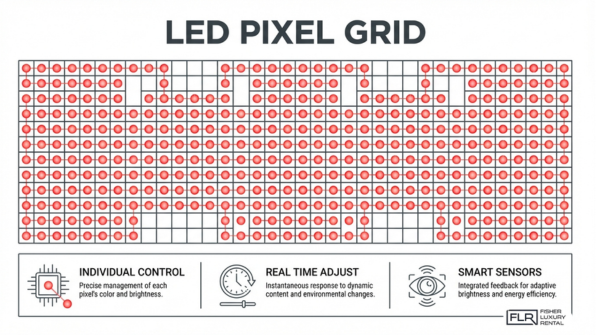
Each matrix headlight contains a 2D pixel array where individual LEDs activate or dim independently, guided by cameras and an electronic control unit that reads traffic conditions. This allows the system to maintain full high-beam illumination while carving out shadow zones around oncoming and preceding vehicles.
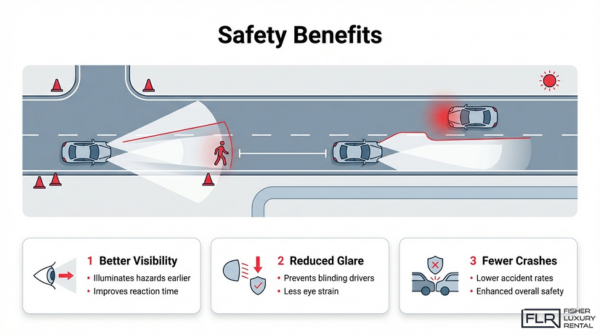
The safety gains are measurable. Adaptive beam systems increase forward visibility for the driver while simultaneously reducing glare for other road users, and vehicles with top-rated headlights show significantly fewer nighttime crashes involving pedestrians and single-vehicle collisions.
Compared to xenon, laser, and standard LED setups, matrix LEDs combine the energy efficiency of conventional LEDs with dynamic beam shaping that no fixed-reflector system can match. However, replacement costs for these assemblies can reach thousands of dollars per unit, and current adaptive driving beam regulations still present engineering constraints.
Matrix LED technology appears most often in luxury and performance vehicles from manufacturers like Audi, BMW, and Mercedes-Benz. For anyone exploring a rental through Fisher Luxury Rental, understanding this feature helps you appreciate the nighttime driving experience these cars provide.
How Do Matrix LED Headlights Work?
Matrix LED headlights work by using a grid of individually controlled LED segments that adjust brightness and direction in real time. The subsections below explain the underlying technology and how these systems differ from standard LED headlights.
What Is the Underlying Technology Behind Matrix LED Headlights?
The underlying technology behind matrix LED headlights is a 2D pixel grid of individually addressable LED segments managed by electronic controls. According to research from the University of Hannover published in IEEE ITS, matrix LED systems consist of a single rectangular LED light source divided into a 2D grid of pixels, where individual LED segments are electronically controlled to create dynamic areas of reduced and unreduced intensity without mechanical movement.
Each headlight unit relies on three core components:
- An array of pixel drivers that power individual LED segments independently.
- An Electronic Control Unit (ECU) that processes real-time data from onboard sensors.
- Smart sensor interfaces, including cameras, that detect oncoming vehicles and road conditions.
When sensors identify another vehicle, the ECU dims only the specific pixels aimed at that driver while keeping surrounding zones at full brightness. This precision, achieved entirely through electronics rather than mechanical shutters, is what separates matrix LED technology from older adaptive systems.
How Do Matrix LED Headlights Differ From Standard LED Headlights?
Matrix LED headlights differ from standard LED headlights in their ability to control individual light segments independently, whereas standard LED units illuminate as a single, fixed beam pattern. Standard LEDs offer improved efficiency and longevity over halogen bulbs, but they lack per-pixel adaptability.
Key differences include:
- Beam control: Standard LEDs switch between fixed high and low beams. Matrix LEDs selectively dim or brighten dozens of individual zones simultaneously.
- Glare management: Matrix systems create shadow corridors around detected vehicles. Standard LEDs rely on manual high-beam toggling.
- Cost: Replacement costs for advanced matrix LED assemblies can reach $6,000 to $12,000 on luxury models, while aftermarket standard LED units typically range from $200 to $600.
According to Taylor & Francis roadmapping research, LED headlight market penetration is expected to reach 50% by 2030 as manufacturers transition from halogen and HID systems to high-resolution active-matrix solutions. For most drivers, matrix LED technology represents a meaningful leap beyond standard LEDs because it actively responds to traffic conditions rather than relying on a single static output.
Understanding how these systems operate sets the stage for exploring their real-world safety and comfort benefits.
What Are the Main Benefits of Matrix LED Headlights?
The main benefits of matrix LED headlights are improved nighttime safety and enhanced driving comfort. These advantages stem from intelligent beam control that adapts in real time to surrounding traffic and road conditions.
How Do Matrix LED Headlights Improve Safety While Driving?
Matrix LED headlights improve safety while driving by maximizing illumination where it is needed most while preventing dangerous glare for oncoming traffic. Adaptive Driving Beam (ADB) systems increase forward visibility for the driver while simultaneously limiting glare to other road users through active beam modification, according to a 2022 NHTSA final rule analysis. Each LED segment deactivates independently around detected vehicles, so drivers maintain near-full high-beam coverage without blinding others. This selective dimming keeps peripheral hazards, such as pedestrians, cyclists, and road debris, visible at all times. For anyone driving unfamiliar roads after dark, this technology meaningfully reduces reaction time demands.
In What Ways Do Matrix LED Headlights Enhance Comfort and Visibility?
Matrix LED headlights enhance comfort and visibility by eliminating the need to manually toggle between high and low beams. The system reads traffic and ambient conditions continuously, adjusting light distribution so drivers can focus entirely on the road. Key comfort features include:
- Cornering light functions that illuminate curves before the vehicle fully enters the turn.
- Highway mode that narrows and extends the beam pattern for greater forward reach at speed.
- City mode that broadens illumination to cover sidewalks and intersections at lower speeds.
- Glare-free high beam that stays active around oncoming vehicles rather than switching off entirely.
Because the transition between lighting modes is seamless and automatic, eye fatigue from constant brightness changes drops significantly during extended nighttime drives. This hands-free adaptability makes matrix LED headlights one of the most practical comfort upgrades in modern vehicle lighting, particularly on long highway stretches or winding rural roads.
Understanding these benefits helps clarify how matrix LED headlights compare to older lighting technologies.
Are Matrix LED Headlights Better Than Other Headlight Technologies?
Matrix LED headlights are better than most other headlight technologies in adaptive capability, energy efficiency, and glare management. The following subsections compare them directly to xenon and laser alternatives, then address their limitations.
How Do Matrix LED Headlights Compare to Xenon and Laser Headlights?
Matrix LED headlights compare favorably to xenon and laser headlights across most practical driving scenarios, though each technology has distinct strengths.
Xenon (HID) headlights produce strong, broad illumination and were the first widely adopted adaptive systems. According to IIHS research, curve-adaptive HID headlights allow drivers to spot hard-to-see objects on dark, curvy roads approximately one-third of a second earlier than conventional fixed headlights. However, xenon units lack the pixel-level beam control that matrix LED systems provide, meaning they cannot selectively dim individual zones to prevent glare.
Laser headlights offer unmatched range, reaching up to 600 meters on high beam, roughly double the distance of conventional LED high beams. That range advantage is narrow in practice, since laser units are typically restricted to high-beam functions only and still require a separate low-beam source.
Matrix LED headlights combine several advantages that neither xenon nor laser can match individually:
- Pixel-level beam shaping that dims around oncoming traffic without switching off the high beam entirely.
- Significantly lower energy consumption, with typical LED lamps drawing approximately 12.5 to 15 watts versus much higher wattage for halogen and HID systems.
- No mechanical moving parts, reducing long-term maintenance needs.
- Full low-beam and high-beam functionality in a single integrated unit.
For most real-world conditions, matrix LED technology delivers the best balance of range, precision, and efficiency.

What Are the Potential Drawbacks or Limitations of Matrix LED Headlights?
The potential drawbacks of matrix LED headlights center on cost, complexity, and system reliability concerns. Replacement assemblies for luxury vehicles can reach $6,000 to $12,000 per unit, making collision or theft damage significantly more expensive than with conventional headlights.
Additional limitations include:
- Sensor dependency: the adaptive beam relies on cameras and software to detect other vehicles, and the system must default to a safe lower-beam state if those sensors fail.
- Intersection detection difficulty: existing adaptive driving beam systems struggle to accurately identify vehicles approaching from perpendicular orientations at intersections.
- Limited aftermarket availability: most matrix LED units are factory-integrated, leaving few retrofit options for older vehicles.
Despite these drawbacks, the safety and visibility gains often justify the premium for drivers who frequently travel at night. Understanding these trade-offs helps when evaluating vehicles equipped with this technology.
What Vehicles Typically Offer Matrix LED Headlights?
Matrix LED headlights are typically offered on luxury, performance, and premium vehicles from manufacturers such as Audi, BMW, Mercedes-Benz, and Porsche. Below, we cover which vehicle segments feature this technology and whether aftermarket installation is feasible.
Are Matrix LED Headlights Available on Luxury or Performance Cars?
Yes, matrix LED headlights are available on luxury and performance cars, where they are most commonly found as standard or optional equipment. Audi pioneered the technology with its digital matrix LED system; the Audi e-tron, for example, utilizes approximately 1.3 million micromirrors per headlight to project high-definition light patterns onto the roadway, according to the Audi MediaCenter. BMW, Mercedes-Benz, and Porsche also integrate matrix LED or adaptive driving beam systems across their lineups. These systems appear most frequently on mid-range and flagship models, including sedans, SUVs, and sports cars. Given that replacement assemblies for luxury vehicles can reach $6,000 to $12,000 per unit, automakers typically reserve full matrix capability for higher trim levels where buyers expect cutting-edge lighting performance.

Can Matrix LED Headlights Be Installed as an Aftermarket Upgrade?
Matrix LED headlights cannot be reliably installed as a true aftermarket upgrade on vehicles not originally equipped with the technology. The system requires factory-integrated components, including camera sensors, a dedicated electronic control unit, and vehicle-specific software calibration, that aftermarket kits do not replicate. While aftermarket LED replacement units are available at $200 to $600 per assembly, according to ShelfTrend’s auto parts market analysis, these products improve brightness but lack the pixel-level beam control that defines matrix functionality. Retrofitting genuine OEM matrix assemblies from a compatible model is technically possible on some platforms, yet it voids warranties and may conflict with regional lighting regulations. For drivers who want the full adaptive experience, choosing a vehicle that ships with factory matrix LED headlights remains the most practical path, and renting one offers a way to experience the technology firsthand.
How Should You Consider Matrix LED Headlights When Renting a Luxury or Exotic Car?
You should consider matrix LED headlights when renting a luxury or exotic car by evaluating the safety advantages, advanced visibility features, and premium technology included in higher-trim vehicles.
Can Fisher Luxury Rental Provide Vehicles Equipped With Matrix LED Headlights?
Yes, Fisher Luxury Rental can provide vehicles equipped with matrix LED headlights across its curated fleet of top-trim luxury and exotic cars. Fisher Luxury Rental stocks models from manufacturers like Audi, Porsche, Mercedes, and Lamborghini, all of which integrate advanced matrix LED systems into their flagship trims. These headlight assemblies represent serious engineering investment; replacement costs for some luxury models reach $6,000 to $12,000 per unit, according to industry retail data. That price reflects the sophistication inside each housing, where systems like those in the Audi e-tron use approximately 1.3 million micromirrors per headlight to project high-definition light patterns onto the road. Because Fisher Luxury Rental purchases only top-trim configurations, renters gain access to this caliber of lighting technology without absorbing ownership costs.
What Are the Key Takeaways About Matrix LED Headlights, Technology, and Benefits?
The key takeaways about matrix LED headlights, technology, and benefits center on three core advantages:
- Matrix LED systems divide a single light source into a 2D pixel grid, enabling electronically controlled zones of varying intensity without mechanical movement.
- Vehicles with top-rated headlights show 19% fewer nighttime single-vehicle crashes and 23% fewer nighttime pedestrian crashes, per IIHS visibility research.
- Adaptive beam shaping delivers maximum forward illumination while selectively dimming around oncoming traffic, combining safety with driving comfort.
For anyone considering a luxury rental, matrix LED headlights represent one of the most practical technology features to prioritize. Fisher Luxury Rental offers a fleet built around these premium specifications, letting you experience cutting-edge lighting firsthand on any reservation.