The supercar is a high-performance, limited-production vehicle that pushes the boundaries of speed, engineering, and design beyond what conventional sports cars achieve. Since the mid-20th century, supercars have served as rolling testbeds for automotive innovation, cultural icons of aspiration, and benchmarks for what road-going machines can accomplish.
This guide covers the origins of the supercar concept, the technological and design breakthroughs that shaped each generation, the defining eras from the 1960s through the present, the iconic brands and models that marked turning points, the cultural impact supercars have had on society and media, and how future innovation and premium driving experiences keep this legacy alive.
Early supercars emerged when postwar engineering ambition collided with a cultural appetite for speed and exclusivity. Vehicles with race-derived engines and radical layouts, like mid-mounted V12 powerplants, established the template that separated supercars from ordinary sports cars.
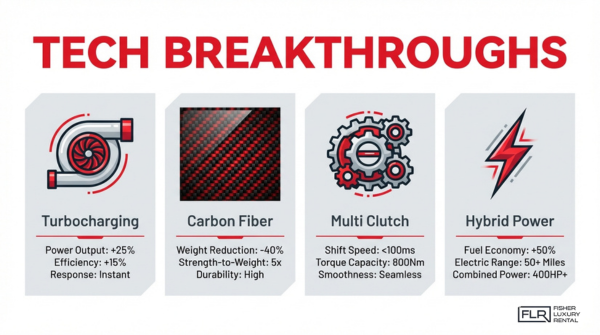
Each subsequent era introduced breakthroughs that redefined performance limits. Turbocharging, carbon fiber monocoques, active aerodynamics, and hybrid powertrains each pushed top speeds and acceleration figures into territory previously reserved for purpose-built race cars.
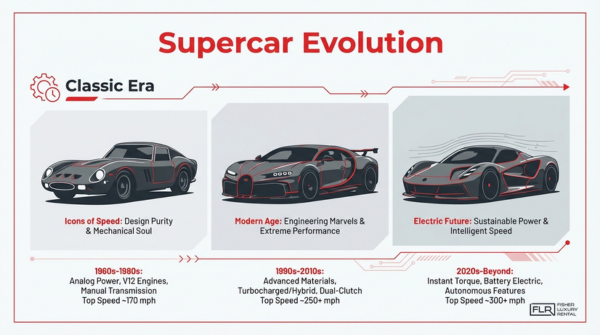
The progression from the 1960s through the 2000s reveals distinct chapters, each shaped by regulation, competition, and shifting buyer expectations. Specific models from Ferrari, Lamborghini, McLaren, Porsche, and Bugatti became era-defining landmarks that reset industry standards.
Beyond the track and the showroom, supercars have shaped film, media, and social identity, fueling collector communities, global events, and a status symbolism that extends well beyond horsepower figures.
Looking ahead, electrification, sustainable materials, and emerging technologies are rewriting the supercar formula, while premium rental services now offer direct access to both historic and modern icons for enthusiasts who want to experience that evolution firsthand.
How did the concept of the supercar originate?
The concept of the supercar originated from early 20th-century engineering ambition and mid-century cultural shifts that redefined automotive performance. The subsections below explore the earliest vehicles considered supercars and the factors that gave rise to the category.
What were the earliest vehicles considered supercars?
The earliest vehicles considered supercars were high-performance, limited-production machines that vastly exceeded the capabilities of standard automobiles. The 1935 Duesenberg SSJ stands among the first, equipped with a supercharged straight-eight engine producing a rated 400 horsepower, according to Conceptcarz. The 1954 Mercedes-Benz 300 SL Gullwing advanced the concept further with its mechanical direct fuel injection system developed by Bosch and iconic upward-opening doors; only 1,400 units were produced between 1954 and 1957. By the mid-1960s, the Lamborghini Miura P400 redefined expectations entirely, placing a 3.9-liter V12 transversely behind the cockpit. These cars shared a common thread: they pushed boundaries in power, engineering, and exclusivity that ordinary production cars simply could not match.

What technological or cultural factors led to the birth of supercars?
The technological and cultural factors that led to the birth of supercars included motorsport-derived engineering, postwar economic prosperity, and a growing public fascination with speed as spectacle. Formula 1 racing technology, as noted by the Harvard Digital Initiative, allowed manufacturers like Ferrari to develop proprietary engine technologies and lightweight carbon fiber components later adapted for road cars. Meanwhile, the cultural landscape played an equally powerful role. Academic research from the Journal of Social Science Development Research indicates that Western film culture used the car as a spectacle, evolving from 1960s cinema violence to the high-tech supercar representations of the 21st century. This convergence of track-tested innovation and cultural desire for automotive drama created fertile ground for the supercar as both a machine and a symbol.
With these origins established, the next section traces how supercars evolved in design and performance across subsequent decades.
How have supercars evolved in design and performance over time?
Supercars have evolved through successive leaps in powertrain technology, materials science, and aerodynamic design. The sections below examine the key technological advancements and the material innovations that drove this transformation.
What are the key technological advancements that shaped supercars?
The key technological advancements that shaped supercars include turbocharged engines, hybrid powertrains, advanced electronics, and active aerodynamics. Turbocharging entered the mainstream with cars like the Ferrari F40, while modern electrification has redefined what performance means entirely. On May 17, 2023, the Rimac Nevera set 23 performance records in a single day, according to the Rimac Newsroom, including a 0-60 mph time of 1.74 seconds and a 0-400-0 km/h run in 29.93 seconds.
Other critical advancements include:
- Carbon fiber monocoque chassis construction dramatically reduced weight while increasing rigidity.
- Multi-clutch automated transmissions replaced traditional manual gearboxes for faster shift times.
- Electronic stability and traction control systems made extreme horsepower figures safer to deploy on public roads.
Each generation built on the last, compressing what once took decades of progress into single model cycles.
How did materials, aerodynamics, and engineering influence supercar evolution?
Materials, aerodynamics, and engineering influenced supercar evolution by enabling higher speeds, greater safety, and sharper handling at lower vehicle weights. The shift from steel to aluminum, and then to carbon fiber composites, reshaped what a chassis could achieve structurally. Active aerodynamic elements, such as adjustable rear wings and underbody diffusers, allowed engineers to balance downforce with drag reduction at varying speeds.
Gordon Murray, designer of the McLaren F1, argues that modern supercar progress should focus on reducing mass and complexity, adhering to a “Design Manifesto” that prioritizes lightweight construction and driver-centric engineering, according to Gordon Murray Automotive. This philosophy remains deeply relevant; the most celebrated supercars have consistently been those where engineering restraint amplified the driving experience rather than buried it under unnecessary technology. Understanding these design principles reveals how defining eras emerged across supercar history.
What are the most important defining eras in supercar history?
The most important defining eras in supercar history span from the mid-engine revolution of the 1960s through the technology-driven hypercars of today. Each era introduced breakthroughs in power, materials, and engineering philosophy.
What distinguished supercars of the 1960s, 1970s, and 1980s?
Supercars of the 1960s, 1970s, and 1980s were distinguished by the shift to mid-engine layouts, rising horsepower, and the emergence of speed as a defining benchmark. The Lamborghini Miura P400, produced between 1966 and 1969, mounted its 3.9-liter V12 transversely behind the cockpit, producing 350 bhp at 7,000 rpm, according to The Lamborghini Registry. This layout became the supercar blueprint.
Through the 1970s, emission regulations and oil crises briefly tempered performance, yet manufacturers refined handling and aerodynamics. By the late 1980s, the Ferrari F40 shattered expectations as the first production car to officially break 200 mph. That milestone cemented raw speed as the supercar’s ultimate currency.
How did the 1990s and 2000s transform the supercar landscape?
The 1990s and 2000s transformed the supercar landscape by introducing advanced materials, electronic systems, and unprecedented power figures. The McLaren F1 pioneered a complete carbon fiber monocoque chassis, and on March 31, 1998, its XP5 prototype reached a two-way average top speed of 240.1 mph, setting a Guinness World Record.
The 2000s escalated further. The Bugatti Veyron 16.4, launched in 2005, featured an 8.0-liter W16 engine with four turbochargers producing 1,001 horsepower and 1,250 Nm of torque. Bugatti produced 450 Veyron units between 2005 and 2015. These machines redefined what “production car” meant, blurring the line between road vehicle and engineering showcase.
What characterizes the current era of supercars?
The current era of supercars is characterized by electrification, hybrid powertrains, and record-shattering acceleration. The Ferrari SF90 Stradale, introduced in 2019, combines a 780 cv V8 turbo engine with three electric motors for a total output of 1,000 cv, marking Ferrari’s first series-production plug-in hybrid.
Pure electric performance has reached astonishing levels. On May 17, 2023, the Rimac Nevera set 23 performance records in a single day, including a 0-60 mph time of 1.74 seconds. According to Technavio, the global supercar market is projected to increase by USD 11.93 billion between 2025 and 2030, driven largely by electrification and hybrid adoption. Understanding these eras reveals how each generation’s innovations shaped the supercars available today.
Which iconic brands and models have defined each era of supercars?
A handful of manufacturers and their groundbreaking models have defined each era of supercars. The sections below explore how leading brands shaped the industry and which specific models marked critical turning points.
How have brands like Lamborghini, Ferrari, McLaren, and Porsche influenced supercar history?
Brands like Lamborghini, Ferrari, McLaren, and Porsche have influenced supercar history by establishing performance benchmarks, pioneering new technologies, and creating cultural icons that redefined what road cars could achieve.
Ferrari’s influence runs especially deep. The transfer of Formula 1 racing technology has allowed Ferrari to develop proprietary engine technologies and lightweight carbon fiber components for road-going production vehicles, according to research from Harvard’s Digital Initiative. This motorsport pipeline gave Ferrari a lasting engineering advantage that few rivals could replicate.
Lamborghini challenged convention from the start, introducing the mid-engine layout with the Miura and building a brand identity around dramatic design. McLaren brought Formula 1 precision to the street with carbon fiber construction and aerodynamic innovation. Porsche, meanwhile, refined the rear-engine sports car into a platform capable of competing at the highest performance levels. Each brand carved a distinct philosophy, and collectively, they established the competitive rivalry that continues to push the supercar segment forward.
Which landmark supercar models marked turning points in the industry?
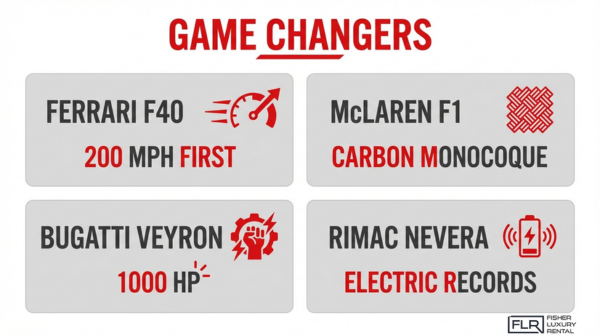
The landmark supercar models that marked turning points in the industry include vehicles that shattered speed records, introduced new construction methods, or redefined market expectations:
- The Ferrari F40, launched in 1987, became the first production car to officially break the 200 mph barrier, reaching 201 mph. Ferrari produced 1,311 F40 units between 1987 and 1992.
- The McLaren F1 was the first production road car to utilize a complete carbon fiber reinforced plastic monocoque chassis, setting a new standard for lightweight construction.
- The Bugatti Veyron 16.4 arrived in 2005 with an 8.0-liter W16 engine producing 1,001 horsepower, proving that four-figure power outputs were achievable in a road-legal car.
- The Rimac Nevera demonstrated electric supremacy by setting 23 performance records in a single day on May 17, 2023, including a 0 to 60 mph time of 1.74 seconds.
According to a Technavio market report, the global supercar market is projected to increase by USD 11.93 billion between 2025 and 2030, driven largely by electrification and hybrid powertrain adoption. Each of these models did not merely set records; they forced every competitor to rethink what was possible, resetting the baseline for the entire industry.
What cultural and social impacts have supercars had throughout their history?
Supercars have shaped popular culture, social identity, and community building since the mid-20th century. Their influence extends from film and media representation to global enthusiast networks.
How have supercars influenced popular culture, media, and status symbolism?
Supercars have influenced popular culture, media, and status symbolism by becoming enduring icons of aspiration, wealth, and technological achievement. From the earliest days of high-performance motoring, these machines transcended their role as transportation and entered the cultural imagination as symbols of success.
According to research published in the Journal of Social Science Development Research, Western film culture has historically used the car as a spectacle, evolving from the spectacle of violence in 1960s cinema to the high-tech supercar representations of the 21st century. This cinematic evolution mirrors the broader cultural shift in how society perceives these vehicles.
Beyond film, supercars permeate video games, music, fashion, and social media, where ownership signals both financial achievement and personal taste. Few consumer products carry the same cultural weight across so many domains simultaneously.
How do supercar events and clubs contribute to automotive communities?
Supercar events and clubs contribute to automotive communities by creating shared spaces where enthusiasts connect over a mutual passion for performance and engineering. Rallies, concours events, track days, and owners’ clubs transform individual ownership into collective experiences that strengthen the broader automotive culture.
These gatherings serve multiple roles: they preserve the heritage of classic models, introduce newer generations to automotive history, and foster networks that span local meets to international tours. For many participants, the community aspect proves as rewarding as the cars themselves. The bonds formed through these events often outlast any single vehicle in a collection, making the social fabric of supercar culture one of its most lasting contributions.
With cultural influence deeply woven into the supercar legacy, looking ahead reveals how innovation may reshape these traditions.
How might the future of supercars be shaped by innovation and changing trends?
The future of supercars will likely be shaped by sustainability demands, electrification, and emerging digital technologies. Below, we explore how electric powertrains and next-generation tech could redefine what a supercar is.
What role will sustainability and electric powertrains play in upcoming supercars?
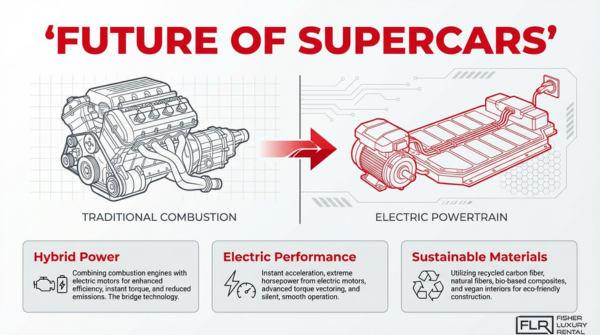
Sustainability and electric powertrains will play a central role in upcoming supercars, driving both performance benchmarks and market growth. The Ferrari SF90 Stradale, introduced in 2019, demonstrated this shift as the brand’s first series-production plug-in hybrid, combining a 780 cv V8 with three electric motors for a total output of 1,000 cv. Fully electric models have pushed even further. According to Technavio, the global supercar market is projected to increase by USD 11.93 billion between 2025 and 2030, driven largely by the acceleration of electrification and hybrid powertrain adoption. For manufacturers historically defined by combustion engines, this transition represents the most significant engineering pivot since the mid-engine revolution of the 1960s.
How could emerging technologies redefine the supercar experience?
Emerging technologies could redefine the supercar experience through advances in artificial intelligence, active aerodynamics, and connectivity. AI-driven chassis systems can now adjust suspension, torque distribution, and braking hundreds of times per second, tailoring the car’s behavior to road conditions and driving style in real time. Lightweight materials continue to evolve beyond carbon fiber, with graphene composites and 3D-printed titanium components enabling stronger, lighter structures. Augmented reality head-up displays and vehicle-to-infrastructure communication are also entering development pipelines. These innovations shift the supercar from a purely mechanical achievement to an integrated digital platform, though the visceral driving connection that defines the category will remain the ultimate measure of success.
How does experiencing a supercar through premium rental services connect enthusiasts with supercar history?
Experiencing a supercar through premium rental services connects enthusiasts with supercar history by placing them behind the wheel of the very machines that defined each era. The sections below cover how Fisher Luxury Rental provides that access and the key takeaways from supercar history.
How does Fisher Luxury Rental offer access to iconic and modern supercars for memorable driving experiences?
Fisher Luxury Rental offers access to iconic and modern supercars by maintaining a curated fleet that spans legendary nameplates, including the Lamborghini Huracan Spyder, Ferrari 488 Spider, McLaren 720S, and Porsche 911 Carrera S. Each model carries forward engineering philosophies that trace back decades.
When L.J.K. Setright popularized the term “supercar” in a 1967 CAR magazine article describing his 1,000-mile journey in a Lamborghini Miura, he captured exactly what makes driving these cars transformative: the visceral, personal connection between driver and machine.
Fisher Luxury Rental brings that same connection to Phoenix, Scottsdale, Portland, and Vancouver. Rather than reading about supercar history, enthusiasts can feel mid-engine balance, carbon fiber rigidity, and turbocharged power delivery firsthand. With a fleet built exclusively from top-trim models, every rental becomes a chapter in the supercar story you experience yourself.
What are the main takeaways about the origin, evolution, and defining eras of supercars?
The main takeaways about the origin, evolution, and defining eras of supercars center on three themes: relentless engineering innovation, cultural influence, and expanding accessibility.
- Supercars originated from early 20th-century engineering ambition, with pre-war machines like the Duesenberg SSJ pushing power boundaries before the Lamborghini Miura established the mid-engine template in the 1960s.
- Each defining era introduced breakthrough technology, from fuel injection and aerodynamic design to carbon fiber monocoques and hybrid powertrains.
- Western film culture elevated supercars from engineering achievements to cultural icons, transforming them into symbols of aspiration and spectacle across generations.
- The global supercar market is projected to grow by USD 11.93 billion between 2025 and 2030, according to Technavio, driven by electrification and hybrid powertrain adoption.
This growth signals that the supercar legacy is far from static. For enthusiasts eager to connect with that living history, premium rental services offer the most direct path from admiration to experience.