
Future exotic car technology encompasses the powertrain, digital, material, and design innovations transforming high-performance vehicles from 2026 onward. These advances are redefining what supercars can deliver in speed, efficiency, and driver experience.
This guide covers powertrain evolution, autonomous and driver-assistance systems, advanced materials and aerodynamics, connectivity and in-car digital technology, sustainability initiatives, next-generation customization, adoption challenges, and how to experience these innovations firsthand.
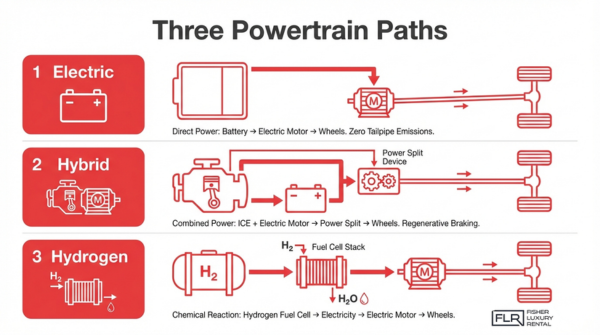
Powertrain development is splitting into three parallel paths: pure electric platforms delivering instant torque with expanding range, hybrid systems that pair combustion engines with electric motors for peak performance, and emerging hydrogen fuel cell drivetrains offering long-range capability with zero tailpipe emissions. Each approach gives exotic manufacturers a distinct strategy for balancing power output with efficiency targets.
Autonomous features and advanced driver-assistance systems are moving beyond lane-keeping into predictive, sensor-fused platforms that adapt to track and street driving alike. Software-defined vehicle architectures now allow over-the-air updates that continuously refine these capabilities after purchase.
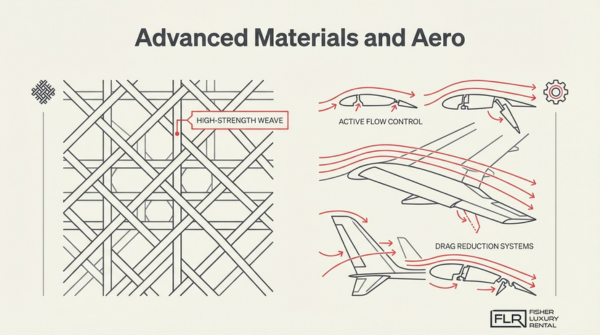
Lightweight carbon composites, large-format additive manufacturing, and active aerodynamic elements are collectively cutting drag and curb weight while increasing structural rigidity. These material and aero gains translate directly into faster lap times and improved efficiency.
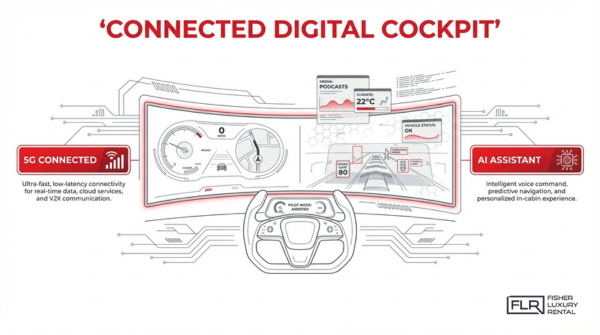
Connected digital cockpits, augmented reality head-up displays, and 5G-enabled services are turning exotic car cabins into immersive command centers. Paired with AI-driven configurators, buyers can now personalize vehicles at a granular level previously reserved for coachbuilt commissions.
Sustainability pressures, regulatory hurdles, and rising complexity present real challenges to adoption. We also explore how exotic car rental services give drivers a direct path to experience these technologies without long-term commitment.
Which Breakthrough Engine and Powertrain Innovations Are Expected in Exotic Cars by 2026?
The breakthrough engine and powertrain innovations expected in exotic cars by 2026 span electric powertrains, advanced hybrid systems, and emerging hydrogen fuel cell technology. Each approach reshapes how high-performance vehicles deliver speed, range, and efficiency.
How Are Electric Powertrains Transforming Exotic Vehicles?
Electric powertrains are transforming exotic vehicles by delivering instant torque, near-silent acceleration, and zero tailpipe emissions without sacrificing top-tier performance. Brands like Porsche, Ferrari, and Lamborghini now engineer dedicated electric architectures that prioritize both driving dynamics and usable range.
Range prediction remains a critical engineering challenge. According to the Institution of Engineering and Technology, computer simulation tools for plug-in hybrids and pure electric vehicles are critical for accurate range prediction, which serves as a key market qualifier under new testing standards such as the World Light Test Procedure. For exotic car buyers, verified range figures can make or break a purchase decision, making these simulation advances essential for building consumer confidence in electric supercars.
What Role Will Hybrid Systems Play in High-Performance Automotive Engineering?
Hybrid systems will play a central role in high-performance automotive engineering by combining combustion power with electric assist for sharper throttle response and improved efficiency. This dual-source approach lets exotic manufacturers preserve the visceral engine character buyers expect while meeting tightening emissions regulations.
Most flagship supercars arriving by 2026 use some form of hybridization:
- Plug-in hybrid layouts add electric-only city driving modes alongside track-capable combustion output.
- Mild-hybrid systems recover braking energy to supplement acceleration without adding significant weight.
- Performance-focused hybrids use electric motors on the front axle to enable torque-vectoring all-wheel drive.
For exotic car enthusiasts, hybrid technology is no longer a compromise. It is a genuine performance multiplier that enhances what a combustion engine can achieve on its own.
Will Hydrogen or Alternative Fuels Become Important for Exotic Cars?
Hydrogen and alternative fuels will become increasingly important for exotic cars, though adoption remains in its early stages compared to battery-electric and hybrid systems. Hydrogen fuel cells offer rapid refueling and long range, two attributes that align well with the grand touring character of many exotic vehicles.
According to a 2024 valuation published in Springer’s Current Sustainable/Renewable Energy Reports, the hydrogen fuel cell vehicle market reached an estimated USD 2.1 billion. Infrastructure limitations, particularly the scarcity of hydrogen refueling stations, currently restrict widespread exotic car applications. However, as fueling networks expand and fuel cell stacks become lighter and more powerful, hydrogen could complement battery-electric platforms in the next generation of high-performance vehicles.
With powertrain technology advancing across electric, hybrid, and hydrogen platforms, the next frontier involves intelligent software that manages these systems in real time.
How Will Autonomous and Advanced Driver-Assistance Features Impact Exotic Cars?
Autonomous and advanced driver-assistance features will impact exotic cars by redefining the balance between driver engagement and automated convenience. The following sections explore upcoming ADAS technologies and the implications of full autonomy.
What New ADAS (Advanced Driver-Assistance Systems) Are Likely to Appear in Luxury Supercars?
New ADAS likely to appear in luxury supercars include predictive collision avoidance, AI-powered adaptive cruise control, and automated parking systems tailored for low-clearance vehicles. Sensor fusion combining LiDAR, radar, and high-resolution cameras will enable real-time environmental mapping at speeds exceeding 200 mph. Supercars present unique engineering challenges for these systems because extreme acceleration rates and aerodynamic profiles demand faster processing and more precisely calibrated responses than standard vehicles require. For exotic car enthusiasts, the most compelling ADAS developments will be those that enhance safety without dulling the visceral driving experience these machines are built to deliver.
How Might Fully Autonomous Driving Change the Exotic Car Experience?
Fully autonomous driving might change the exotic car experience by shifting the owner’s role from active pilot to optional participant. According to the National Institute of Standards and Technology (NIST), there are five levels of driving automation, where Level 1 is considered “driver assistance” and Level 5 is fully driven independent of the human in all conditions. Most current supercars operate at Level 2, blending partial automation with hands-on control.
A Level 5 exotic car would raise fundamental questions about purpose. Much of a supercar’s value lies in driver engagement: the steering feel, throttle response, and braking precision that connect human intention to mechanical output. Full autonomy could transform long-distance grand touring while preserving manual modes for spirited driving on track days. The brands most likely to succeed will offer selectable autonomy, letting owners toggle seamlessly between full control and hands-free cruising depending on context.
With driver-assistance systems evolving rapidly, the materials and aerodynamics underlying these platforms are advancing just as fast.
What Cutting-Edge Materials and Aerodynamic Advances Are Anticipated?
Cutting-edge materials and aerodynamic advances anticipated for exotic cars center on lighter composites, novel manufacturing methods, and active airflow systems that reshape performance and efficiency.
How Will Lightweight Carbon Composites and Emerging Materials Influence Performance?
Lightweight carbon composites and emerging materials will influence performance by reducing vehicle mass, increasing structural rigidity, and enabling higher power-to-weight ratios. For affluent buyers who demand exclusivity, the curation of high-end materials defines both refinement and measurable driving capability, according to a 2023 MDPI analysis of luxury car data.
Beyond traditional carbon fiber, large-format additive manufacturing with metallic materials is reshaping how automakers produce complex, large-scale components directly from digital designs while cutting material waste. These advances allow exotic car engineers to create geometries previously impossible with conventional tooling. When paired with next-generation resin systems and nano-reinforced polymers, the result is a chassis that feels stiffer through corners yet weighs significantly less than aluminum equivalents.
Which Innovative Aerodynamics and Active Systems Will Be Used in Exotic Cars?
The innovative aerodynamics and active systems used in exotic cars will include active rear diffusers, deployable fairings, adaptive spoilers, and digitally controlled airflow channels. A 2022 study published in Scientific Reports found that combined aerodynamic modifications, such as rear diffusers and fairings, reduced a vehicle’s drag coefficient from 0.4 to 0.352, representing a 12% improvement.
Active aerodynamic systems go further by adjusting in real time. Sensors feed data to onboard computers that reposition flaps, lower ride height, and redirect cooling airflow based on speed, cornering load, and ambient conditions. This dynamic approach means a supercar can prioritize low drag on highways for efficiency, then shift to maximum downforce entering a tight curve. For drivers who want to feel the difference between passive and active aero firsthand, renting a late-model exotic offers the most direct comparison. Fisher Luxury Rental’s fleet in Phoenix and Portland includes vehicles like the McLaren 720S and Ferrari 488 Spider, which showcase active aerodynamic systems that adjust dynamically based on driving conditions.
What Connectivity, Infotainment, and In-Car Tech Will Be Available in 2026?
Connectivity, infotainment, and in-car tech available in 2026 will center on software-defined vehicle platforms, ultra-fast wireless networks, and immersive digital cockpits. The following subsections cover 5G connected services and augmented reality driver interfaces.
Will 5G and Connected Services Enhance Exotic Car Enjoyment?
Yes, 5G and connected services will enhance exotic car enjoyment by enabling real-time data streaming, over-the-air updates, and seamless cloud integration at speeds that current 4G LTE networks cannot match. Low-latency 5G connections allow exotic vehicles to receive instant navigation rerouting, live track telemetry, and remote diagnostics without perceptible delay.
According to the IEEE Standards Association, the shift toward software-defined vehicles is accelerating, with technical evolution showcased through the 2026 IEEE SA Ethernet & IP @ Automotive Technology Day. This push means exotic cars will function increasingly as connected platforms, where performance tuning, suspension calibration, and infotainment preferences update wirelessly.
For drivers accustomed to peak performance, always-on connectivity transforms the cabin into an extension of their digital lives while preserving the visceral thrill of the drive.
How Are Digital Cockpits and Augmented Reality Changing Driver Interaction?
Digital cockpits and augmented reality are changing driver interaction by replacing analog gauges with adaptive, context-aware displays that overlay critical driving data directly onto the windshield. Head-up AR projections can highlight apex lines on a track, flag pedestrian hazards, or display navigation cues without requiring drivers to look away from the road.
Modern exotic vehicles now integrate pillar-to-pillar curved screens, haptic feedback steering wheels, and voice-activated AI assistants into a unified cockpit ecosystem. These systems learn individual driver preferences over time, adjusting display layouts, ambient lighting, and seat positioning automatically upon entry.
The result is a cockpit experience that feels less like operating a machine and more like interacting with an intelligent co-pilot, one that adapts in real time to both driving conditions and personal taste. With digital cockpits maturing rapidly, the next frontier involves sustainability choices that shape how these technologies are manufactured.
How Will Sustainability and Eco-Friendly Initiatives Shape Exotic Car Design?
Sustainability and eco-friendly initiatives will shape exotic car design by driving adoption of greener manufacturing processes, closed-loop material strategies, and carbon-neutral production goals. The following subsections cover breakthroughs in sustainable manufacturing and how brands tackle battery recycling and carbon offsetting.

Are There Breakthroughs in Sustainable Manufacturing for Supercars?
Yes, there are breakthroughs in sustainable manufacturing for supercars, particularly through large-format additive manufacturing and bio-based composites. According to a Wiley publication on large-format additive manufacturing (LFAM), metallic LFAM is reshaping production of large-scale automotive components by enabling complex geometries directly from digital designs while significantly reducing material waste. This process eliminates traditional tooling, cutting both energy consumption and raw material surplus during fabrication.
Beyond additive methods, several manufacturers now integrate recycled carbon fiber and plant-derived resins into body panels and interior elements. These materials maintain the strength-to-weight ratios that supercars demand while shrinking environmental footprints. For high-performance brands where every gram matters, sustainable manufacturing is no longer a compromise; it is a competitive advantage that aligns engineering precision with environmental responsibility.
How Are Exotic Car Brands Addressing Battery Recycling and Carbon Offsetting?
Exotic car brands are addressing battery recycling and carbon offsetting through closed-loop recycling programs, lifecycle carbon accounting, and verified offset partnerships. As electrified powertrains become standard in the luxury segment, responsible end-of-life battery management has moved from optional initiative to brand imperative.
Key strategies include:
- Closed-loop battery recycling recovers lithium, cobalt, and nickel from spent cells for reuse in new battery packs.
- Second-life applications repurpose degraded EV batteries as stationary energy storage units at manufacturing facilities.
- Verified carbon offset programs fund reforestation or renewable energy projects to neutralize production emissions.
- Lifecycle carbon audits track total emissions from raw material extraction through vehicle delivery, enabling transparent sustainability reporting.
Given that the market penetration rate of new energy vehicles has now surpassed 50% according to a Springer Nature analysis, the pressure on exotic brands to match mainstream EV sustainability standards will only intensify. Brands that build recycling infrastructure early will differentiate themselves as environmental stewardship becomes a deciding factor for affluent buyers.
With sustainability now embedded in how exotic cars are built and powered, the next frontier is how buyers personalize these vehicles to reflect individual taste.
What Will Next-Gen Customization and Personalization Look Like in Exotic Cars?
Next-gen customization and personalization in exotic cars will combine AI-driven digital tools with deeply bespoke physical engineering. Below, we explore how configurators and tailored manufacturing are evolving for 2026 models.
How Will Digital Configurators and Bespoke Engineering Evolve for 2026 Models?
Digital configurators and bespoke engineering will evolve for 2026 models through AI-powered personalization platforms, real-time 3D visualization, and manufacturing processes that translate digital designs directly into physical components. Buyers will interact with immersive configurators that simulate materials, colors, and performance tuning before production begins.
Several advances are driving this shift:
- AI algorithms analyze owner preferences to suggest unique trim, interior, and performance combinations.
- Real-time rendering engines let clients preview their exact specification under different lighting and driving conditions.
- Large-format additive manufacturing with metallic materials enables complex, one-off components built directly from digital designs while reducing material waste, according to a study published by Wiley.
- Over-the-air software updates allow owners to personalize driving modes, suspension settings, and cockpit layouts long after taking delivery.
This level of personalization reflects a broader industry pattern. Luxury car data analysis, as noted by MDPI’s Data journal, targets affluent individuals who seek exclusivity, where the curation of high-end materials and performance optimization define modern refinement. For exotic manufacturers, bespoke engineering is no longer limited to paint and leather swatches; it now extends to software-defined vehicle architecture that owners can reconfigure at will.
In practice, this means the distinction between “factory spec” and “custom build” is disappearing. Brands that master digital-to-physical personalization pipelines will set the benchmark for 2026 and beyond. Understanding these customization capabilities helps frame the regulatory and cost challenges that come with adopting such technologies.
What Are the Limitations and Potential Challenges for Adopting New Exotic Car Technologies?
The limitations and potential challenges for adopting new exotic car technologies include evolving regulatory frameworks and the significant costs tied to cutting-edge engineering. These hurdles affect manufacturers and owners alike.
What Regulatory Hurdles Might Affect Technological Innovation?
Regulatory hurdles that might affect technological innovation include emissions standards, autonomous driving legislation, and international certification requirements. Governments worldwide are tightening environmental mandates, which forces exotic car manufacturers to redesign powertrains on compressed timelines. Autonomous driving faces a fragmented legal landscape; according to the National Institute of Standards and Technology (NIST), there are five levels of driving automation, where Level 1 is “driver assistance” and Level 5 is fully autonomous in all conditions. Most jurisdictions have not yet established clear rules for vehicles operating above Level 2, creating uncertainty for brands investing in higher-level systems. Type approval processes also vary between regions, so a feature legal in one country may require costly re-engineering elsewhere. For exotic manufacturers producing limited volumes, these compliance burdens consume a disproportionate share of development budgets.
How Might Costs and Maintenance Complexity Impact Exotic Car Owners?
Costs and maintenance complexity impact exotic car owners through higher purchase prices, specialized servicing requirements, and expensive component replacements. Advanced hybrid powertrains, software-defined architectures, and active aerodynamic systems each add layers of engineering that demand trained technicians and proprietary diagnostic tools. According to Boston Consulting Group, the US market for vehicles priced at or above $100,000 is projected to grow at a 5% to 7% compound annual rate through 2035, reaching $180 billion to $215 billion. That growth signals strong demand, yet it also reflects escalating vehicle complexity and pricing. Over-the-air software updates can introduce new capabilities but may also create unexpected compatibility issues. For many enthusiasts, renting provides a practical way to experience these technologies without bearing the full weight of long-term ownership costs. Fisher Luxury Rental serves the Phoenix and Portland markets with exotic vehicles including the Lamborghini Huracan Spyder and Porsche 911 Carrera S, allowing drivers to evaluate cutting-edge automotive engineering firsthand.
How Can You Experience the Latest Exotic Car Technologies with Fisher Luxury Rental’s Fleet?
You can experience the latest exotic car technologies with Fisher Luxury Rental’s fleet by renting cutting-edge vehicles that showcase modern performance, connectivity, and engineering innovations. The sections below cover how renting provides hands-on access to new innovations and the key takeaways shaping exotic car technology through 2026 and beyond.
Can Renting an Exotic Car from Fisher Luxury Rental Let Customers Try the Newest Innovations?
Yes, renting an exotic car from Fisher Luxury Rental can let customers try the newest innovations firsthand. Fisher Luxury Rental maintains a fleet of top-trim models, including the Lamborghini Huracan Spyder, McLaren 720S, Ferrari 488 Spider, and Porsche 911 Carrera S. Renting removes the commitment of purchasing while delivering full access to the latest powertrain engineering, active suspension tuning, and infotainment platforms. For anyone curious about how next-generation performance technology feels behind the wheel, a rental offers the most practical path to a real-world evaluation.
What Are the Key Takeaways About Future Exotic Car Technologies for 2026 and Beyond?
The key takeaways about future exotic car technologies for 2026 and beyond center on rapid convergence across electrification, software integration, advanced materials, and sustainability:
- Electric and hybrid powertrains are becoming standard in high-performance segments, with new energy vehicle market penetration already surpassing 50%.
- Software-defined vehicle architectures are transforming how exotic cars receive updates, personalize driver settings, and integrate connectivity features.
- Lightweight composites and aerodynamic optimization continue to push performance boundaries while improving efficiency.
- Hydrogen fuel cell technology is expanding range possibilities; the 2026 Toyota Mirai, for example, delivers an EPA-estimated 402 miles of driving range according to Toyota’s newsroom.
- Sustainability initiatives, from manufacturing processes to battery recycling, are reshaping how supercar brands design and build vehicles.
These shifts mean that every year brings measurably different driving experiences to the exotic car segment. Fisher Luxury Rental regularly updates its fleet, giving customers a way to stay current with evolving automotive technology without long-term ownership.