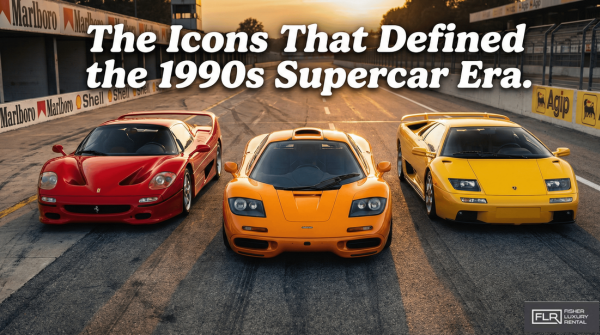
The best 1990s supercars are high-performance vehicles from manufacturers like McLaren, Ferrari, Lamborghini, Porsche, and Bugatti that combined unprecedented engineering ambition with Formula 1 technology transfer to permanently redefine what a road car could achieve.
This guide covers the iconic models and their standout specifications, the technical innovations that changed the automotive industry, the brands that led the decade’s supercar revolution, how these machines compare to modern hypercars, their lasting cultural impact, and how we can still experience their thrill today.
Cars like the McLaren F1, Ferrari F50, and Lamborghini Diablo each represented a distinct performance philosophy. The F1 used a full carbon fiber monocoque and a naturally aspirated BMW V12 producing 618 horsepower to reach 240 mph; the F50 bolted its V12 directly to the chassis as a stressed member, mirroring genuine F1 construction; and the Diablo evolved across an 11-year production run from 485 to 575 horsepower.
These vehicles pioneered technologies we now consider standard. Carbon fiber chassis construction, sequential twin-turbocharging, active aerodynamics, and electronically controlled all-wheel drive all trace directly to 1990s supercar programs, particularly the Porsche 959 and McLaren F1.
Their influence reached far beyond engineering. Video games like Gran Turismo and Need for Speed, magazine cover tests, and Le Mans victories embedded these cars into a generation’s identity, fueling a collector market where values have appreciated by hundreds, even thousands, of percent.
Despite modern hypercars doubling their power figures, the raw, analog driving experience of 1990s supercars commands a growing premium. Today’s exotic car rental market allows enthusiasts to experience vehicles that carry this same legacy of performance, design, and exclusivity.
Which Iconic 1990s Supercars Are Most Revered by Enthusiasts Today?
The most revered 1990s supercars today include the McLaren F1, Ferrari F50, Lamborghini Diablo, Porsche 959, Bugatti EB110, and Jaguar XJ220. Their lasting appeal comes down to standout performance specifications and design philosophies that still influence supercar development.
What Features and Performance Specs Set These 1990s Supercars Apart?
The features and performance specs that set these 1990s supercars apart were naturally aspirated power, lightweight construction, manual transmissions, and top speeds that remained competitive for decades. Each model pursued a distinct engineering philosophy, yet all shared a commitment to raw, unassisted driver engagement.
Key specifications that defined the era’s best:
- The McLaren F1 produced 618 hp from a BMW S70/2 V12, hit 240.1 mph, and weighed just 1,138 kg thanks to the first full carbon fiber monocoque in a production road car.
- The Ferrari F50 bolted its 513 hp V12 directly to a carbon fiber tub as a stressed member, replicating Formula 1 chassis architecture in a street-legal machine.
- The Lamborghini Diablo evolved from 485 hp to 575 hp across its production run, introducing the VT all-wheel-drive system and iconic scissor doors.
- The Porsche 959 delivered 444 hp through sequential twin-turbocharging and an electronically controlled PSK all-wheel-drive system that varied torque distribution in real time.
- The Bugatti EB110 used four turbochargers on a 3.5L V12, producing up to 603 hp in Super Sport form with an Aérospatiale-built carbon fiber chassis.
- The Jaguar XJ220 reached 217 mph with a twin-turbocharged V6 derived from Group C racing.
What makes these specs remarkable is context. Every car relied on mechanical precision rather than electronic safety nets, demanding genuine skill from the driver. That analog purity is precisely what separates them from modern equivalents and sustains their reverence among collectors.

How Did Design Trends of the 1990s Influence Supercar Development?
Design trends of the 1990s influenced supercar development by establishing engineering templates that manufacturers still follow today. Carbon fiber construction, active aerodynamics, and Formula 1 technology transfer all originated as 1990s supercar innovations and became standard across the industry.
Gordon Murray’s lightweight philosophy for the McLaren F1, prioritizing power-to-weight ratio over raw horsepower, directly inspired the GMA T.50 and a generation of lightweight performance cars. Ferrari’s approach with the F50, adapting race-derived engines and chassis techniques for road use, created a blueprint the company has repeated with the Enzo, LaFerrari, and F80. The Porsche 959’s PSK all-wheel-drive system evolved into the PTM system used in every 911 Turbo since, while also influencing torque-vectoring systems at Audi, BMW, and Mercedes-Benz. As Hagerty UK noted in 2024, “the F1 is arguably the greatest of the lot,” reflecting how strongly these design principles still resonate.
Beyond individual technologies, the 1990s proved that supercar development could push boundaries without electronic driver aids, a lesson that continues shaping how enthusiasts evaluate automotive greatness today.
How Did 1990s Supercars Impact Automotive Culture and Technology?
1990s supercars impacted automotive culture and technology by pioneering engineering breakthroughs that became industry standards and by embedding themselves into popular media that shaped an entire generation’s aspirations. The following sections cover the key innovations and the cultural influence these vehicles achieved.
What Innovations Originated from 1990s Supercars That Shaped the Industry?
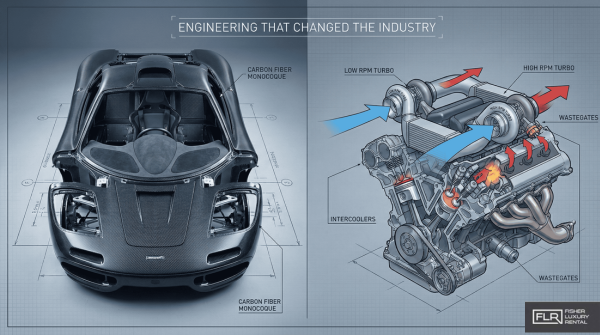
The innovations that originated from 1990s supercars and shaped the industry include carbon fiber monocoque construction, sequential twin-turbocharging, active aerodynamics, and electronically controlled all-wheel drive. The McLaren F1 introduced the first full carbon fiber monocoque chassis in a production road car, a structure that was lighter, stiffer, and stronger than any steel or aluminum alternative. The Porsche 959 pioneered sequential twin-turbocharging, eliminating turbo lag by spooling a smaller turbocharger at low revs before a larger unit engaged at higher speeds. Its PSK all-wheel-drive system continuously varied torque distribution between axles, forming the direct ancestor of Porsche Traction Management used in the 911 Turbo today. Meanwhile, the Bugatti EB110’s chassis, manufactured by aerospace firm Aérospatiale, demonstrated that aircraft-grade composite fabrication could serve automotive applications. These technologies now appear across the entire performance car spectrum, from entry-level sports cars to modern hypercars.
How Did These Vehicles Influence Popular Media and Car Enthusiasts?
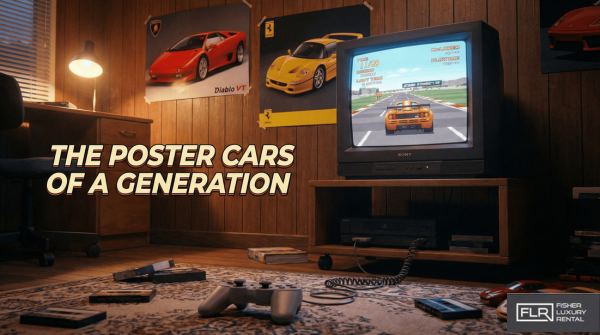
These vehicles influenced popular media and car enthusiasts by dominating cinema, video games, and automotive journalism throughout the decade. The Lamborghini Diablo appeared in films such as Dumb and Dumber (1994) and countless music videos, while the McLaren F1 GTR’s victory at the 1995 24 Hours of Le Mans cemented the F1’s legend beyond the showroom. According to a 2025 Petrolicious analysis, “the explosion of interest in 1990s supercars” traces directly to the generation that experienced them first through screens. The original Gran Turismo (1997) featured the McLaren F1 as one of its most coveted cars, and the Need for Speed series showcased the Diablo, Ferrari F512M, and Porsche 911 Turbo to millions of players worldwide. Pre-internet car magazines like Autocar, Car and Driver, and Road & Track further mythologized these machines through landmark comparison tests. That emotional imprint now drives both collector demand and a lasting enthusiasm for analog, driver-focused performance.
With their cultural footprint firmly established, understanding which brands led this revolution reveals how competition fueled the era’s greatest achievements.
Which Brands Led the 1990s Supercar Revolution and Why?
Lamborghini, Ferrari, McLaren, and Porsche led the 1990s supercar revolution by each pursuing a distinct engineering philosophy that collectively redefined performance standards. Other brands, including Bugatti and Jaguar, added further depth to the decade’s legacy.
What Role Did Lamborghini, Ferrari, McLaren, and Porsche Play in the 1990s?
Lamborghini, Ferrari, McLaren, and Porsche each played a defining role in the 1990s by anchoring the decade’s supercar revolution around four fundamentally different approaches to performance.
- Lamborghini produced the Diablo, the decade’s longest-running and most commercially successful supercar, with approximately 2,900 units built across multiple variants featuring V12 power and iconic scissor doors.
- Ferrari created the F50, bolting an F1-derived V12 directly to a carbon fiber monocoque as a stressed member, transferring Grand Prix technology to the road with minimal compromise.
- McLaren delivered the F1, the first production car with a full carbon fiber monocoque chassis, producing 618 hp from a naturally aspirated BMW V12 and reaching 240.1 mph.
- Porsche pioneered the 959’s PSK electronically controlled all-wheel-drive system and sequential twin-turbocharging, technologies that became the foundation for modern performance drivetrains.
According to a 2011 BBC report, “ultra-expensive road cars, such as McLaren’s 1992 F1, were the first to make use of carbon fibre composites. Ferrari and Lamborghini followed.” Each brand’s willingness to invest in unproven technology, rather than iterate on existing formulas, is what separated the 1990s from every preceding era of supercar development.
How Did Other Notable Brands Contribute to the Decade’s Supercar Legacy?
Other notable brands contributed to the decade’s supercar legacy by pushing boundaries in powertrain complexity, lightweight construction, and outright speed.
Bugatti revived its dormant name with the EB110, a quad-turbocharged V12 producing up to 603 hp in Super Sport form. Its carbon fiber chassis, manufactured by French aerospace firm Aérospatiale, represented a pioneering collaboration between the automotive and aviation industries. Jaguar launched the XJ220, whose twin-turbocharged V6, derived from the Group C XJR-9 racing engine, achieved a top speed of 217 mph, briefly making it the fastest production car in the world.
Although neither brand sustained long-term commercial success with these models, both proved that the 1990s supercar revolution extended well beyond Italy and Germany. The engineering risks Bugatti and Jaguar accepted during this period laid conceptual groundwork that competitors would refine for decades afterward.
With each brand’s distinct contribution mapped, the next question is how these 1990s legends measure against today’s hypercars.
How Do 1990s Supercars Compare to Today’s Exotic Cars?
1990s supercars compare to today’s exotic cars through striking differences in power, technology, and driving philosophy. The sections below examine the key advancements that separate three decades of development and explain why the older machines remain fiercely desirable.
What Advancements Have Emerged Since the 1990s in Supercars?
The advancements that have emerged since the 1990s in supercars span hybrid powertrains, electronic driver aids, and exponential increases in horsepower. Modern hypercars routinely exceed 1,000 hp, compared to the 450 to 620 hp range typical of their 1990s predecessors.
Key areas of progression include:
- Hybrid and electric power: Cars like the Ferrari F80 (1,184 hp) and Porsche 918 Spyder (887 hp) combine combustion engines with electric motors for instant torque delivery.
- Electronic driver aids: Launch control, torque vectoring, and multi-mode traction control systems make extreme performance accessible to a wider range of drivers.
- Active aerodynamics: Multi-element, computer-controlled wings and diffusers continuously adjust downforce, building on the simpler active spoiler systems pioneered by the McLaren F1.
- Materials and construction: Carbon fiber, once exclusive to cars like the F1 and Ferrari F50, is now standard across the supercar segment and increasingly common in production vehicles.
According to a January 2026 TopSpeed comparison, the Bugatti Tourbillon produces 1,775 hp and targets a 277 mph top speed, while the 1990s EB110 Super Sport achieved 221 mph with 603 hp. Despite these gains, the McLaren F1’s 3.2-second 0 to 60 mph time remains only marginally slower than its spiritual successor, the 1,035 hp Speedtail, at approximately 2.9 seconds. Lightweight construction and engineering efficiency still matter as much as raw output.
Why Do 1990s Supercars Remain Sought After Despite Newer Models?
1990s supercars remain sought after despite newer models because they deliver an analog, unfiltered driving experience that modern electronics have largely eliminated. Without traction control, stability management, or paddle-shift gearboxes, these cars demand complete driver engagement.
As Petrolicious reported in April 2025, “the explosion of interest in 1990s supercars” is driven by collectors who grew up with these machines in games like Gran Turismo and Need for Speed, and now have the means to acquire them. This generational demand, combined with extreme rarity (only 64 road-going McLaren F1s, 349 Ferrari F50s), creates a supply constraint that no amount of modern production can replicate.
Additional factors sustaining demand include:
- Naturally aspirated soundtracks: The V12 engines in the F1, F50, and Diablo produce visceral exhaust notes that turbocharged and hybrid successors cannot match.
- Mechanical purity: Manual transmissions, hydraulic steering, and minimal electronic intervention create a direct connection between driver and machine.
- Proven appreciation: The McLaren F1’s value has risen roughly 2,400% from its original price, reinforcing these cars as both passion purchases and alternative investments.
For those seeking to understand what makes these marques special, driving modern Ferraris, McLarens, and Lamborghinis from companies like Fisher Luxury Rental—operating in Phoenix, Scottsdale, Portland, and Vancouver—offers firsthand experience with the engineering DNA that made the 1990s era legendary.
For most enthusiasts, the choice between a 1990s supercar and a modern hypercar is not about which is faster. It is about which delivers a more memorable experience behind the wheel. That distinction is precisely why the best machines from the 1990s continue to command attention alongside cars with twice the horsepower.
With the comparison between eras in perspective, the next section explores how to experience these legendary machines firsthand.
How Can You Experience the Thrill of 1990s Supercars Today with Fisher Luxury Rental?
You can experience the thrill of 1990s supercars today by renting exotic and luxury vehicles from Fisher Luxury Rental. The following sections cover available rental options and the key takeaways from this era of automotive excellence.
Can You Rent Iconic 1990s and Modern Exotic Cars with Fisher Luxury Rental?
Yes, you can rent iconic modern exotic cars For enthusiasts who grew up admiring the McLaren F1 or Ferrari F50 on bedroom posters and in video games, experiencing modern exotic cars from these legendary brands offers a way to connect with that performance legacy. The company specializes in exotic and luxury vehicles, offering a curated fleet that includes models from McLaren, Ferrari, Lamborghini, and Porsche, brands that defined the 1990s supercar era and continue producing world-class performance machines today.
Fisher Luxury Rental operates in Phoenix, Scottsdale, Portland, and Vancouver, providing access to vehicles such as the McLaren 720S, Ferrari 488 Spider, Lamborghini Huracan Spyder, and Porsche 911 Carrera S—modern descendants of the legendary marques that defined the 1990s supercar era. Each represents the direct engineering lineage of the 1990s legends covered in this article. Renting removes the burden of six-figure maintenance costs and specialist storage while delivering the visceral, high-performance driving experience these marques are known for.
What Are the Key Takeaways About the Best 1990s Supercars That Defined an Era We Covered?
The key takeaways about the best 1990s supercars that defined an era are rooted in engineering ambition, cultural influence, and lasting market impact. The most important lessons from this article include:
- The McLaren F1, Ferrari F50, Porsche 959, Lamborghini Diablo, and Bugatti EB110 each pioneered technologies like carbon fiber monocoques, sequential turbocharging, active aerodynamics, and electronically controlled all-wheel drive that remain standard in today’s hypercars.
- These vehicles delivered performance figures that still rival modern machines with double the horsepower, proving that lightweight construction and driver-focused engineering produce results no amount of electronics can replicate.
- Cultural saturation through video games, films, and automotive magazines created a generation of enthusiasts now driving collector values to extraordinary levels.
- Ownership costs for these cars remain prohibitively high, making the luxury rental market a practical alternative for experiencing supercar heritage firsthand.
For most enthusiasts, renting an exotic car from a knowledgeable operator like Fisher Luxury Rental is the smartest path to experiencing this golden era’s DNA without the financial commitment of collecting.
*-+