The best hypercars of 2026 are ultra-limited, hybrid-powered machines from manufacturers like Bugatti, McLaren, Ferrari, Lamborghini, and Pagani, ranked by a combination of powertrain output, acceleration benchmarks, aerodynamic innovation, and collector demand.
This guide covers top performance specs and head-to-head comparisons, brand-level competition among leading marques, new models and limited editions shaping the market, expert and owner rating methodologies, buyer and renter considerations, and how to experience these cars through Fisher Luxury Rental.
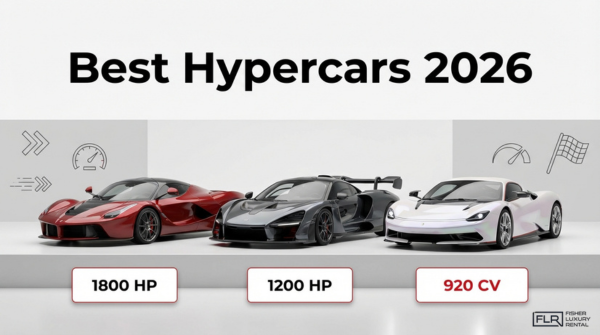
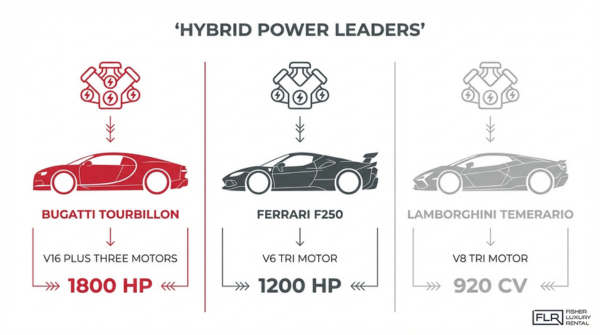
The 2026 class pushes hybrid powertrains to new extremes. The Bugatti Tourbillon pairs a V16 with three electric motors for 1,800 horsepower, while the Ferrari F250 targets upwards of 1,200 horsepower from a compact V6 tri-motor system. Acceleration and top-speed figures across the segment reflect F1-derived technology filtering directly into road cars.
Lamborghini, Ferrari, and McLaren each approach the hypercar segment with distinct philosophies. McLaren’s W1 introduces patented lightweight materials and an F1-bred hybrid drivetrain. Lamborghini’s Temerario combines a twin-turbo V8 with tri-motor electrification for 920 CV. Ferrari relies on allocation-based exclusivity to control demand at the corporate level.
Limited production runs and rising collector valuations define 2026’s market. Exotic vehicle prices continue climbing as ICE-powered models grow increasingly collectible amid the industry’s shift toward electrification. Models like the Pagani Utopia Roadster and Czinger 21C, which uses 3D-printed structural components, attract both enthusiasts and investors.
Rankings depend on layered evaluation: journalists weigh power-to-weight ratios, lap times, and material innovation, while owners rate livability, driving feel, and long-term maintenance costs that can reach tens of thousands annually. We also break down rental requirements and fleet options at Fisher Luxury Rental for those who want seat time without the ownership commitment.
Which 2026 Hypercars Stand Out as the Top Performers?
The 2026 hypercars that stand out as the top performers include the Bugatti Tourbillon, McLaren W1, Ferrari F250, and Lamborghini Temerario. Each pushes boundaries in power output, acceleration, and hybrid technology.
What Are the Defining Performance Specs of 2026’s Best Hypercars?
The defining performance specs of 2026’s best hypercars center on hybrid powertrains, extreme horsepower figures, and lightweight engineering. The Bugatti Tourbillon produces a combined 1,800 horsepower from an all-new 8.3-liter naturally aspirated V16 engine, engineered with Cosworth, paired with three electric motors. The Ferrari F250 pairs a 3.0-liter V6 with a tri-motor hybrid system generating upwards of 1,200 horsepower. The Lamborghini Temerario combines a twin-turbo 4.0-liter V8 with three electric motors for 920 CV of total output. Meanwhile, the Pagani Utopia Roadster takes a different path entirely; its Mercedes-AMG-developed 6.0-liter twin-turbo V12 delivers 852 hp and 1,100 Nm of torque without any hybrid assistance. According to Bugatti Automobiles, the Tourbillon’s V16 and tri-motor layout represents the most powerful production powertrain configuration available in 2026.
How Do 2026 Hypercars Compare in Terms of Speed and Acceleration?
2026 hypercars compare in speed and acceleration through measurably different powertrain strategies and weight philosophies.
| Hypercar | Powertrain | Combined Output | Notable Acceleration |
| Bugatti Tourbillon | 8.3L V16 + 3 electric motors | 1,800 hp | Top-tier straight-line speed |
| Ferrari F250 | 3.0L V6 + tri-motor hybrid | 1,200+ hp | Race-derived launch capability |
| McLaren W1 | MHP-8 + E-module hybrid | Not yet disclosed | 0–200 km/h in 5.8 seconds |
| Lamborghini Temerario | 4.0L twin-turbo V8 + 3 motors | 920 CV | Balanced mid-engine response |
| Pagani Utopia Roadster | 6.0L twin-turbo V12 | 852 hp | Naturally aspirated throttle response |
According to McLaren Automotive, the W1 reaches 200 km/h from a standstill in 5.8 seconds using its F1-derived battery technology and 8-speed dual-clutch transmission. Raw horsepower alone does not determine real-world speed; weight reduction and aerodynamic efficiency often matter more at this level.
What Innovations and Technologies Define 2026’s Leading Hypercars?
The innovations and technologies that define 2026’s leading hypercars span advanced materials, additive manufacturing, and motorsport-derived engineering. The Czinger 21C uses 3D printing for over 20% of its structural components, including suspension and chassis parts, to optimize both weight and rigidity. According to WIRED, the McLaren W1 introduces “InnoKnit,” the world’s first application of a patented, super-light material that integrates lighting and sound components under a single flexible surface. Formula 1 technology transfer continues to shape this generation. The 2026 F1 regulations emphasize reduced vehicle dimensions and cleaner airflow, and those aerodynamic principles are filtering directly into road-legal hypercar designs. Fully electric entrants are also arriving, with the McMurtry Spéirling PURE, featuring Helix electric motors, scheduled to begin production deliveries in 2026. This mix of hybrid, ICE, and pure-electric approaches makes the 2026 class one of the most technologically diverse in hypercar history.
How Do Hypercar Brands Like Lamborghini, Ferrari, and McLaren Compete in 2026?
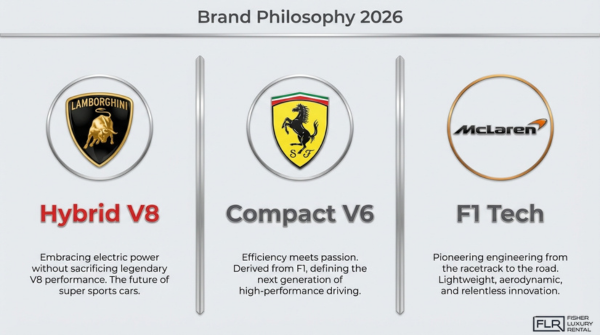
Hypercar brands like Lamborghini, Ferrari, and McLaren compete in 2026 through distinct hybrid powertrain strategies, proprietary materials, and motorsport-derived technology. Each brand’s approach reflects a different philosophy on power, exclusivity, and innovation.
What Makes Lamborghini’s 2026 Hypercar Lineup Unique?
Lamborghini’s 2026 hypercar lineup is unique because of its hybrid V8 architecture paired with a tri-motor electric system. The 2026 Lamborghini Temerario combines a twin-turbo 4.0-liter V8 engine with three electric motors, generating a combined maximum power output of 920 CV (677 kW), according to Automobili Lamborghini S.p.A. This configuration marks a significant departure from Lamborghini’s traditionally naturally aspirated engines. By downsizing displacement while adding forced induction and electrification, Lamborghini preserves its aggressive performance character while meeting tightening European emissions standards. For buyers who value raw, visceral driving dynamics wrapped in hybrid efficiency, this powertrain balance makes the Temerario one of the most compelling entries in the 2026 hypercar field.
How Are Ferrari’s 2026 Hypercars Setting New Standards?
Ferrari’s 2026 hypercars are setting new standards by combining a compact V6 engine with race-derived hybrid technology to produce flagship-level power. The Ferrari F250, internally designated as Ferrari’s next hypercar project, pairs a 3.0-litre V6 with a tri-motor hybrid system to generate upwards of 1,200 horsepower, as reported by Carscoops. Advanced aerodynamics remain central to Ferrari’s design mission, with engineers controlling airflow over, under, and around the vehicle to maximize downforce and stability. Industry analysts have described the F250 as a “multi-million-dollar masterpiece” blending race-car technology with limited-run exclusivity. Ferrari’s willingness to extract over 1,200 horsepower from just three liters of displacement signals a broader industry shift where efficiency and output are no longer trade-offs.
What Innovations Are McLaren Bringing to Their 2026 Hypercars?
McLaren is bringing innovations in hybrid powertrain engineering and advanced materials to their 2026 hypercars. The McLaren W1 features the High-Performance Hybrid Powertrain, consisting of the new MHP-8 engine, F1-derived battery technology, and an 8-speed dual clutch transmission that propels the car to 200 km/h in 5.8 seconds. According to WIRED, the W1 also introduces InnoKnit, the world’s first application of a patented, super-light material that integrates lighting and sound components under a single flexible surface. These motorsport-to-road technology transfers give McLaren a distinct competitive edge, particularly as 2026 Formula 1 regulations push for reduced vehicle dimensions and less turbulent aerodynamics. McLaren’s commitment to material science innovation, not just raw power, positions the W1 as a genuinely forward-thinking hypercar.
What New Models and Limited Editions Are Making Headlines in 2026?
The new models and limited editions making headlines in 2026 include the Bugatti Tourbillon, Ferrari F250, Pagani Utopia Roadster, and McMurtry Spéirling PURE. Below, we cover the most coveted models and the limited production hypercars buyers should watch for.
Which 2026 Hypercars Are Most Coveted by Collectors and Enthusiasts?
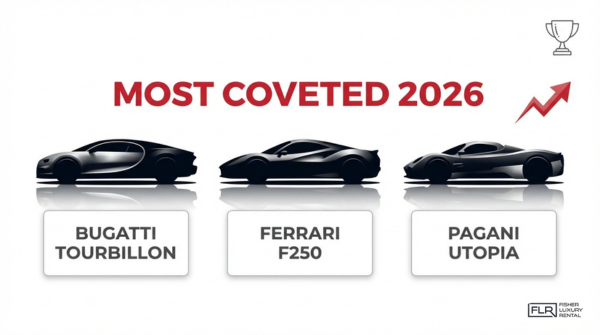
The 2026 hypercars most coveted by collectors and enthusiasts are the Bugatti Tourbillon, Ferrari F250, and Pagani Utopia Roadster. The Bugatti Tourbillon produces a combined 1,800 horsepower from its 8.3-liter naturally aspirated V16 engine paired with three electric motors. Ferrari’s F250 generates upwards of 1,200 horsepower through a hybrid V6 tri-motor system. The Pagani Utopia Roadster delivers 852 hp from a Mercedes-AMG twin-turbo V12 without any hybrid assistance.
Collector demand for these models is intensifying. According to a 2026 MPH market report, exotic vehicle prices are rising due to tightening limited supply and the increasing collectibility of ICE models as manufacturers shift toward electrification. For serious collectors, cars like the Tourbillon and Utopia Roadster represent some of the last pure combustion-era flagships, which only accelerates their desirability.
What Limited Production Hypercars Should Buyers Watch For?
The limited production hypercars buyers should watch for are the Czinger 21C, McMurtry Spéirling PURE, and Ferrari F250. The Czinger 21C utilizes 3D printing for over 20% of its structural components, including suspension and chassis parts. Production deliveries of the McMurtry Spéirling PURE, featuring Helix electric motors, are scheduled to begin in 2026. Ferrari’s allocation process for limited-edition hypercars is controlled by the corporate office, with dealers submitting lists of clients deemed most suitable for ownership.
- The Czinger 21C appeals to buyers seeking cutting-edge manufacturing innovation.
- The McMurtry Spéirling PURE targets collectors who want a fully electric, fan-downforce hypercar.
- The Ferrari F250 requires an established purchase history with the brand for allocation eligibility.
Securing any of these models demands more than capital; it requires relationships, timing, and often a proven ownership record. Understanding expert reviews and user ratings can further sharpen a buyer’s strategy.
How Do Expert Reviews and User Ratings Influence 2026 Hypercar Rankings?
Expert reviews and user ratings influence 2026 hypercar rankings by establishing measurable benchmarks and real-world validation. The following subsections cover the criteria professionals use and how owner feedback shapes perception.
What Criteria Do Experts Use to Evaluate 2026 Hypercars?
The criteria experts use to evaluate 2026 hypercars include powertrain performance, aerodynamic innovation, material engineering, hybrid integration, and design longevity. Reviewers measure acceleration, top speed, and lap times against stated manufacturer claims. Build quality, cockpit ergonomics, and the sophistication of active aerodynamic systems also factor heavily into scoring.
Technology transfer from motorsport carries significant weight. According to Car and Driver, the McLaren W1 “looks poised to set a new standard of performance” by picking up where the legendary P1 left off. Innovations such as 3D-printed structural components and F1-derived battery systems increasingly separate top-ranked models from the rest.
Exclusivity and collectibility round out evaluation criteria. Limited production numbers, allocation difficulty, and long-term value retention all affect where a hypercar lands in professional rankings. For most buyers tracking these lists, the intersection of track capability and investment potential matters more than any single metric alone.
How Do Owners and Enthusiasts Rate the 2026 Models?
Owners and enthusiasts rate the 2026 models based on driving feel, daily usability, emotional impact, and community prestige. While expert reviews prioritize quantifiable data, user ratings emphasize subjective qualities: steering feedback, exhaust note character, and the visceral sensation of acceleration under real conditions.
According to a 2026 Deloitte global automotive consumer study, consumer interest in internal combustion engine vehicles remains at 61%, while hybrid purchase intent stands at 26%. This preference directly shapes how enthusiasts evaluate models like the Pagani Utopia Roadster, which delivers 852 hp from a pure ICE V12, versus hybrid-dominant competitors.
Owner forums and social media increasingly influence public perception before professional outlets publish full reviews. Reliability concerns, dealer experience, and post-purchase support consistently rank among top discussion points. These grassroots signals can elevate or diminish a hypercar’s reputation faster than any magazine score.
Understanding how reviews and ratings shape rankings helps buyers identify which models truly deliver on their promises.
What Should Potential Buyers and Renters Know Before Choosing a 2026 Hypercar?
Potential buyers and renters should evaluate allocation requirements, pricing trends, powertrain preferences, and long-term maintenance costs before choosing a 2026 hypercar. The following sections cover key purchase and rental considerations alongside critical ownership factors.
What Are the Key Considerations for Renting or Buying a 2026 Hypercar?
The key considerations for renting or buying a 2026 hypercar are allocation eligibility, rising market prices, powertrain type, and insurance requirements. Limited-edition models from Ferrari and Bugatti require manufacturer allocation, where corporate offices select buyers based on purchase history and dealer relationships. Exotic vehicle prices are climbing in 2026 as limited supply tightens and internal combustion engine models gain collectibility amid the industry’s shift toward electrification, according to a 2026 MPH market analysis. Consumer powertrain preference also matters: a 2026 Deloitte study found that ICE purchase intent remains at 61%, while hybrid interest stands at 26%. For those not ready to commit to ownership, renting offers hypercar access without multi-million-dollar purchase prices, though renters should confirm age minimums, valid licensing, and full-coverage transferable insurance before booking.
What Maintenance and Ownership Factors Are Important in 2026?
The maintenance and ownership factors important in 2026 include servicing costs, driving patterns, and the financial profile required for hypercar ownership. According to a HotCars analysis, the average annual maintenance cost for a collection of 11 daily-driven exotic cars reaches approximately $84,600. Even single-vehicle ownership carries significant expense; routine servicing for high-performance brands often exceeds standard luxury vehicle costs by a wide margin. Driving habits affect cost calculations as well, since long-distance trips exceeding 200 km occur on only 5% of driving days for luxury owners yet account for 18% of annual mileage. The buyer demographic itself reflects these financial realities: the average Bugatti purchaser in 2026 reportedly owns 42 cars, three jets, and holds a net worth near $200 million. For enthusiasts outside that bracket, renting remains the most practical path to experiencing hypercar performance firsthand.
How Can You Experience a 2026 Hypercar With Fisher Luxury Rental?
You can experience a 2026 hypercar with Fisher Luxury Rental by renting from a curated fleet of high-performance exotic cars. The sections below cover available services and key takeaways from this guide.
What Exotic Car Rental Services Does Fisher Luxury Rental Offer for 2026 Hypercars?
Fisher Luxury Rental offers exotic car rental services that include McLaren, Ferrari, and Lamborghini models available across Phoenix, Portland, and Vancouver. The fleet features vehicles that deliver hypercar-level thrills:
- Fisher Luxury Rental provides a Ferrari 488 Spider with a 661 horsepower twin-turbo V8, a top speed of 205 MPH, and a 0-60 time of 3.0 seconds for $1,499 per day.
- Fisher Luxury Rental includes a McLaren 720S with a fully built 1,100 horsepower twin-turbo engine at $1,299 per day.
- Fisher Luxury Rental offers a Lamborghini Huracan Spyder Convertible at $1,099 per day.
Renters must be at least 25 years old, hold a valid driver’s license, and provide proof of full coverage transferable auto insurance. For anyone who wants to feel what 1,000+ horsepower delivers without a multi-million-dollar purchase commitment, renting remains the most accessible path into the hypercar experience.
What Are the Key Takeaways About Best Hypercars 2026: Top Rated Exotic Cars & Rankings We Covered?
The key takeaways about the best hypercars of 2026 center on three themes: unprecedented hybrid performance, rising market values, and increasing accessibility through rental.
- Models like the Bugatti Tourbillon (1,800 hp), Ferrari F250 (1,200+ hp), and Lamborghini Temerario (920 CV) represent the most powerful production generation ever built.
- Hybrid and electrified powertrains now define the segment, while makers like Pagani prove pure combustion still commands collector demand.
- Exotic vehicle prices continue climbing as ICE models gain collectibility during the industry shift toward electrification.
- Limited allocation processes make ownership unrealistic for most buyers, positioning rental as a practical alternative.