
Classic Lamborghini models are the production vehicles built by Automobili Lamborghini from its 1963 founding in Sant’Agata Bolognese through the early 2000s, spanning groundbreaking cars like the 350 GT, Miura, Countach, and Diablo that established the brand as a defining force in supercar engineering and design.
This guide covers the brand’s origin story and founding rivalry, the early models that created the exotic car segment, Lamborghini’s evolving design philosophy across decades, a complete list of classic models and rare variants, the challenges of collecting and maintaining these cars, and how we at Fisher Luxury Rental connect enthusiasts with these machines.
Lamborghini’s founding traces back to Ferruccio Lamborghini, a successful tractor manufacturer who channeled his frustration with existing sports cars into building a competing automotive company from the ground up, complete with a purpose-built 46,000 square meter factory.
Early models like the 350 GT introduced a Bizzarrini-designed V12 engine that became the brand’s mechanical signature, while the Miura revolutionized the industry by placing that V12 transversely behind the driver; a layout that defined the modern supercar. Only 764 Miuras were ever produced.
Lamborghini’s design language shifted dramatically through the 1970s and 1980s as Marcello Gandini’s wedge-shaped Countach replaced the Miura’s curves, creating a visual identity that still shapes models like the Aventador and Revuelto today.
For collectors, classic Lamborghinis command significant attention at auction, with Countach 25th Anniversary editions reaching $1,655,000, though ownership demands equally serious commitment; factory engine rebuilds for a Miura alone cost approximately $75,000.
At Fisher Luxury Rental, we offer a way to experience both classic and modern Lamborghini performance without the complexity of long-term ownership and restoration.
What Is the History Behind the Lamborghini Brand’s Foundation?
The history behind the Lamborghini brand’s foundation begins in 1963, when Ferruccio Lamborghini channeled his frustration with existing sports cars into building his own. The sections below cover who founded the company and how it earned a legendary reputation.
Who Founded Lamborghini and Why Was the Company Created?
Lamborghini was founded by Ferruccio Lamborghini, a successful tractor manufacturer who wanted to build a superior grand touring car after growing dissatisfied with the sports cars available to him. Automobili Lamborghini was officially founded in 1963 in Sant’Agata Bolognese, with the factory built on a 46,000 square meter site that included a large, well-lit assembly hall directly connected to the office building, according to the Lamborghini Historical Archive.
The company’s first prototype, the 350 GTV (chassis number 0100), debuted at the 1963 Turin Auto Show. Just one year later, Lamborghini unveiled the 350 GT production car (chassis #101) at the 1964 Geneva Auto Show. That first production model featured a 280 hp V12 engine designed by Giotto Bizzarrini and carried a U.S. price of $13,900. Few startups have ever moved from concept to production this quickly in the supercar world, and that velocity set the tone for everything Lamborghini would become.

How Did Lamborghini Establish Its Reputation in the Automotive World?
Lamborghini established its reputation in the automotive world by combining audacious engineering with aggressive styling that directly challenged established rivals. From the V12-powered 350 GT through the wedge-shaped Countach, each successive model pushed boundaries in performance and visual drama.
Collector demand today reflects this enduring prestige. In December 2023, a 1989 Lamborghini Countach 25th Anniversary edition (model number #KLA12722) set a world record for the model at auction, selling for $1,655,000, according to The Lamborghini Registry. Results like these confirm that the brand’s earliest commitment to uncompromising performance created a legacy collectors still prize decades later.
With its foundation firmly established, Lamborghini’s earliest production models would go on to set the standard for exotic cars worldwide.
Which Early Lamborghini Models Set the Standard for Exotic Cars?
Early Lamborghini models set the standard for exotic cars through groundbreaking V12 engineering, mid-engine layouts, and bold Italian design. The 350 GT, 400 GT, Miura, and Espada each advanced what a high-performance grand tourer could be.
What Made the Lamborghini 350 GT and 400 GT Significant?
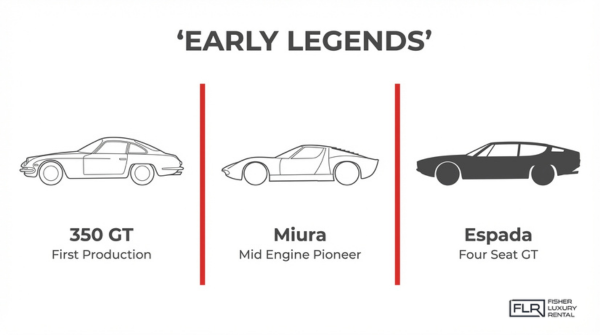
The Lamborghini 350 GT and 400 GT were significant because they established Lamborghini as a legitimate rival to Ferrari in the grand touring segment. The 350 GT, produced between 1964 and 1966, was Lamborghini’s first production vehicle. It featured a 280 hp V12 engine designed by Giotto Bizzarrini and carried a U.S. price of $13,900. The 400 GT evolved the formula with a capacity increase to four liters and a power output boost to 320 CV. Together, these models proved that Lamborghini could deliver refined V12 grand tourers with engineering sophistication to match any European competitor. For a brand barely two years old, that achievement was remarkable.
How Did the Miura Redefine the Supercar Segment?
The Miura redefined the supercar segment by placing a V12 engine behind the driver in a transverse mid-engine configuration, a pioneering layout for a production road car. According to historical accounts documented by Road & Track, this transverse mounting of the V12 served as the template for the modern supercar layout that virtually every mid-engine exotic follows today. With 350 PS from its 4.0-liter powerplant, the Miura P400 combined race-car engineering with road-going refinement in ways no production vehicle had attempted before. The result was a car that didn’t just compete within an existing category; it created an entirely new one that defined what a supercar could be.
Why Is the Espada Considered Iconic Among Classic Lamborghinis?
The Espada is considered iconic among classic Lamborghinis because it proved a front-engine V12 grand tourer could seat four adults without sacrificing performance or dramatic styling. Produced from 1968 to 1978, the Espada combined Bertone’s striking design with genuine everyday usability, a rare combination in the exotic car world. While most Lamborghini models of the era prioritized two-seat performance, the Espada offered something different: a full four-seat layout paired with the same V12 lineage found across the brand’s range. With total Miura production reaching just 764 units across all variants, the Espada gave collectors a more practical yet equally charismatic alternative from Lamborghini’s golden era. These early models collectively built the foundation that later icons like the Countach would expand upon.
How Did Lamborghini’s Design Philosophy Change Over the Decades?
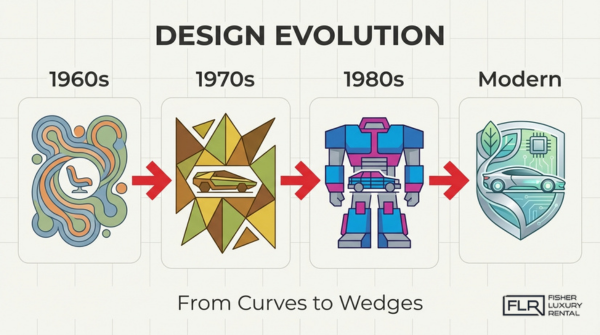
Lamborghini’s design philosophy changed over the decades by shifting from elegant grand touring proportions in the 1960s to aggressive, angular wedge shapes in the 1970s and 1980s. The subsections below cover key innovations and how signature features evolved across eras.
What Innovations Did Lamborghini Introduce in the 1970s and 1980s?
Lamborghini introduced several defining innovations in the 1970s and 1980s, most notably the radical wedge-shaped body architecture and scissor doors that became synonymous with the brand. The Countach LP400, launched in 1974, pioneered a sharp, geometric silhouette that broke completely from the curvaceous lines of the Miura era. Wide rear haunches, NACA ducts for engine cooling, and dramatically low ride heights became standard design elements during this period. Ferruccio Lamborghini himself had started from humble origins, born in 1916 in Renazzo, Ferrara, and beginning his industrial career with the “Carioca” tractor in 1948 before building the automotive empire that produced these breakthroughs. The boldness of 1970s and 1980s Lamborghini design set a visual template that no competitor successfully replicated.
How Have Lamborghini’s Signature Features Evolved With Each Era?
Lamborghini’s signature features have evolved with each era by building iteratively on the design DNA established by predecessor models. The 1960s emphasized flowing, handcrafted bodywork over tubular steel frames. By the 1970s, Marcello Gandini’s Countach replaced curves with flat planes and sharp creases. Through the 1980s, wider body kits and prominent rear wings added aerodynamic function to visual aggression. Mechanical continuity also bridged these eras; during a documented restoration of a Countach LP400, original Miura SV camshafts were found installed, later replaced with standard factory components after reaching end of service life, according to The Countach Register. This parts interchangeability illustrates how deeply each generation’s engineering informed the next.
With design principles established, the complete list of classic models shows how each car embodied these evolving philosophies.
What Is the Complete List of Classic Lamborghini Models?
The complete list of classic Lamborghini models spans from the 1964 350 GT through the early 1990s Diablo, covering milestone grand tourers, mid-engine supercars, and limited-production variants. The following sections highlight the most historically significant models and the rarest examples collectors pursue.
Which Lamborghini Models Are Recognized as Milestones in Automotive History?
The Lamborghini models recognized as milestones in automotive history include the 350 GT, 400 GT, Miura, Espada, Countach, Jalpa, and LM002. Each redefined what a production exotic car could achieve in its era.
Key milestone models include:
- 350 GT (1964–1966): Lamborghini’s first production car, powered by a Bizzarrini-designed V12 producing 280 hp.
- 400 GT (1966–1968): An evolution of the 350 GT with displacement increased to four liters and output raised to 320 CV.
- Miura (1966–1973): The world’s first mid-engine production supercar, with total production reaching 764 units across P400, P400S, P400SV, and one Jota variant.
- Countach (1974–1990): The wedge-shaped icon that defined supercar posters for a generation.
- LM002: Lamborghini’s V12-powered off-road vehicle, a radical departure from low-slung supercars.
The Petersen Automotive Museum currently displays several of these milestones, including a 1968 Miura P400, a 1985 Countach 5000 S, and a 1989 LM002. For collectors and enthusiasts, these models represent the core of Lamborghini’s legacy.
What Are the Rarest Classic Lamborghini Collectors Seek?
The rarest classic Lamborghinis collectors seek are ultra-low-production variants and one-off specials that were built in extremely limited numbers. Models like the Miura Jota, Miura P400SV, and early Countach LP400 “Periscopio” sit at the top of most collectors’ wish lists.
Only one true Jota was ever built, making it the most elusive Lamborghini in existence. The P400SV, with just 150 units produced, commands strong premiums due to its status as the final and most powerful Miura variant. Early Countach LP400 models, limited to 150 units, are equally coveted for their pure, unadorned Gandini design.
Scarcity alone does not drive demand; provenance, matching numbers, and documented service history separate trophy-level examples from the rest. Understanding these nuances helps explain the auction records these cars consistently set.
How Have Classic Lamborghini Models Influenced Modern Supercars?
Classic Lamborghini models have influenced modern supercars through design language, engineering layout, and performance philosophy. The following sections explore how today’s Lamborghinis draw from vintage models and how public perception has evolved.
In What Ways Do Today’s Lamborghinis Draw Inspiration from Vintage Models?
Today’s Lamborghinis draw inspiration from vintage models through design DNA, powertrain architecture, and mid-engine layout principles established decades ago. The Countach’s futuristic “wedge” shape, designed by Marcello Gandini, continues to influence the design language of modern Lamborghini models like the Aventador and Revuelto, according to Automobili Lamborghini. Sharp angular bodywork, dramatic air intakes, and aggressive proportions trace directly back to 1970s styling cues.
Beyond aesthetics, the mid-engine configuration pioneered by the Miura became the structural blueprint every modern Lamborghini follows. The naturally aspirated V12, first introduced in the 350 GT, persists in the Revuelto’s hybrid powertrain. Few automakers maintain this level of continuity between heritage and current production.
How Has the Public’s Perception of the Brand Shifted Over Time?
The public’s perception of the brand has shifted from niche Italian rival to global cultural icon. In the 1960s, Lamborghini was viewed primarily as Ferrari’s ambitious challenger, appealing to a small circle of European GT buyers. Through the Miura and Countach eras, that perception transformed dramatically.
Poster culture of the 1970s and 1980s cemented the Countach as a symbol of aspiration, pushing Lamborghini beyond automotive circles into mainstream pop culture. Today, the brand represents peak supercar theatricality. Collectors pay record auction prices for vintage models, while younger audiences associate Lamborghini with technological ambition through hybrid flagships like the Revuelto. This dual identity, rooted in heritage yet forward-looking, gives the brand a cultural reach most competitors struggle to match.
With the brand’s influence clearly woven into modern supercar DNA, owning or maintaining these classic models presents its own set of challenges and rewards.
What Are the Challenges and Rewards of Driving or Collecting Classic Lamborghinis?
The challenges and rewards of driving or collecting classic Lamborghinis center on high maintenance costs, parts scarcity, and limited daily practicality, balanced by exceptional investment returns and an unmatched driving experience. The sections below cover maintenance realities and modern road usability.
What Should Enthusiasts Know About Maintaining a Classic Lamborghini?
Enthusiasts should know that maintaining a classic Lamborghini requires specialized expertise, significant financial commitment, and access to authentic parts. A full engine rebuild for a classic Lamborghini Miura from the factory costs approximately USD 75,000, according to restoration documentation reviewed by Ninja Riders Malang.
Lamborghini’s Polo Storico division oversees restorations of models like the Miura and Countach, guided by a “Committee of the Wise” that ensures historical accuracy. This dedicated restoration arm stocks authentic spare parts covering over 65 percent of Lamborghini’s historical fleet. For collectors, partnering with factory-certified specialists rather than general mechanics is essential to preserving both mechanical integrity and long-term value.
Are Classic Lamborghinis Practical for Modern Road Use?
Classic Lamborghinis are not practical for modern road use in the conventional sense. These vehicles were engineered for performance in their era, not for daily commuting. Limited visibility from low-slung cabins, absence of modern driver aids, and manual climate systems make routine driving demanding.
Key practicality limitations include:
- Fuel consumption rates that far exceed modern standards.
- Lack of electronic stability control, traction management, and ABS.
- Cabin ergonomics designed for spirited driving, not comfort over long distances.
- Specialized tire and brake component requirements with limited availability.
That said, the visceral connection these cars offer, from unassisted steering feel to the sound of a naturally aspirated V12, rewards drivers with an experience no modern supercar fully replicates. For most collectors, occasional weekend drives and curated events represent the ideal balance between preservation and enjoyment.
With the ownership experience in perspective, Fisher Luxury Rental offers a way to enjoy iconic Lamborghini performance without the long-term commitment.
How Can You Experience Classic and Modern Lamborghini Models with Fisher Luxury Rental?
You can experience classic and modern Lamborghini models with Fisher Luxury Rental by renting exotic vehicles from a curated fleet that puts iconic performance within reach. The sections below cover how Fisher Luxury Rental makes these experiences accessible and the key takeaways from Lamborghini’s storied brand history.
How Does Fisher Luxury Rental Make Classic and Exotic Lamborghini Experiences Accessible?
Fisher Luxury Rental makes classic and exotic Lamborghini experiences accessible by offering models like the Lamborghini Huracan Spyder Convertible for daily rental. Owning a Lamborghini involves significant costs; even basic Huracán service averages around £750, with extensive maintenance exceeding £1,500. Renting bypasses those ownership burdens entirely. Fisher Luxury Rental operates in Phoenix, Scottsdale, Portland, and Vancouver, providing a turnkey luxury experience without long-term financial commitment. For enthusiasts captivated by the brand born from Ferruccio Lamborghini’s 1963 rivalry with Ferrari, a rental delivers the visceral thrill of a V12 supercar lineage on your own terms.

What Are the Key Takeaways About Classic Lamborghini Models and Brand History?
The key takeaways about classic Lamborghini models and brand history center on six decades of relentless engineering ambition and design innovation. Lamborghini’s journey began with the 350 GT and 400 GT, evolved through the mid-engine Miura, and reached icon status with the angular Countach. Collector demand remains intense; at RM Sotheby’s Paris auction in February 2021, two iconic Lamborghini models sold at record prices. The Lamborghini Museum in Sant’Agata Bolognese preserves this legacy, showcasing 60 years of innovation through iconic models and production line tours. For anyone who wants to feel that heritage firsthand rather than admire it behind glass, Fisher Luxury Rental offers a direct path to the driver’s seat.