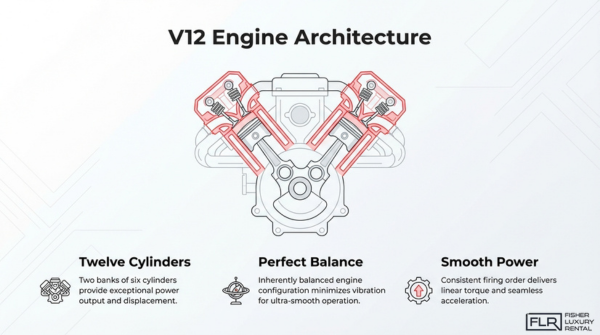
A V12 engine is a twelve-cylinder piston engine where two banks of six cylinders sit in a V configuration around a common crankshaft. This layout delivers near-perfect mechanical balance, smooth continuous power, and the distinctive high-revving sound that defines supercar performance.
We cover V12 engine design and architecture, power output and mechanical balance, the driving experience these engines create, ownership costs and challenges, iconic V12 supercars from leading manufacturers, the future of V12s amid electrification, and how to experience one firsthand.
The V12’s architecture sets it apart from V8 and V10 alternatives. Two rows of six cylinders fire in a precisely sequenced order that cancels vibration at its source, producing remarkably smooth power delivery while enabling the use of advanced lightweight materials like aluminum alloys and metal-matrix composites in modern engine blocks and pistons.
Raw power output is where the V12 excels. Larger displacements, such as the Lamborghini Aventador’s 6.5-litre unit producing 700 PS, generate a wider band of high-end power than smaller-cylinder engines. Inherent mechanical symmetry reduces noise, vibration, and harshness, letting drivers feel every horsepower without unwanted roughness.
Behind the wheel, a V12 supercar offers an experience no other powertrain replicates. The linear throttle response, ascending exhaust note, and seamless acceleration create an aspirational connection between driver and machine.
That experience comes with trade-offs. V12 engines consume more fuel than comparable V8s due to additional cylinders and internal friction, and yearly maintenance costs for V12 Ferraris can reach $1,500 to $2,000 or more depending on model and usage.
Brands like Ferrari and Lamborghini have built their legacies around the V12, from Ferrari’s Formula One engines spanning 1950 to 1995 through to modern hybrid-assisted flagships. Regulatory pressures from CAFE standards and EPA emissions rules now push manufacturers toward electrified alternatives, though many are integrating hybrid systems to preserve the V12’s character rather than retiring it entirely.
What Defines a V12 Engine and How Does Its Design Differ from Other Engine Types?
A V12 engine is a twelve-cylinder piston engine in which two rows of six cylinders are arranged in a V shape around a common crankshaft. Its design differs from other engine types through superior mechanical balance, higher cylinder count, and smoother power delivery.
What Is the Cylindrical Layout of a V12 Engine?
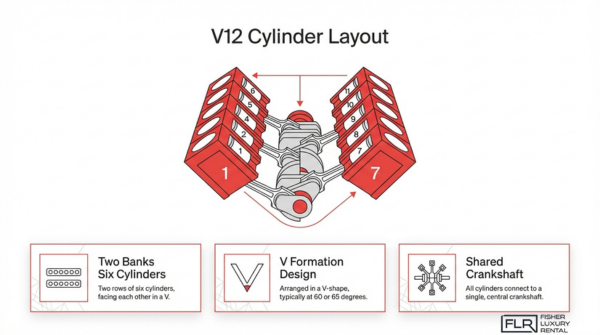
The cylindrical layout of a V12 engine positions twelve cylinders in two symmetrical banks of six, angled in a V formation around a shared crankshaft. Each bank functions as an inline-six, a configuration known for inherent primary and secondary balance. According to the International Journal of Research in Engineering, Architecture and Management, this arrangement places two rows of six cylinders in a V shape around a common crankshaft. Modern V12 engine blocks increasingly incorporate lightweight materials, such as aluminum alloys and composite materials, to reduce overall mass without sacrificing structural rigidity. For the T.50 supercar’s 654-hp V12, Cosworth utilized metal-matrix composite pistons to withstand extreme thermal and mechanical loads. This material evolution allows the V12 layout to remain viable in performance-focused applications despite its inherently larger footprint compared to V8 or V6 alternatives.
How Does the Configuration of a V12 Impact Performance?
The configuration of a V12 impacts performance by enabling smooth, continuous power delivery across a broad RPM range. With twelve firing events per two crankshaft revolutions, power pulses overlap almost seamlessly, eliminating the vibration gaps found in engines with fewer cylinders. The T.50s Niki Lauda’s V12 achieves a power-to-weight ratio of 835 PS/tonne, surpassing that of a naturally aspirated LMP1 car, according to Cosworth. Ferrari’s F140 V12, first built in 2002 for the Enzo, initially produced 651 hp and was refined over 19 years to extract even greater output. This near-perfect mechanical balance also preserves the V12’s renowned sound and smooth character, qualities increasingly difficult to replicate as electrification reshapes engine design. Understanding how this configuration translates to real-world driving helps explain why so many supercar manufacturers continue choosing it.
Why Are V12 Engines Preferred in Many Supercars?
V12 engines are preferred in many supercars because they deliver unmatched power, inherent mechanical balance, and a wider band of high-end performance. The following sections explore their specific performance advantages and their direct impact on acceleration and top speed.
What Performance Advantages Do V12 Engines Offer?
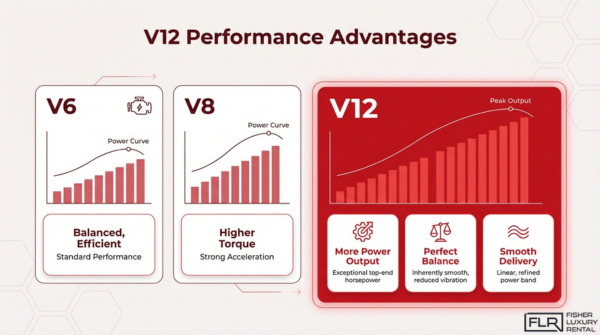
The performance advantages V12 engines offer include superior power output, near-perfect mechanical balance, and exceptionally smooth power delivery across a wide RPM range. Twelve cylinders firing in a precisely staggered sequence eliminate the vibration pulses that plague smaller configurations, producing continuous torque without the gaps felt in V6 or V8 layouts.
This inherent balance also reduces stress on internal components, allowing engineers to push higher compression ratios and rev limits. According to a technical paper published by SAE International, the V12 engine produces a greater power output than a V10 F1 engine while maintaining a wider range of high torque values. That broader powerband gives drivers usable thrust at virtually any speed, which is why manufacturers like Ferrari and Lamborghini have relied on V12 configurations for their flagship models for decades.
For most supercar applications, this combination of smoothness and sustained high-RPM power is what separates a V12 from everything else in the lineup.
How Does a V12 Engine Affect Acceleration and Top Speed?
A V12 engine affects acceleration and top speed by delivering sustained, high-output power through a broad RPM range, minimizing the torque dips that slow momentum during gear changes. Because twelve cylinders fire in rapid, evenly spaced intervals, power reaches the drivetrain almost continuously, translating into relentless forward thrust.
Large displacement amplifies this effect. The Lamborghini Aventador’s 6.5-litre V12, codenamed L539, produces a maximum output of 700 PS (690 hp), enabling acceleration from standstill to top speeds well above 200 mph. That level of sustained horsepower at high RPM is critical for top-speed runs, where aerodynamic drag increases exponentially and only engines with deep power reserves can continue accelerating.
Compared to turbocharged alternatives, naturally aspirated V12 engines deliver throttle response with virtually zero lag, giving the driver immediate, linear access to full power. This predictability under hard acceleration is one reason V12 supercars consistently rank among the fastest production vehicles ever built.
Understanding why these engines dominate supercar flagships leads naturally to examining how a V12 produces more power than smaller engines.
How Does a V12 Engine Produce More Power Than Smaller Engines?
A V12 engine produces more power than smaller engines through greater displacement, optimized firing order, and superior mechanical balance. The following subsections explain how each factor contributes.
How Do Displacement and Firing Order Contribute to Power Output?
Displacement and firing order contribute to power output by allowing a V12 engine to burn more fuel per cycle while delivering overlapping power strokes for continuous torque. Larger displacement means each combustion event generates greater force. With twelve cylinders firing in a precisely sequenced order, power pulses overlap so the crankshaft receives near-constant rotational energy rather than intermittent bursts.
The Lamborghini Aventador’s 6.5-litre V12 engine, codenamed L539, produces a maximum output of 700 PS (515 kW; 690 hp), demonstrating how large displacement translates directly into exceptional horsepower. This evenly spaced firing order also eliminates the gaps in power delivery that smaller engines experience between combustion events. For supercar applications, this combination of high displacement and balanced firing sequence is what separates a V12 from V8 or V6 alternatives in outright performance capability.
What Role Does Balance Play in the Smoothness of a V12 Engine?
Balance plays a central role in the smoothness of a V12 engine because twelve cylinders arranged in two banks of six create near-perfect mechanical symmetry. Each piston’s inertial forces are naturally counterbalanced by another piston moving in the opposite direction, eliminating the need for heavy external balancing shafts that smaller configurations require.
According to Underhood Service, when proper engine balance is achieved, it reduces Noise, Vibration, and Harshness (NVH) felt inside the vehicle. This means V12 supercars deliver power with a refined, almost turbine-like smoothness at high RPMs. Reduced vibration also decreases stress on internal components, contributing to greater durability under sustained performance driving. For anyone who has experienced a well-tuned V12 at full throttle, the seamless power delivery is immediately distinguishable from any engine with fewer cylinders.
Understanding how displacement, firing order, and balance combine to create superior power helps explain why V12 supercars deliver such a distinctive driving experience.
What Are the Distinctive Driving Experiences Offered by V12 Supercars?
The distinctive driving experiences offered by V12 supercars combine an unmatched engine sound, seamless power delivery, and an aspirational quality no other powertrain replicates. Below, we explore the sensory characteristics and the cultural allure that set these machines apart.
How Is the Sound and Feel of a V12 Different from Other Engines?
The sound and feel of a V12 is different from other engines because of its naturally balanced twelve-cylinder firing order, which produces a high-pitched, continuous exhaust note rather than the rumble typical of V8s or the rasp of turbocharged V6s. According to a Patsnap Eureka report, the V12 engine is renowned for its smooth power delivery and distinctive sound, both of which are at risk when introducing electric elements.
That seamless firing sequence eliminates the vibration gaps drivers notice in engines with fewer cylinders. Behind the wheel, the sensation is almost turbine-like: linear thrust builds without interruption from idle to redline. For enthusiasts who value sensory engagement, this combination of auditory drama and mechanical refinement is what makes the V12 irreplaceable.
What Makes Driving a V12 Supercar Aspirational?
Driving a V12 supercar is aspirational because it represents the pinnacle of automotive engineering, exclusivity, and heritage. Ferrari has produced V12 racing engines for Formula One between 1950 and 1995, according to Wikipedia, with derived engines also powering iconic road cars. That racing lineage gives every V12 supercar a direct connection to motorsport history few other configurations can claim.
Only a handful of manufacturers still build naturally aspirated V12 engines, which makes each model increasingly rare. Tightening emissions regulations further limit future production, amplifying collector and cultural value. For many drivers, the V12 is less about specifications on paper and more about an emotional connection to craftsmanship that prioritizes experience over efficiency.
With the driving experience covered, the practical trade-offs of V12 ownership deserve equal attention.
What Are the Main Drawbacks and Challenges Associated with V12 Engines in Supercars?
The main drawbacks and challenges associated with V12 engines in supercars include poor fuel efficiency, high maintenance costs, and increasing regulatory pressure. These issues affect both daily usability and long-term ownership.
How Does Fuel Efficiency Compare with Other Engine Types?
Fuel efficiency compares unfavorably for V12 engines relative to smaller powertrains. Twelve cylinders generate more internal friction and consume significantly more fuel than V8 or V6 alternatives at comparable speeds. According to a Patsnap Eureka report, regulatory pressures, including Corporate Average Fuel Economy (CAFE) standards and Environmental Protection Agency (EPA) emissions regulations, have directly impacted V12 engine development. These tightening restrictions make it increasingly difficult for manufacturers to justify large-displacement, naturally aspirated V12 programs. For buyers who prioritize running costs alongside performance, this trade-off is worth careful consideration before committing to a twelve-cylinder supercar.
Are Maintenance and Ownership Costs Higher for V12 Cars?
Yes, maintenance and ownership costs are higher for V12 cars than for most other performance vehicles. Twelve cylinders mean more spark plugs, additional valve adjustments, and larger quantities of oil at every service interval. According to Ferrari Lake Forest, average yearly Ferrari maintenance costs generally range between $1,500 and $2,000, varying by model and year. That figure covers routine service alone; major repairs or component replacements can escalate costs well beyond those estimates. The complexity of V12 drivetrains also limits the number of qualified technicians, often restricting service options to specialized dealerships or independent exotic shops.
Understanding these ownership realities makes exploring rental alternatives an appealing way to enjoy V12 power without the long-term financial commitment.
How Have Iconic Supercar Brands Utilized V12 Engines Over Time?
Iconic supercar brands have utilized V12 engines as the pinnacle of performance and prestige for decades. From Lamborghini’s mid-engine flagships to Ferrari’s front-engine grand tourers, the sections below trace specific models and recent developments.
Which Famous Lamborghinis and Ferraris Feature V12 Engines?
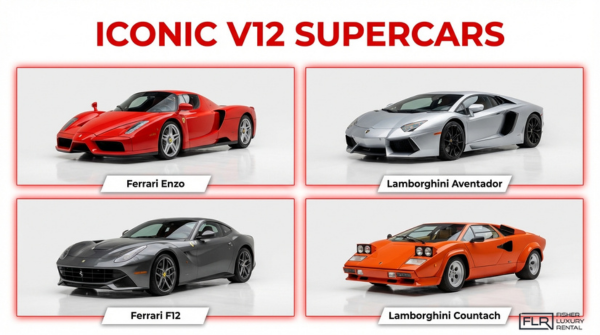
Famous Lamborghinis and Ferraris that feature V12 engines span decades of automotive engineering. Lamborghini’s lineage runs from the original Miura through the Countach, Diablo, and Murciélago, culminating in the Aventador. The Aventador’s 6.5-litre V12 engine, codenamed L539, produces a maximum power output of 700 PS (690 hp). Ferrari’s V12 heritage is equally deep. According to autoevolution, the Ferrari F140 V12 engine, first built in 2002 for the Enzo Ferrari, initially produced 651 hp and was refined over 19 years to increase its output. That same architecture powered the F12berlinetta, 812 Superfast, and Daytona SP3. For both marques, the V12 remains the defining engine of their flagship models.
What Are Some Noteworthy V12-Powered Supercars in Recent Years?
Some noteworthy V12-powered supercars in recent years include the Gordon Murray T.50, Aston Martin Valkyrie, Pagani Utopia, and Lamborghini Revuelto. The T.50 stands apart for its engineering ambition; according to Cosworth, the T.50s Niki Lauda’s V12 achieves a power-to-weight ratio of 835 PS/tonne, surpassing that of a naturally aspirated LMP1 car. Pagani continues to pair a Mercedes-AMG-derived V12 with lightweight construction, while the Revuelto introduces hybrid assistance alongside its V12. These models demonstrate that even as electrification advances, manufacturers continue investing in twelve-cylinder powertrains for their most exclusive offerings.
With the V12’s legacy firmly established across these brands, the question turns to how electrification trends may reshape its future.
How Is the Future of V12 Engines in Supercars Shaping Up Amid Electrification Trends?
The future of V12 engines in supercars is shaping up as a tension between heritage preservation and regulatory compliance. Below, we explore manufacturer commitments and the hybrid alternatives gaining traction.
Are Manufacturers Planning to Phase Out V12 Engines?
Manufacturers are not universally planning to phase out V12 engines, though production is narrowing significantly. Regulatory pressures, including Corporate Average Fuel Economy (CAFE) standards and the Environmental Protection Agency’s (EPA) emissions regulations, have impacted V12 engine development, according to a Patsnap Eureka report on supercar performance metrics. Brands like Ferrari and Lamborghini continue releasing new V12 models, yet each generation must meet stricter emissions thresholds. Rather than full elimination, most manufacturers are adapting through hybridization, preserving the V12 while adding electrified components. For enthusiasts, this signals that the naturally aspirated V12 in its purest form is becoming increasingly rare.
What Hybrid or Electrified Alternatives Are Emerging?
The hybrid or electrified alternatives emerging in the supercar segment pair V12 combustion engines with electric motor assistance. The V12 engine is renowned for its smooth power delivery and distinctive sound, both of which are at risk when introducing electric elements, according to a Patsnap Eureka analysis on electrification’s impact on traditional V12 design. Manufacturers address this by using electric motors to fill low-RPM torque gaps while letting the V12 dominate at higher revs. Models like the Ferrari SF90 architecture and Lamborghini’s PHEV platforms demonstrate this approach. These systems boost total output and reduce emissions without fully replacing the twelve-cylinder core. For drivers who value the V12 character, hybrid integration represents a practical compromise rather than a concession. Understanding these shifts makes experiencing a V12 today all the more compelling.
How Can You Experience a V12 Supercar Without Ownership?
You can experience a V12 supercar without ownership through luxury exotic car rentals. Fisher Luxury Rental offers access to high-performance supercars, letting you enjoy the thrill without long-term costs.
What V12 Supercar Rental Options Does Fisher Luxury Rental Offer?
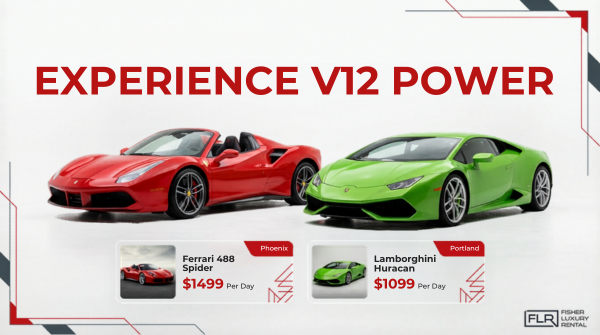
Fisher Luxury Rental offers a curated fleet of exotic supercars, including Ferrari and Lamborghini models, available for daily rental in Phoenix, AZ and Portland, OR. The Ferrari 488 Spider starts at $1,499 per day, while the Lamborghini Huracan Spyder Convertible starts at $1,099 per day.
These rentals eliminate the burden of V12 ownership costs. According to a data analysis by SoFi, the average maintenance cost for a luxury car is $12,000 annually. Renting provides the full sensory experience of a high-performance engine, from the distinctive exhaust note to seamless power delivery, without service bills or depreciation. For anyone passionate about supercar performance, a weekend rental delivers lasting memories at a fraction of ownership expense.
What Are the Key Takeaways About How V12 Engines Work in Supercars: Power & Benefits Explained We Covered?
The key takeaways about how V12 engines work in supercars are rooted in their unique architecture, performance advantages, and evolving role in the automotive landscape. The most important points include:
- V12 engines arrange twelve cylinders in two banks of six around a common crankshaft, producing near-perfect mechanical balance.
- This inherent balance reduces noise, vibration, and harshness, creating an exceptionally smooth driving experience.
- V12 configurations deliver greater power output and a wider range of high torque values compared to smaller engine types.
- Iconic brands like Ferrari and Lamborghini have built their legacies around V12 power.
- Electrification trends and emissions regulations are reshaping V12 production, making current V12 supercars increasingly rare.
For those who want to feel what decades of engineering mastery produce, Fisher Luxury Rental makes the V12 supercar experience accessible without the commitment of ownership.