A supercar engine is a high-performance powertrain engineered to deliver extreme horsepower, rapid acceleration, and precise throttle response at the limits of automotive technology. In 2026, these engines span naturally aspirated V12s, twin-turbo V6s and V8s, hybrid HPEV systems, and fully electric architectures.
We cover what defines a supercar engine today, the major powertrain types and how they compare, the historical and material innovations driving engine evolution, the iconic models and brands setting new benchmarks, the environmental regulations reshaping development, and the maintenance realities of owning or driving these machines.
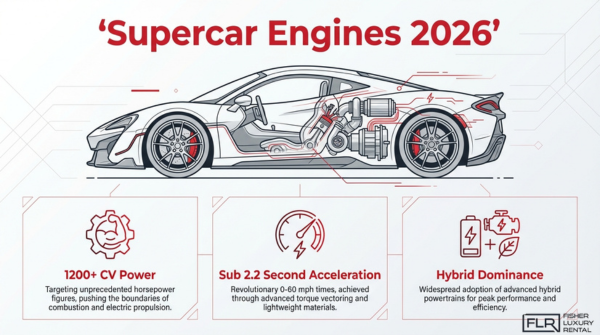
Supercar engines in 2026 are measured by total system power, torque output, 0-100 km/h times, and thermal efficiency. Flagship hybrids now exceed 1,200 CV by pairing combustion engines with electric motors, pushing sub-2.2-second sprint times.
Naturally aspirated engines still deliver linear power and mechanical purity, while turbocharging and e-turbo technology eliminate lag for instant boost. Hybrid systems dominate the new model cycle, achieving higher combined efficiency than pure ICE layouts; full electric supercars push past 100 MPGe but carry significant weight penalties from large battery packs.
Decades of innovation, from mid-engine layouts to carbon fiber monocoques, have shaped the modern supercar. Aerospace-derived composite methods, additive manufacturing for cylinder heads, and advanced ceramic piston coatings now reduce weight and improve durability under extreme combustion pressures.
Ferrari, Lamborghini, and McLaren lead 2026 with hybrid flagships alongside high-performance Super SUVs that bring supercar power to elevated platforms. Euro 7 standards and tightening EPA mandates are forcing manufacturers to balance raw output with meaningful emissions reductions.
AI-driven predictive maintenance platforms and maturing hybrid reliability mean modern supercars cost less to maintain than their predecessors, though proper care remains essential to protect these complex powertrains.
What Defines a Supercar Engine in 2026?
A supercar engine in 2026 is defined by hybrid powertrain integration, advanced materials, and performance metrics that far exceed traditional benchmarks. The following sections explore how modern engines differ from their predecessors and which metrics matter most.
How Do Modern Supercar Engines Differ From Traditional Models?
Modern supercar engines differ from traditional models in three fundamental ways: powertrain architecture, efficiency, and ownership costs. Where older exotics relied on large-displacement naturally aspirated engines with fuel efficiency typically ranging from 15 to 20 mpg, today’s supercars pair downsized turbocharged units with electric motors for dramatically higher output per liter.
Hybrid integration also transforms the ownership equation. According to Top Speed, some modern supercars show lower average annual maintenance costs of roughly $400 to $600, compared to significantly higher bills for older exotic models. Simplified service intervals and AI-driven diagnostics contribute to this reduction.
For anyone considering a supercar in 2026, these differences mean more usable power, better fuel economy, and lower long-term running costs than previous generations delivered.
What Performance Metrics Are Used to Evaluate Supercar Engines?
The performance metrics used to evaluate supercar engines include total system power, maximum torque, and 0-100 km/h acceleration time. These three benchmarks reveal how effectively an engine converts energy into real-world speed.
According to Ferrari, the F80 V6 twin-turbo hybrid produces 1,200 CV of total system power, 850 Nm of ICE torque, and reaches 100 km/h in 2.15 seconds.
| Model | Total Power | Max Torque | 0–100 km/h |
| Ferrari F80 V6 Hybrid | 1,200 CV | 850 Nm | 2.15 s |
| McLaren W1 V8 Hybrid | 1,275 PS | 1,340 Nm | 2.7 s |
| Lamborghini Revuelto V12 Hybrid | 1,015 CV | 725 Nm | 2.5 s |
| Lamborghini Temerario V8 Hybrid | 920 CV | 730 Nm | 2.7 s |
Understanding these metrics helps contextualize the different engine types covered next.
What Are the Main Types of Supercar Engines Available Today?
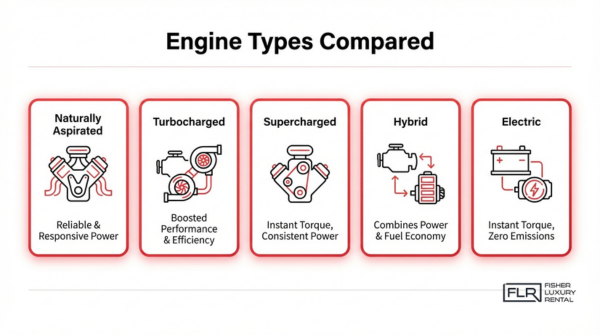
The main types of supercar engines available today are naturally aspirated, turbocharged, supercharged, hybrid, and full electric powertrains. Each type offers distinct performance characteristics, efficiency levels, and driving experiences.
How Do Naturally Aspirated Engines Compare to Turbocharged and Supercharged Options?
Naturally aspirated engines compare to turbocharged and supercharged options primarily in how they deliver power. A naturally aspirated engine relies solely on atmospheric pressure to draw air into the combustion chamber, producing linear throttle response and a visceral, high-revving sound signature that purists prize.
Turbocharged engines use exhaust-driven turbines to force more air into the cylinders, generating significantly higher power from smaller displacement. Supercharged engines achieve a similar effect through a belt-driven compressor, delivering more immediate boost with less lag. The trade-offs break down as follows:
- Naturally aspirated engines offer predictable power delivery and mechanical simplicity but produce less power per liter.
- Turbocharged engines maximize output and efficiency, though traditional designs can exhibit turbo lag at low RPM.
- Supercharged engines provide instant, linear boost response but consume more energy to drive the compressor.
For drivers who value raw, unfiltered engagement, naturally aspirated setups remain unmatched. However, tightening emissions standards are pushing most manufacturers toward forced induction or hybrid alternatives.
What Role Do Hybrid and Electric Engines Play in 2026 Supercars?
Hybrid and electric engines play a central role in 2026 supercars by combining extreme performance with improved efficiency and regulatory compliance. Hybrid powertrains pair an internal combustion engine with one or more electric motors, filling torque gaps and enabling instant low-end response that pure ICE designs cannot match.
According to JD Power’s 2026 Vehicle Dependability Study, overall vehicle dependability is stabilizing as hybrid systems mature, signaling that early reliability concerns are fading. The efficiency and weight differences across powertrain types are significant:
| Powertrain Type | Typical Efficiency | Relative Weight |
| Traditional ICE | 15–20 mpg | Lightweight |
| Hybrid (PHEV/HPEV) | 25–35 mpg | Heavier (batteries and electric motors) |
| Full Electric (BEV) | 100+ MPGe | Very heavy (large battery packs) |
Carbon fiber construction helps offset the weight penalty that batteries introduce, making these hybrid and electric platforms viable for track-focused applications. With hybrid and electric options redefining what supercar performance looks like, understanding how this technology evolved over the decades adds valuable perspective.
How Has Supercar Engine Technology Evolved Over the Decades?
Supercar engine technology has evolved through decades of breakthroughs in combustion design, forced induction, and hybrid integration. The following sections trace the historic innovations that built the foundation and the modern materials now pushing engine design further.
What Historic Innovations Have Shaped Supercar Engines?
Historic innovations that have shaped supercar engines include mid-engine layouts, multi-valve cylinder heads, turbocharging, and electronic fuel injection. Early supercars relied on large-displacement naturally aspirated engines, where raw displacement alone generated power. The shift to mid-engine configurations in the 1960s transformed weight distribution and handling dynamics, setting a template that most manufacturers still follow.
Turbocharging arrived in the 1970s and 1980s, compressing intake air to extract significantly more power from smaller displacements. Electronic engine management systems then replaced mechanical carburetors, enabling precise fuel delivery and ignition timing. Each generation refined what came before, and the cumulative effect of these innovations created the platform on which today’s hybrid powertrains are built.
How Are Modern Materials and Engineering Advancing Engine Design?
Modern materials and engineering are advancing engine design by reducing weight, improving thermal efficiency, and enabling complex geometries previously impossible to manufacture. Additive manufacturing (3D printing) now produces intricate cylinder heads and pistons that shed mass while enhancing thermal management. Advanced ceramic coatings applied to piston crowns and valves lower heat transfer, boosting durability under extreme combustion pressures.
According to CompositesWorld, McLaren utilizes aerospace-inspired ART methods for volume composite engineering, bringing lightweight structural techniques from aviation directly into supercar production. Carbon fiber integration across engine bays and structural components is also becoming standard practice. These material advances matter because they offset the added weight of hybrid battery packs, keeping power-to-weight ratios competitive with older, purely mechanical designs.
With the engineering foundation established, the most iconic supercar engines of 2026 showcase these innovations in production form.
What Are the Most Iconic Supercar Engines and Models of 2026?
The most iconic supercar engines of 2026 come from Ferrari, Lamborghini, and McLaren, each deploying hybrid powertrains that redefine performance benchmarks. Below, we explore how these brands set new standards and which engines dominate the super SUV segment.
How Do Top Brands Like Ferrari, Lamborghini, and McLaren Set New Standards?
Top brands like Ferrari, Lamborghini, and McLaren set new standards by pairing advanced hybrid systems with high-revving combustion engines to produce unprecedented power-to-weight ratios.
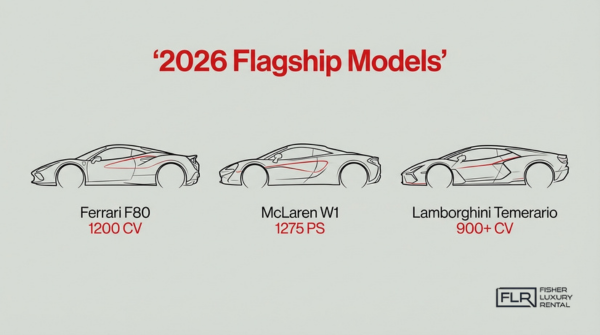
The standout models and their powertrain specs include:
| Model | Engine | Total System Power | 0–100 km/h |
| Ferrari F80 | V6 Twin-Turbo Hybrid | 1,200 CV | 2.15 s |
| McLaren W1 | V8 Twin-Turbo Hybrid | 1,275 PS | 2.7 s |
| Lamborghini Revuelto | V12 NA Hybrid | 1,015 CV | 2.5 s |
| Lamborghini Temerario | V8 Twin-Turbo Hybrid | 920 CV | 2.7 s |
According to McLaren, the W1 features the all-new MHP-8, a 90-degree V8 with a flat-plane crank revving to 9,200 rpm, paired with a lightweight E-module to reach 1,275 PS combined output. The Temerario replaces the Huracán’s V10 with a bespoke V8 that revs to 10,000 rpm and uses three electric motors for torque vectoring. What makes this generation truly significant is how every manufacturer has committed fully to electrified architecture without sacrificing the visceral character that defines a supercar.
What Noteworthy Engines Are Powering Super SUVs?
Noteworthy engines powering super SUVs in 2026 include the Lamborghini Urus SE’s plug-in hybrid V8, the Ferrari Purosangue’s naturally aspirated V12, and the Aston Martin DBX707’s twin-turbo V8.
| Model | Engine | Total Power | 0–100 km/h | Top Speed |
| Lamborghini Urus SE | 4.0L V8 PHEV | 800 CV | 3.4 s | 312 km/h |
| Ferrari Purosangue | 6.5L V12 NA | 725 HP | 3.3 s | 310 km/h |
| Aston Martin DBX707 | 4.0L V8 Twin-Turbo | 707 PS | 3.3 s | 310 km/h |
The Ferrari Purosangue stands apart as the only super SUV retaining a naturally aspirated V12, a powertrain choice that prioritizes throttle response and emotional engagement over hybrid efficiency. Meanwhile, the Urus SE’s plug-in hybrid system represents Lamborghini’s direction for balancing supercar-level acceleration with reduced emissions in a larger platform. For anyone who dismissed SUVs as utilitarian, these models prove that supercar-caliber engineering now extends well beyond two-seat mid-engine layouts.
With these flagship models and super SUVs defining the 2026 landscape, understanding the regulatory pressures shaping their development adds essential context.
How Do Environmental Factors and Regulations Affect Supercar Engine Development?
Environmental factors and regulations affect supercar engine development by forcing manufacturers to redesign powertrains for lower emissions without sacrificing performance. The subsections below cover the latest emissions standards and how brands balance power with sustainability.
What Are the Latest Emissions Standards Impacting Supercars?
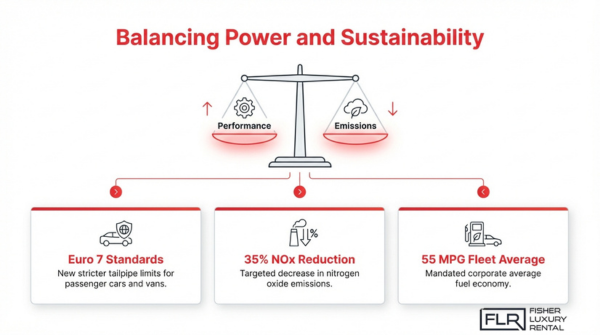
The latest emissions standards impacting supercars include Euro 7 regulations and updated U.S. EPA fuel economy mandates. Euro 7 standards, effective late 2026, target a 35% reduction in NOx emissions for new passenger vehicles, according to Blackcircles.com. These stricter limits apply to all new cars sold in Europe, including low-volume supercar producers. Simultaneously, U.S. EPA regulations mandate a fleet-wide average of approximately 55 mpg by model year 2026. For manufacturers building vehicles that rarely exceed 20 mpg in pure ICE form, these benchmarks create significant engineering pressure. Hybrid integration has become the most viable compliance pathway, allowing brands to offset high-output combustion engines with electric-only driving modes during standardized test cycles.
How Are Manufacturers Balancing Performance and Sustainability?
Manufacturers are balancing performance and sustainability by pairing high-revving combustion engines with electric motor systems that serve dual purposes. Electric motors fill torque gaps, eliminate turbo lag, and enable zero-emission city driving, all while adding total system output. Ferrari, Lamborghini, and McLaren have each released flagship hybrids that exceed 900 horsepower from their ICE alone, then push well past 1,000 horsepower with electric assistance. This approach satisfies emissions testing by allowing short electric-only operation, while delivering greater peak performance than their predecessors. Lightweight materials, such as carbon fiber and advanced composites, further offset the added weight of batteries. For most supercar buyers, the result is a faster, cleaner car with no meaningful compromise in driving character.
With regulatory frameworks tightening, proper engine maintenance becomes even more critical for preserving both performance and compliance.
What Maintenance and Care Do Modern Supercar Engines Require?
Modern supercar engines require scheduled servicing, high-quality fluids, and proactive monitoring to sustain peak output. The following sections cover how proper upkeep extends engine life and which mistakes owners should avoid.
How Can Proper Upkeep Enhance Longevity and Performance?
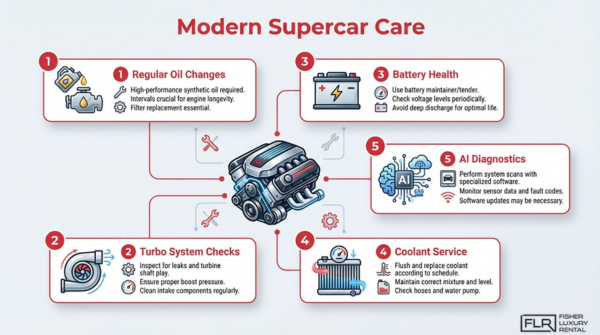
Proper upkeep enhances longevity and performance by keeping every engine subsystem within manufacturer-specified tolerances. Hybrid powertrains, now standard across Ferrari, McLaren, and Lamborghini lineups, add battery conditioning and electric motor calibration to traditional service schedules.
Key maintenance practices include:
- Following OEM-recommended oil change intervals with manufacturer-approved synthetic lubricants.
- Inspecting turbocharger systems, intercoolers, and e-turbo electronics for boost leaks or sensor faults.
- Monitoring hybrid battery state-of-health and scheduling cell balancing as needed.
- Replacing coolant on schedule, since advanced ceramic coatings on pistons and valves demand stable thermal management.
- Using AI-driven predictive maintenance platforms that analyze real-time vehicle data to flag component wear before failures occur.
According to a 2026 LinkedIn market report, manufacturers are deploying AI-driven platforms that use real-time vehicle data to predict component failures and schedule service before issues arise. For owners of high-output hybrid engines, this predictive approach is arguably the single biggest advancement in reducing unplanned downtime.
What Are Common Pitfalls Owners Should Avoid?
Common pitfalls owners should avoid include neglecting hybrid-specific service requirements, using non-approved fluids, and skipping software updates. Many owners treat hybrid supercars like traditional ICE vehicles, overlooking battery thermal management and electric motor diagnostics entirely.
Frequent mistakes to watch for:
- Ignoring manufacturer software updates that recalibrate engine mapping, traction control, and energy recovery systems.
- Using aftermarket parts or fluids not validated for high-performance hybrid drivetrains.
- Allowing extended storage without a battery management routine, which accelerates cell degradation.
- Skipping brake fluid changes on vehicles with regenerative braking, where moisture contamination affects both hydraulic and electronic systems.
- Deferring service because annual costs seem high, when some modern supercars average only $400 to $600 in yearly maintenance according to Top Speed.
Even minor oversights compound quickly in engines producing 900 CV or more, so staying ahead of scheduled maintenance is always less costly than reactive repairs. With maintenance fundamentals covered, experiencing these engines firsthand brings the technology to life.
How Can You Experience the Latest Supercar Engines with Fisher Luxury Rental?
You can experience the latest supercar engines with Fisher Luxury Rental by reserving exotic and luxury vehicles from a curated fleet that includes models from Ferrari, McLaren, Lamborghini, and Porsche.
Can Exotic and Luxury Car Rentals Let You Drive the Most Advanced Supercars?
Yes, exotic and luxury car rentals can let you drive the most advanced supercars without the commitment of ownership. Fisher Luxury Rental maintains a fleet featuring some of the most sought-after nameplates in performance motoring, including the Ferrari 488 Spider, McLaren 720S, and Lamborghini Huracan Spyder. Each vehicle represents top-trim specification, giving drivers direct access to the turbocharged, naturally aspirated, and hybrid engine technologies shaping 2026. Whether you want to feel the mid-engine responsiveness of a twin-turbo V8 or the open-air rush of a high-revving convertible, renting removes the barrier between curiosity and the driver’s seat. Fisher Luxury Rental serves Phoenix, Scottsdale, Portland, and Vancouver.
What Are the Key Takeaways About Supercar Engines, Their Types, and Evolution in 2026?
The key takeaways about supercar engines, their types, and evolution in 2026 center on three shifts:
- Hybrid powertrains now dominate flagship models, combining combustion engines with electric motors to deliver over 1,000 CV in vehicles like the Ferrari F80 and McLaren W1.
- Engine diversity remains strong, with naturally aspirated V12s, twin-turbo V6s, flat-plane crank V8s, and full-electric architectures all coexisting.
- Stricter emissions standards, including Euro 7, are accelerating the adoption of lightweight materials and electrified drivetrains across every segment.
According to LinkedIn’s Supercar Market Growth Forecast 2026-2030 report, manufacturers are deploying AI-driven platforms that use real-time vehicle data to predict component failures, signaling that engine evolution now extends well beyond raw power into predictive maintenance and long-term reliability.