The fastest exotic cars in 2026 are production and limited-run hypercars capable of reaching 60 mph in under two seconds, led by electric and hybrid powertrains from manufacturers like Rimac, Chevrolet, Pininfarina, and Porsche. The 0-60 mph benchmark remains the most recognized measure of raw acceleration performance.
This guide covers the quickest 2026 models and how they compare, why 0-60 times matter as a performance metric, the engineering factors behind extreme acceleration, which brands dominate the leaderboard, how 2026 times stack up against previous years, and how enthusiasts can experience these cars firsthand.
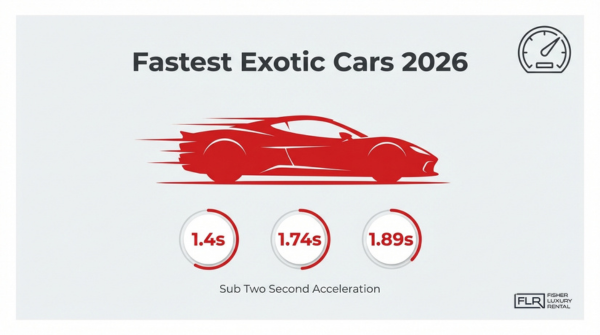
We break down the top contenders, from the Rimac Nevera R at 1.74 seconds to the Corvette ZR1X at 1.89 seconds and the Porsche 911 Turbo S hybrid at 2.0 seconds flat. Each model pushes production-car acceleration into territory once reserved for purpose-built race machines.
The 0-60 sprint reveals more than bragging rights. It reflects how powertrain responsiveness, launch control calibration, and traction management translate into real driving sensation, though the metric has limits when evaluating total performance.
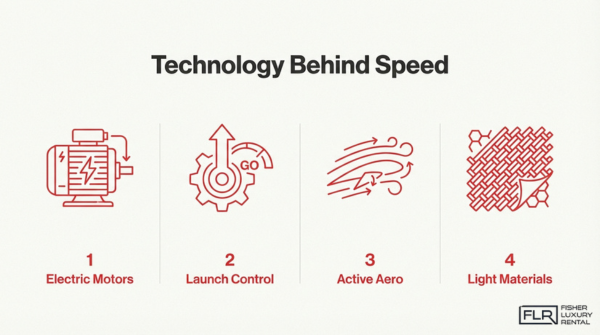
Hybrid powertrains, electric all-wheel-drive systems, lightweight materials, and active aerodynamics work together to shave fractions of a second from launch times. Power-to-weight ratio and tire technology remain the most decisive variables in determining where a car lands on the acceleration chart.
Rimac, Porsche, McLaren, Pininfarina, and Chevrolet lead the 2026 leaderboard with record-setting models that reflect a broader shift toward electrified performance across the supercar market. We also explore how year-over-year acceleration gains are narrowing as production cars approach physical limits, and how Fisher Luxury Rental provides direct access to elite exotic vehicles for drivers who want to feel these numbers from behind the wheel.
Which 2026 Exotic Cars Have the Quickest 0-60 Acceleration?
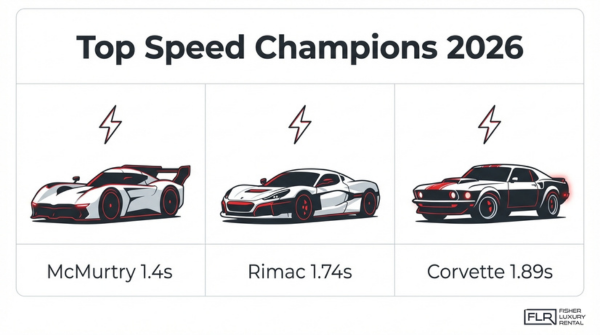
The 2026 exotic cars with the quickest 0-60 acceleration include the McMurtry Spéirling at 1.4 seconds, the Rimac Nevera R at 1.74 seconds, and the Chevrolet Corvette ZR1X at 1.89 seconds. Below, we break down the new models, compare their performance, and explore the technology behind these times.
What New Models in 2026 Achieve the Fastest 0-60 Times?
The new models in 2026 that achieve the fastest 0-60 times span both electric and hybrid powertrains. According to carwow, the McMurtry Spéirling is the fastest-accelerating car in the world as of early 2026, reaching 0-60 mph in 1.4 seconds. The standout production models include:
- The Rimac Nevera R hits 0-60 mph in 1.74 seconds using four electric motors and a 108-kWh battery.
- The Pininfarina Battista leads electric acceleration ratings at 1.8 seconds.
- The Chevrolet Corvette ZR1X clocks 1.89 seconds, making it the quickest American production car ever built.
- The Porsche 911 Turbo S (992.2) achieves 2.0 seconds with its hybrid powertrain.
What stands out most is the diversity of powertrains cracking the sub-2-second barrier; electrification is no longer optional at this performance tier.
How Do the Top 2026 Exotic Cars Compare in 0-60 Performance?
The top 2026 exotic cars compare in 0-60 performance across a range from 1.4 to 2.6 seconds, with electric models dominating the fastest positions. The following table shows how these vehicles stack up:
| Model | 0-60 mph (sec) | Powertrain | Notable Spec |
| McMurtry Spéirling | 1.4 | Electric | Track-focused, fan-assisted downforce |
| Rimac Nevera R | 1.74 | Electric (4 motors) | 108-kWh battery |
| Pininfarina Battista | 1.8 | Electric | Luxury grand tourer |
| Corvette ZR1X | 1.89 | Hybrid | 8.99-second quarter-mile |
| Porsche 911 Turbo S (992.2) | 2.0 | Hybrid | Road-legal sports car benchmark |
| Porsche Cayenne Turbo Electric | 2.4 | Electric | 1,139 HP SUV with launch control |
| Corvette E-Ray | 2.5 | Hybrid (eAWD) | 655 HP, V-8 plus electric motor |
| Hennessey Venom F5 | 2.6 | Twin-turbo V-8 | Combustion-only hypercar |
Pure electric vehicles claim the top three spots. Although the Hennessey Venom F5 remains competitive, combustion-only powertrains are clearly losing ground in the acceleration race.
What Technological Advances Contribute to Faster 0-60 Times in 2026 Exotic Cars?
The technological advances that contribute to faster 0-60 times in 2026 exotic cars center on electrified powertrains, lightweight construction, and active aerodynamics. According to a University of Bologna Ph.D. thesis by M. Sali, the use of lightweight materials and modular platforms directly leads to higher power-to-weight ratios and improved acceleration.
Key technologies driving these gains include:
- Hybrid and multi-motor electric powertrains that deliver instant torque with zero lag.
- Advanced launch control systems capable of managing forces so intense they produce tunnel-vision effects at full acceleration.
- Active aerodynamic components that adjust in real time to optimize downforce and stability during launch.
- Battery cell configurations engineered to maximize the power-to-weight trade-off for sub-4-second acceleration brackets.
Formula 1’s 2026 regulations, which emphasize increased electrical power and sustainable fuels, are accelerating the transfer of hybrid technology into road-legal supercars, shaping what future exotic cars will deliver in coming generations. Understanding these innovations helps frame why certain 2026 models deliver record-setting performance.
Why Do 0-60 Acceleration Times Matter for Exotic Cars?
0-60 acceleration times matter for exotic cars because they quantify the most visceral element of supercar ownership: raw launch speed. The following sections explore how acceleration shapes the driving experience and whether 0-60 remains the definitive performance benchmark.
How Does 0-60 Time Affect the Driving Experience?
0-60 time affects the driving experience by determining the intensity of force a driver feels during initial acceleration. Advanced launch control systems in today’s electric and hybrid supercars produce what automotive journalists at Pushing Pistons describe as “violent” acceleration, where even a 2.6-second 0-60 sprint can cause a “tunnel vision” effect for the driver.
That sensory impact is what separates exotic cars from standard performance vehicles. When a car reaches 60 mph in under two seconds, the g-forces compress the driver into the seat with enough pressure to blur peripheral vision momentarily. However, repeated exposure to ultra-fast launches can also produce motion sickness and dizziness, which is worth considering before stacking back-to-back runs. For most enthusiasts, the 0-60 moment defines the emotional peak of any exotic car encounter.
Are 0-60 Times the Best Way to Judge an Exotic Car’s Performance?
0-60 times are not the best way to judge an exotic car’s total performance, though they remain the most universally recognized metric. According to Yahoo Autos, performance testing by automotive publications highlights that 0-60 times are becoming less defining for sports cars as vehicles reach physical limits, with focus shifting toward top speed and track handling.
A car’s behavior once rolling often differs substantially from its standing-start capability. Metrics such as lateral grip, braking distance, and quarter-mile consistency reveal more about real-world composure. Top speed also retains significant prestige value in the supercar segment. The smartest approach treats 0-60 as one data point within a broader evaluation that includes cornering dynamics, powertrain refinement, and driver engagement at sustained speeds.
Understanding what 0-60 times reveal, and what they leave out, helps frame the mechanical factors that actually produce those numbers.
What Factors Influence 0-60 Times in Exotic Cars?
The factors that influence 0-60 times in exotic cars include engine type, powertrain configuration, vehicle weight, and aerodynamic design. The following subsections break down how each factor contributes to acceleration performance.
How Do Engine Types and Powertrains Impact 0-60 Times?
Engine types and powertrains impact 0-60 times by determining how much power reaches the wheels and how efficiently that power converts into forward motion. Pure electric powertrains deliver instant torque from zero rpm, which eliminates turbo lag and transmission shift delays. Hybrid configurations combine combustion engines with electric motors for supplemental low-end thrust. The Rimac Nevera R, for example, uses four electric motors and a 108-kWh battery to achieve a 1.74-second 0-60 mph time, according to Zero To 60 Times. All-wheel-drive systems further improve launch traction by distributing power across four contact patches instead of two. For most exotic cars in 2026, the powertrain architecture matters as much as raw horsepower; how that power is delivered off the line defines the acceleration gap between competitors.
What Role Does Vehicle Weight and Aerodynamics Play in Acceleration?
Vehicle weight and aerodynamics play a direct role in acceleration by dictating how much energy is needed to move the car and how effectively it manages airflow at speed. A lower power-to-weight ratio means the engine has less mass to overcome during launch. According to a University of Bologna Ph.D. thesis by M. Sali, the use of lightweight materials and modular platforms in sports car design results in higher power-to-weight ratios, which directly leads to improved acceleration. Active aerodynamic components, including adjustable spoilers and underbody diffusers, reduce drag during straight-line sprints while adding downforce for stability. Carbon fiber, aluminum, and titanium construction keep curb weight low without sacrificing structural rigidity. These engineering choices explain why two cars with identical horsepower can post very different 0-60 results.
With these mechanical factors understood, the next section highlights which 2026 models put them to record-breaking use.
What Are the Most Popular 2026 Exotic Cars with Record-Breaking Acceleration?
The most popular 2026 exotic cars with record-breaking acceleration span electric hypercars, hybrid supercars, and electrified American performance machines. Below, we break down which brands lead the leaderboard and what standout features set them apart.
Which Brands Dominate the Fast 0-60 Leaderboard in 2026?
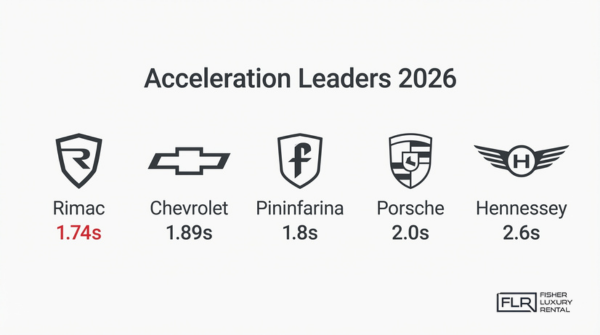
The brands that dominate the fast 0-60 leaderboard in 2026 include Rimac, Chevrolet, Pininfarina, Porsche, and Hennessey. Each occupies a distinct tier in the supercar vs hypercar hierarchy:
- Rimac leads the hypercar segment with the Nevera R, which hits 0-60 mph in 1.74 seconds using four electric motors and a 108-kWh battery.
- Chevrolet claims the fastest American production car title; according to Pedal Commander, the 2026 Corvette ZR1X records a 1.89-second 0-60 mph sprint with an 8.99-second quarter-mile.
- Pininfarina places the Battista at 1.8 seconds, competing directly in the electric hypercar bracket.
- Porsche covers multiple segments, from the 911 Turbo S hybrid at 2.0 seconds to the Cayenne Turbo Electric at 2.4 seconds.
- Hennessey represents the combustion holdouts with the Venom F5 at 2.6 seconds.
The diversity here is striking. Electrification no longer belongs to a single niche; it defines the entire top tier of acceleration performance.
What Are the Standout Features of These Top Accelerating Cars?
The standout features of these top accelerating cars center on hybrid and electric powertrains, advanced launch control, and exceptional power-to-weight ratios. The McLaren W1 achieves a claimed power-to-weight ratio of 2.45 pounds per horsepower, significantly lower than the Ferrari 296 GTB hybrid, according to Car and Driver. Quad-motor configurations in vehicles like the Rimac Nevera R deliver independent torque vectoring to each wheel, maximizing traction off the line. Hybrid systems, such as the one in the Porsche 911 Turbo S, combine combustion responsiveness with electric torque fill for near-instantaneous power delivery. These technologies work together so effectively that the real differentiator is no longer raw horsepower alone; it is how precisely each system manages power at the moment of launch. For a wider view across performance categories, our ranking of the best exotic cars covers top performers in every segment.
With these record-setters defining the current landscape, understanding how their times compare to previous years reveals just how fast the segment is evolving.
How Do 2026 Exotic Cars’ 0-60 Times Compare to Previous Years?
2026 exotic cars’ 0-60 times represent a dramatic leap forward compared to previous years. The trends below show how acceleration benchmarks have compressed over recent model years.
What Trends Can We See in Exotic Car Acceleration Over Recent Model Years?
The trends in exotic car acceleration over recent model years reveal a consistent compression of 0-60 times, driven largely by electrification and hybrid powertrains. In 2006, the Ford GT recorded a Lightning Lap time of 3:00.7, a performance level that, according to Car and Driver’s historical data, is no longer competitive among today’s top-tier vehicles.
By 2026, the fastest production cars have shattered previous benchmarks:
- The Rimac Nevera R achieves 0-60 mph in 1.74 seconds with four electric motors.
- The Pininfarina Battista reaches 60 mph in 1.8 seconds.
- The Porsche 911 Turbo S (992.2) hits 2.0 seconds using a hybrid powertrain.
What once required purpose-built race cars now comes standard in road-legal models. Each generation pushes closer to the physical limits of tire grip and human tolerance, making the gap between exotic cars and motorsport machinery smaller than ever. For deeper context on how the segment has evolved over decades, explore our breakdown of supercar facts and history. With how quickly these records are falling, experiencing today’s fastest models firsthand becomes all the more compelling.
How Can Car Enthusiasts Experience 2026’s Fastest Exotic Cars?
Car enthusiasts can experience 2026’s fastest exotic cars through exotic car rental services, track day events, and automotive experience centers. The sections below cover where to rent these vehicles and what to know before driving them.
Where Can You Rent a 2026 Exotic Car for the Ultimate Driving Experience?
You can rent a 2026 exotic car for the ultimate driving experience through specialty exotic car rental companies that maintain fleets of high-performance vehicles. These providers offer access to models from brands like Ferrari, McLaren, Lamborghini, and Porsche without the commitment of ownership. Fisher Luxury Rental serves the Phoenix and Portland metro areas with a curated fleet of top-trim exotic and luxury vehicles, including many of the most rented exotic cars in Phoenix that enthusiasts book through flexible rental options.
Renting removes the barrier of six- and seven-figure purchase prices, letting drivers experience sub-3-second 0-60 acceleration firsthand. According to a 2025 openPR hypercar market report, the global hypercar market is valued at approximately US $56,897.23 million and is projected to grow at a 10.54% CAGR through 2033, reflecting surging consumer demand for these machines. For most enthusiasts, renting remains the most practical way to get behind the wheel of the latest exotic performance technology.
What Should Renters Know About Driving High-Performance Exotic Vehicles?
Renters should know that driving high-performance exotic vehicles requires preparation, respect for the car’s capabilities, and awareness of physical effects. Key considerations include:
- Acceleration forces are intense. According to autoevolution, repeated exposure to ultra-fast 0-60 launches can cause motion sickness, dizziness, and mild head trauma from rapid acceleration forces.
- Safety systems help, but attention is essential. Modern supercars use electronic stability control, traction management, and carbon-ceramic brakes to manage extreme performance risks.
- Launch control changes the experience. Advanced launch control in electric and hybrid exotics can produce a tunnel-vision effect, even at 2.6-second 0-60 speeds.
- Insurance and deposit requirements vary. Most rental providers require supplemental coverage and substantial security deposits for vehicles in this performance tier.
Gradually building speed on early drives is the smartest approach. With the right preparation, renting an exotic car becomes the gateway to firsthand hypercar performance. Companies like Fisher Luxury Rental emphasize both vehicle quality and customer preparation, ensuring renters understand the capabilities of high-performance machines before experiencing their full acceleration potential
How Can Fisher Luxury Rental Help You Experience the Fastest Exotic Cars of 2026?
Fisher Luxury Rental can help you experience the fastest exotic cars of 2026 by providing premium access to a curated fleet of high-performance vehicles. Below, explore the rental options available and the key acceleration insights covered in this guide.
Can Fisher Luxury Rental’s Premium Exotic and Luxury Car Rentals Provide Access to 2026’s Top Acceleration Models?
Yes, Fisher Luxury Rental’s premium exotic and luxury car rentals can provide access to 2026’s top acceleration models through a fleet that includes some of the most sought-after performance nameplates. Fisher Luxury Rental offers access to premium exotic and luxury vehicles including models from Ferrari, McLaren, Lamborghini, Corvette, and Porsche. Each model represents a brand currently pushing the boundaries of 0-60 performance in 2026. Renting eliminates the commitment of ownership while delivering the visceral thrill of driving machines engineered for extreme acceleration. For anyone who wants to feel what sub-3-second launches are like firsthand, a rental experience is the most practical path.
What Are the Key Takeaways About the Fastest Exotic Cars 0-60 Times 2026: Top Acceleration List We Covered?
The key takeaways about the fastest exotic cars 0-60 times 2026: top acceleration list we covered are:
- Hybrid and electric powertrains now dominate the acceleration leaderboard, with models like the Rimac Nevera R reaching 0-60 in 1.74 seconds.
- Lightweight materials and advanced power-to-weight ratios directly improve launch performance across every segment.
- Active aerodynamics and launch control systems transform raw horsepower into consistent, repeatable acceleration runs.
- According to a 2025 openPR hypercar market report, the global hypercar market is projected to expand at a CAGR of 10.54% from 2026 to 2033, signaling sustained demand for these machines.
- Safety technologies such as electronic stability control and carbon-ceramic brakes are essential for managing the forces generated by sub-2-second sprints.
For enthusiasts ready to move beyond the numbers on a spec sheet, Fisher Luxury Rental puts these performance benchmarks within reach.