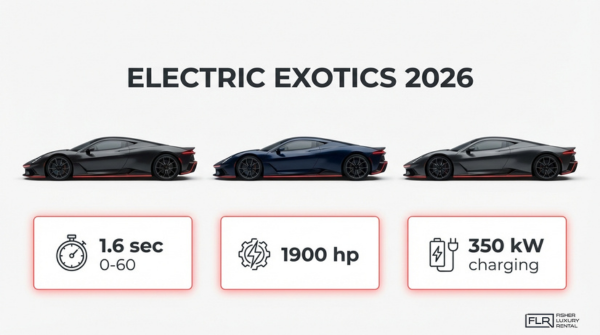
The best electric exotic cars and hypercars for 2026 are high-performance luxury vehicles from manufacturers like Rimac, Ferrari, Lamborghini, Pininfarina, Lotus, and Lucid that combine sub-two-second acceleration, 800V architecture, and supercar design with zero-emission electric powertrains.
This guide covers hypercar performance benchmarks, the electric exotic car landscape and how it compares to combustion rivals, standout supercar features and technology, range and charging usability, pricing and availability, the evolving luxury driving experience, and how to get behind the wheel through Fisher Luxury Rental.
Models like the Rimac Nevera R, Pininfarina Battista, and Lucid Air Sapphire are rewriting acceleration and top-speed records, with 0-60 times falling below 1.9 seconds and power outputs exceeding 1,200 horsepower.
Heritage brands are entering the space aggressively. Ferrari’s all-electric Luce and the Lamborghini Lanzador represent a philosophical shift; these marques now engineer electric drivetrains that preserve their signature character rather than mimic combustion engines.
Advances in axial flux motors, solid-state battery development, and 800V charging systems allow 2026 electric exotics to deliver 350 kW fast charging and real-world ranges approaching 200 miles, directly addressing the two biggest consumer concerns: range anxiety and charge time.
Pricing for these vehicles spans from roughly $200,000 for electric supercars to well over $2 million for limited-production hypercars, with staggered release windows throughout 2026 and beyond.
The shift to electric powertrains is reshaping what luxury performance feels like, from instant torque delivery to engineered motor acoustics, and Fisher Luxury Rental provides a way to experience these machines firsthand.
Which 2026 Electric Hypercars Are Setting New Performance Benchmarks?
The 2026 electric hypercars setting new performance benchmarks include the Rimac Nevera R, Pininfarina Battista, and Lucid Air Sapphire. These machines redefine speed records, acceleration limits, and the underlying technology powering them.
What Are the Top Speed and Acceleration Records for New Electric Hypercars?
The top speed and acceleration records for new electric hypercars span from sub-two-second 0-60 times to speeds exceeding 268 mph. According to Rimac Newsroom, the Rimac Nevera R achieved a 0-60 mph time of 1.66 seconds and a top speed of 431.45 km/h (268.2 mph), setting 24 performance records.
Other leading benchmarks include:
- The Pininfarina Battista produces 1,900 horsepower and 2,340 Nm of torque, reaching 0-100 km/h in 1.86 seconds with a 350 km/h top speed.
- The Lucid Air Sapphire generates 1,234 horsepower from a three-motor powertrain, hitting 0-60 mph in 1.89 seconds and a top speed of 205 mph.
- The Lamborghini Lanzador targets a top speed exceeding 220 mph with dual-motor all-wheel drive.
These figures confirm that electric powertrains have moved well beyond parity with combustion hypercars; they now dominate outright.

How Do 2026 Electric Hypercars Innovate in Technology and Design?
2026 electric hypercars innovate in technology and design through advanced motor architectures, next-generation battery chemistry, and high-voltage platforms. Next-generation axial flux motors, such as those developed by YASA, deliver 1,000-plus horsepower from units weighing as little as 28 pounds, dramatically improving power density over conventional radial-flux designs.
High-voltage 800V architectures, operating between 600V and 900V, enable ultra-fast charging at 350 kW or more while reducing wiring harness weight. Solid-state batteries are also entering the picture; according to Fortune Business Insights, the global EV solid-state battery market is projected to grow from $78.6 million in 2026 to $3,582.7 million by 2034. Ferrari is even engineering its Luce to amplify authentic electric motor sound through specific frequencies rather than simulating combustion noise. These innovations collectively push hypercars beyond raw speed into a new era of efficiency and sensory refinement.
What Distinguishes the Electric Exotic Car Options Coming in 2026?
The electric exotic car options coming in 2026 are distinguished by heritage brands entering the EV space, multi-motor powertrains exceeding 1,000 horsepower, and performance that rivals or surpasses combustion predecessors. The following sections cover which brands lead this market and how electric exotics compare to traditional models.
Which Brands Are Leading the 2026 Electric Exotic Car Market?
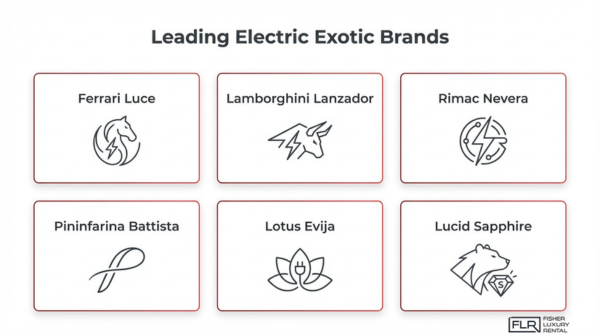
The brands leading the 2026 electric exotic car market include Ferrari, Lamborghini, Rimac, Pininfarina, Lotus, and Lucid. Ferrari enters with the Luce, Modena’s first all-electric vehicle, producing 11,500 Nm of torque in launch mode. Lamborghini follows with the Lanzador, a 2+2 ultra-GT featuring dual electric motors and all-wheel drive, with an expected top speed exceeding 220 mph.
Established EV-native manufacturers are equally aggressive. The Pininfarina Battista delivers 1,900 horsepower and 2,340 Nm of torque, while Lucid’s Air Sapphire produces 1,234 horsepower from its three-motor powertrain. According to Stellar Market Research, the global luxury electric vehicle market is expected to reach $214.7 billion in 2026, growing toward $838.11 billion by 2032. That trajectory confirms electric exotics are no longer niche experiments; they represent the core growth strategy for the world’s most prestigious automakers. The lineup of luxury exotic car brands entering the EV era is broader today than at any point in modern automotive history.
How Do Electric Exotics Compare to Traditional Combustion Exotics?
Electric exotics compare to traditional combustion exotics favorably in acceleration and torque delivery, though differences remain in driving character and range perception. Instant torque from electric motors eliminates turbo lag entirely, giving models like the Lucid Air Sapphire a 0-to-60-mph time of 1.89 seconds, a figure most combustion exotics cannot match.
Quality has also improved considerably. According to the 2026 J.D. Power U.S. Electric Vehicle Experience Ownership Study, the premium EV segment recorded 75.0 problems per 100 vehicles, its best result since 2021. Still, combustion loyalists raise valid concerns: a Deloitte survey found 47% of U.S. consumers cite driving range as their top EV concern, with charging time close behind at 44%.
For pure straight-line performance, electric exotics now dominate. Where combustion models retain an edge is in emotional feedback, such as engine sound and progressive throttle feel, though brands like Ferrari are addressing this by engineering amplified motor acoustics rather than synthetic engine noise. Understanding these standout features reveals what makes 2026 electric supercars compelling beyond raw speed.
What Are the Standout Features of 2026 Electric Supercars?
The standout features of 2026 electric supercars include multi-motor powertrains exceeding 1,200 horsepower, luxury-grade interiors, and advanced technologies like 800V charging architectures and axial flux motors. The sections below explore performance, luxury appointments, and cutting-edge tech.
Which Performance and Luxury Features Define 2026 Electric Supercars?
The performance and luxury features that define 2026 electric supercars are extreme multi-motor power outputs, sub-two-second acceleration, and refined cabin appointments that rival grand tourers. The Lucid Air Sapphire uses a three-motor powertrain producing 1,234 horsepower, reaching 0 to 60 mph in 1.89 seconds with a 205 mph top speed. The Pininfarina Battista delivers 1,900 horsepower and 2,340 Nm of torque, achieving 0 to 100 km/h in 1.86 seconds. This spread between 1,234 and 1,900 horsepower reflects the blurring supercar vs hypercar boundary as electric drivetrains redefine both categories.
Beyond raw speed, these supercars prioritize daily usability alongside luxury. According to Automobili Pininfarina, the Battista pairs its output with a top speed of 350 km/h and bespoke interior personalization. Instant torque delivery, paired with handcrafted materials and near-silent cabins, creates an experience where performance and refinement coexist rather than compete.
What Cutting-Edge Tech Is Found in the Latest Electric Supercars?
The cutting-edge tech found in the latest electric supercars includes 800V electrical architectures, next-generation axial flux motors, and engineered acoustic systems. High-performance EVs are migrating to 800V platforms, operating between 600V and 900V, to enable ultra-fast charging rates of 350 kW or more while reducing wiring harness weight.
Axial flux motors represent another leap forward. According to Yahoo Finance, next-generation units developed by companies like YASA deliver 1,000-plus horsepower from motors weighing as little as 28 pounds, offering dramatically higher power density than conventional radial-flux designs.
Even the sensory experience is being reimagined. Ferrari is engineering the Luce to amplify the authentic sound of its electric motors by playing specific frequencies rather than simulating combustion noise. This approach preserves emotional engagement without resorting to artificial audio, setting a new standard for how electric supercars connect with their drivers.
While waiting for these next-generation electric Ferraris to reach the market, enthusiasts can experience the visceral connection of current Ferrari performance through rentals of models like the Ferrari 488 Spider, which delivers 661 horsepower and the signature Ferrari exhaust note through a twin-turbo V8.
With performance and technology defining the supercar tier, range and charging capabilities determine how practical these machines are beyond the track.

How Do 2026 Electric Exotic Cars Address Range, Charging, and Usability?
2026 electric exotic cars address range, charging, and usability through larger battery packs, 800V fast-charging architectures, and improved real-world practicality. The following subsections cover typical range figures and the rapid evolution of charging infrastructure.
What Is the Typical Range for 2026 Electric Hypercars and Exotics?
The typical range for 2026 electric hypercars and exotics falls between approximately 195 and 300+ miles, depending on the model and driving conditions. The Lotus Evija, for example, provides an all-electric range of 195 miles (314 km) under WLTP combined cycles, according to Lotus Cars. Grand touring-oriented models like the Lamborghini Lanzador and Lucid Air Sapphire target higher figures suited to longer drives.
Range remains a top concern for buyers. A Deloitte consumer survey found that 47% of U.S. respondents cited driving range as their primary hesitation with electric vehicles. For hypercars designed around track-level performance, shorter ranges reflect deliberate engineering trade-offs prioritizing power density over cruising distance. As solid-state battery technology matures, these figures should climb significantly in subsequent model years.
How Is Fast Charging Evolving for the 2026 Luxury Electric Segments?
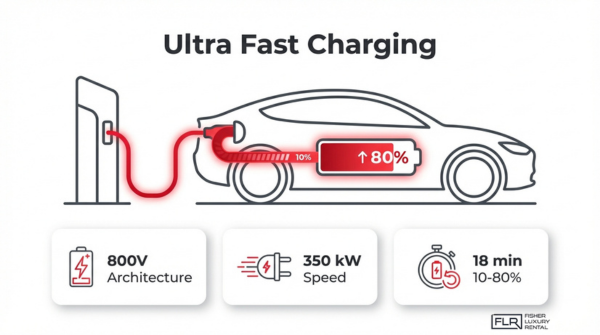
Fast charging for the 2026 luxury electric segments is evolving through widespread adoption of 800V electrical architectures that support ultra-fast charging rates of 350 kW or more. According to a 2025 technical review published on arXiv, high-performance EVs are migrating to 800V platforms, operating between 600V and 900V, to enable these speeds while simultaneously reducing wiring harness weight.
The Lotus Evija demonstrates the practical impact: its 800V, 350 kW charging system replenishes the battery from 10% to 80% in under 18 minutes. This level of speed makes mid-route charging stops comparable in duration to a brief fuel stop. For most exotic car owners and renters, the combination of 800V architecture and expanding DC fast-charging networks makes daily usability far more realistic than even two years ago.
With charging infrastructure rapidly catching up to performance, the next consideration for buyers is pricing and availability across these models.
How Do Prices and Availability Compare Among 2026 Electric Hypercars and Exotics?
Prices and availability for 2026 electric hypercars and exotics vary dramatically by manufacturer and production timeline. The sections below cover release windows and projected pricing for the most anticipated models.
When Will the Top 2026 Electric Exotics Be Available for Purchase or Rental?
The top 2026 electric exotics will be available on staggered timelines, with some already in limited production and others still approaching their debut. The Pininfarina Battista and Rimac Nevera are currently in customer hands through highly limited production runs. The Lamborghini Lanzador production version is expected to arrive in 2026 as a 2+2 ultra-GT with dual electric motors. According to Tesla Accessories News, Tesla is targeting an April 2026 production-intent reveal for the second-generation Roadster, with actual production ramp-up expected 12 to 18 months after that reveal. The Ferrari Luce, Lotus Evija, and Lucid Air Sapphire each occupy different stages of production readiness. For enthusiasts unwilling to wait or commit to seven-figure purchases, rental availability through specialty fleets offers a practical alternative.
What Are the Projected Price Ranges for 2026’s Most Coveted Models?
The projected price ranges for 2026’s most coveted electric exotic models span from roughly $250,000 to well over $2 million, depending on exclusivity and performance tier.
- The Rimac Nevera R commands pricing above $2.4 million, reflecting its record-setting 1.66-second 0-60 mph capability.
- The Pininfarina Battista, with 1,900 horsepower, carries a base price near $2.2 million.
- The Lotus Evija is positioned around $2.1 million for its limited production allocation.
- The Ferrari Luce is expected to exceed $500,000 as Ferrari’s first all-electric model.
- The Lamborghini Lanzador and Tesla Roadster are anticipated below the $500,000 threshold.
According to Stellar Market Research, the global luxury electric vehicle market is expected to reach $214.7 billion in 2026, confirming strong demand across these price segments. With rising interest and constrained supply shaping the electric exotic landscape, understanding how these vehicles transform the broader luxury driving experience becomes equally important.
How Does the Rise of Electric Exotic Cars Impact the Luxury Car Experience?
The rise of electric exotic cars impacts the luxury car experience by redefining performance expectations and dividing enthusiast opinion. Below, we explore how the driving experience itself changes and how owners are responding.
In What Ways Does Driving Electric Change the Exotic Car Experience?
Driving electric changes the exotic car experience by delivering instant torque, near-silent cabins, and acceleration that redefines what feels fast. Electric powertrains eliminate turbo lag and gear shifts entirely, producing seamless thrust from a standstill. The Pininfarina Battista, for example, delivers 1,900 horsepower and 2,340 Nm of torque for a 0-100 km/h time of 1.86 seconds, according to Automobili Pininfarina.
Yet this raw speed comes with trade-offs that reshape the sensory experience:
- Engine sound, long central to exotic car identity, is absent or artificially generated.
- Ferrari is engineering its first EV to amplify authentic motor frequencies rather than simulate combustion noise.
- Regenerative braking alters pedal feel and driving rhythm.
- Lower center of gravity from battery placement sharpens cornering dynamics.
For many drivers, the visceral connection to a screaming V8 or V12 defined the exotic experience. Electric exotics must replace that emotional layer with new sensations, and the best ones succeed by making sheer acceleration the centerpiece. For those who still prioritize that traditional combustion exotic experience, luxury rental fleets in markets like Phoenix and Portland offer access to current-generation supercars like the McLaren 720S and Lamborghini Huracán Spyder, allowing drivers to experience that visceral engine sound and progressive power delivery firsthand.
How Are Owners and Enthusiasts Reacting to Electric Exotic Models?
Owners and enthusiasts are reacting to electric exotic models with a mix of genuine excitement and lingering skepticism. Performance benchmarks generate undeniable enthusiasm; even seasoned collectors acknowledge the physics-defying acceleration these cars achieve.
However, real concerns persist. According to a 2025 Deloitte Global Automotive Consumer Study, 47% of surveyed U.S. consumers cited driving range as their top concern for electric vehicles, with charging time following at 44%. These practical anxieties carry into the exotic segment, where weekend drives and track days demand reliable range and rapid recharging.
Purists still question whether an electric exotic can deliver the same emotional engagement as combustion-powered predecessors. That said, quality improvements are shifting perceptions. The premium EV segment recorded 75.0 problems per 100 vehicles in 2026, its best score since 2021, signaling that reliability concerns are fading. As electric exotics mature, firsthand experience behind the wheel is converting skeptics faster than any spec sheet. For a broader look at where the segment is heading, our overview of future exotic cars maps the technologies and trends redefining luxury automotive design.
With the luxury car experience evolving rapidly, experiencing these models firsthand remains the best way to judge.
How Can You Experience the Best 2026 Electric Exotic Cars With Fisher Luxury Rental?
Fisher Luxury Rental offers a curated fleet of high-performance exotic and luxury vehicles available across Phoenix and the Pacific Northwest, providing an opportunity to experience luxury and exotic driving. Below, discover what Fisher Luxury Rental offers and the key takeaways from 2026’s electric exotic car landscape.
What Electric Exotic and Luxury Cars Does Fisher Luxury Rental Offer for Driving Enthusiasts?
Fisher Luxury Rental offers driving enthusiasts a fleet of exotic and luxury vehicles in the Phoenix area and the Pacific Northwest, including models such as the Ferrari 488 Spider, McLaren 720S, and Lamborghini Huracán Spyder. Each vehicle is a top-trim model maintained to exacting standards.
As manufacturers like Ferrari, Lamborghini, and Rimac push electric performance into hypercar territory, the opportunity to experience high-performance exotic cars becomes increasingly compelling. Renting provides a way to experience exotic car performance, and Fisher Luxury Rental offers access to traditional exotic vehicles like the Ferrari 488 Spider and McLaren 720S, whether for a weekend getaway through Scottsdale or a scenic drive outside Portland.
What Are the Key Takeaways About the Best Electric Exotic Cars and Hypercars for 2026?
The key takeaways about the best electric exotic cars and hypercars for 2026 center on three themes: unprecedented performance, rapid technological evolution, and growing accessibility.
- Electric hypercars now deliver sub-two-second 0-60 mph times, with models like the Rimac Nevera R, Pininfarina Battista, and Lucid Air Sapphire redefining acceleration benchmarks.
- Brands such as Ferrari, Lamborghini, and Lotus are entering the electric segment with vehicles engineered to preserve each marque’s distinct character.
- Advances in 800V charging architecture and solid-state battery development are steadily closing the gap on range and charging concerns.
- Premium EV quality continues to improve, reinforcing buyer and renter confidence in the segment.
For enthusiasts eager to experience exotic car performance firsthand, specialty rental companies provide a path from curiosity to experience. Explore Fisher Luxury Rental’s full exotic cars collection to find top-trim Ferraris, Lamborghinis, McLarens, and more across Phoenix and the Pacific Northwest.