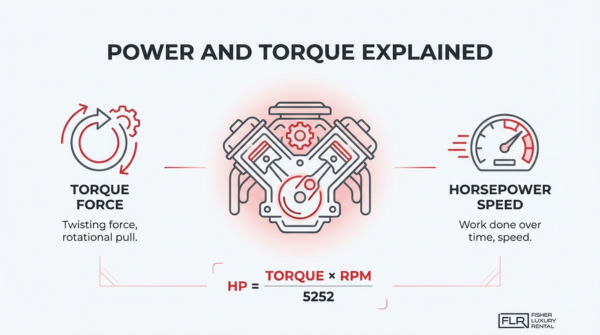
Engine horsepower is the rate at which an engine performs work, calculated by multiplying torque by RPM and dividing by 5,252. Torque is the rotational force the engine produces; horsepower measures how quickly that force is applied over time.
This guide covers the fundamentals of horsepower and torque, how these two forces interact within an engine and transmission, the design and fuel factors that shape power output, driving techniques that maximize performance, and what all of this means behind the wheel of an exotic rental.
Horsepower and torque each serve distinct roles in how a vehicle performs. Torque drives initial acceleration off the line, while horsepower sustains speed and determines top-end capability. Understanding which metric matters in a given scenario clears up one of the most common points of confusion among car enthusiasts.
Inside the engine, these forces never operate independently. Gear ratios multiply torque at low speeds and trade it for velocity at higher gears, meaning the transmission plays a direct role in how power reaches the wheels. Different engine configurations prioritize one characteristic over the other depending on their intended purpose.
Several engineering variables control total output. Displacement, air intake volume, forced induction systems like turbochargers, and fuel octane ratings all influence how much horsepower and torque an engine can deliver.
Knowing where peak power and torque sit in the RPM range helps drivers shift at the right moment and select the right vehicle for their goals. These principles apply directly to the experience of driving high-performance exotic cars available through luxury rental services.
What Is Engine Horsepower and How Is It Calculated?
Engine horsepower is a unit of measurement that quantifies the rate at which an engine performs work. According to Power Test, LLC, horsepower is mathematically defined as (Torque × RPM) / 5,252, where torque is measured in pound-feet and RPM is revolutions per minute. The following sections explain why this metric matters for performance and how ratings have evolved.

Why Is Horsepower an Important Measure in Automotive Performance?
Horsepower is an important measure in automotive performance because it represents the maximum acceleration capacity an engine can sustain at any given velocity. While torque initiates movement, horsepower determines how quickly and consistently that force translates into speed over time.
This distinction matters when evaluating vehicles for highway passing, top speed, and sustained high-speed driving. A common misconception is that torque alone determines acceleration; however, as automotive engineer Jason Fenske of Engineering Explained clarifies, horsepower accounts for the critical relationship between work and time that governs real-world speed. For anyone comparing performance vehicles, horsepower provides the most reliable single number for understanding overall power delivery.
How Have Horsepower Ratings Changed Over Time?
Horsepower ratings have changed significantly over time due to shifting regulatory priorities and engineering advances. Between 1975 and the early 1980s, average new vehicle horsepower fell sharply as manufacturers prioritized fuel economy in response to emissions standards and fuel crises; vehicle weight dropped during this same period.
The trend reversed after 2004. According to the U.S. Environmental Protection Agency’s Automotive Trends Report, fuel economy, horsepower, and weight have all generally increased together since that year. Advances in turbocharging, direct injection, and variable valve timing allowed engineers to extract more power from smaller, more efficient engines. This parallel rise means modern vehicles no longer force buyers to choose between power and efficiency, a shift that fundamentally reshaped how consumers evaluate engine performance.
What Is Torque in Cars and How Does It Differ from Horsepower?
Torque in cars is the rotational force an engine produces, while horsepower measures the rate at which that force performs work over time. The following subsections explain how torque shapes acceleration and why it matters for towing.
How Does Engine Torque Affect Acceleration and Driving Experience?
Engine torque affects acceleration and driving experience by determining how forcefully the drivetrain can push the vehicle forward from a standstill. Torque is the primary factor for initial acceleration, while horsepower becomes more critical for maintaining peak speed, according to Kelley Blue Book.
A high-torque engine delivers strong, immediate thrust when you press the accelerator. That sensation of being pushed back into your seat at a green light comes directly from available torque at low RPM. As speed builds, horsepower takes over to sustain momentum. This is why a common misconception persists: many drivers believe torque alone determines acceleration, when horsepower actually represents the maximum acceleration capacity at any given velocity.
For anyone who has driven a high-performance exotic, the interplay between these two forces is what makes the experience unforgettable.
What Role Does Torque Play in Towing and Hauling Capabilities?
Torque plays a central role in towing and hauling capabilities because moving heavy loads from rest requires sustained rotational force at low engine speeds. Without adequate torque, a vehicle struggles to overcome the inertia of a loaded trailer, regardless of its horsepower rating.
The SAE J2807 standard, published by SAE International, establishes minimum performance criteria for determining a vehicle’s Gross Combination Weight Rating and Trailer Weight Rating through specific acceleration, braking, and handling tests. Vehicles rated for higher towing capacities consistently feature engines tuned for peak torque delivery at lower RPM ranges.
This is precisely why trucks and heavy-duty SUVs prioritize torque over top-end horsepower. For drivers choosing between vehicles, matching torque output to the intended load matters more than chasing headline power figures.
With torque’s role in real-world performance now clear, understanding how horsepower and torque interact inside the engine reveals the full picture.
How Do Horsepower and Torque Work Together in a Car’s Engine?
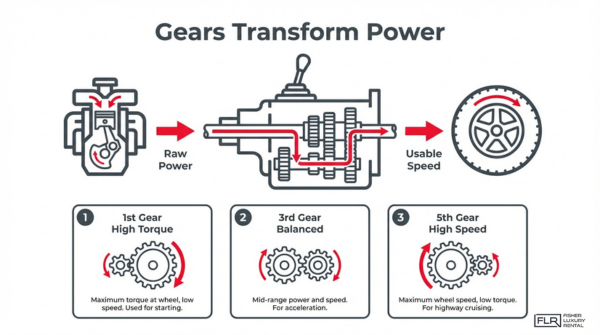
Horsepower and torque work together in a car’s engine through the transmission, which uses gear ratios to convert raw rotational force into usable speed. The sections below explain how gear ratios manage this relationship and why different engine designs prioritize one metric over the other.
How Do Gear Ratios Influence the Use of Horsepower and Torque?
Gear ratios influence the use of horsepower and torque by multiplying or reducing the engine’s rotational force before it reaches the wheels. According to Iris Dynamics, a 2:1 gear ratio multiplies the input torque by a factor of 2 while simultaneously reducing the output rotational speed by the same factor. Lower gears amplify torque for acceleration from a stop, while higher gears trade that force multiplication for greater wheel speed. This mechanical exchange is why the transmission serves as the critical link between what the engine produces and how the car actually performs. Without gear ratios translating the power band effectively, even a high-output engine would struggle to deliver smooth, usable performance across varying driving conditions. Choosing between a manual vs automatic exotic car determines how directly the driver controls these gear changes and how the engine’s torque reaches the wheels.
Why Do Different Engines Emphasize Horsepower or Torque?
Different engines emphasize horsepower or torque because each metric serves a distinct performance purpose. High-torque engines deliver stronger rotational force at lower RPM, which benefits heavy loads and rapid launches. High-revving engines prioritize horsepower, sustaining power output at elevated speeds where maintaining velocity matters most.
According to Engineering Explained, high-torque engines typically provide faster initial acceleration until meeting resistance, at which point engines with higher horsepower can maintain higher top speeds. Diesel truck engines, for example, produce massive low-end torque for towing. Sports car engines like those in a Lamborghini Huracan or McLaren 720S, by contrast, are tuned to deliver peak horsepower across a broad RPM range. Our Ferrari vs Lamborghini vs McLaren comparison breaks down exactly how each manufacturer’s engine philosophy translates to real-world driving feel. Choosing between these approaches depends entirely on the intended driving application, from hauling capacity to track performance.
What Factors Influence a Car’s Horsepower and Torque Output?
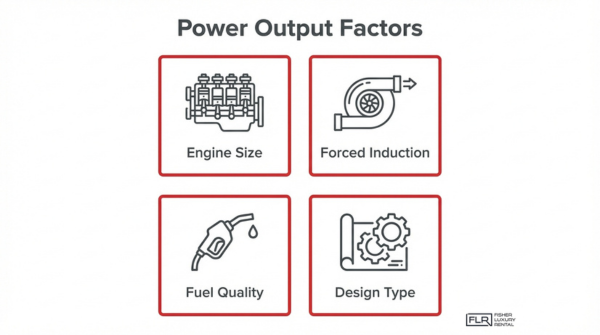
A car’s horsepower and torque output depends on engine design, forced induction systems, and fuel characteristics. The following subsections cover how displacement shapes power, how turbochargers and superchargers multiply it, and how fuel type and quality protect or limit performance.
How Do Engine Design and Displacement Impact Power?
Engine design and displacement impact power by determining how much air and fuel the combustion chambers can process per cycle. Larger displacement engines draw in a greater volume of the air-fuel mixture, producing more torque at lower RPMs. According to research from Oregon State University, the primary factor in determining engine power output is the mass of air that enters the chamber for combustion, since air density is significantly lower than fuel density.
Cylinder configuration also plays a role. V8 engines generate power differently than inline-four layouts, even at similar displacements, because bore diameter, stroke length, and valve timing all shape the torque curve. For high-performance applications, maximizing airflow per combustion event remains the single most effective way to increase output.
What Effect Do Turbochargers and Superchargers Have on Power and Torque?
Turbochargers and superchargers increase power and torque by forcing more air into the combustion chamber than atmospheric pressure alone allows. This process, called forced induction, raises the effective air mass per cycle, which enables more fuel to burn and produce greater output from the same displacement.
The two systems differ in how they are driven. Turbochargers use exhaust gas energy, while superchargers are mechanically driven by the crankshaft. That mechanical connection comes at a cost: according to Kitplanes, driving a supercharger generating 14 psi of boost can require approximately 75 horsepower, yet it adds roughly 100 horsepower to total engine output. The net gain still makes forced induction one of the most efficient paths to higher performance without increasing engine size.
How Do Fuel Type and Quality Affect Engine Performance?
Fuel type and quality affect engine performance by influencing combustion stability and the compression ratios an engine can safely use. Higher-octane fuels resist premature detonation, known as engine knock, which allows manufacturers to tune engines for more aggressive ignition timing and higher compression.
According to a study published by the National Institute of Standards and Technology, higher compression ratios result in higher knock intensities, which can lower a fuel’s rating by approximately one octane unit while increasing the requirement for higher-octane fuels to prevent engine damage. Running lower-grade fuel than an engine requires forces the engine control unit to retard timing, reducing both horsepower and torque. For performance vehicles, premium fuel is not optional; it is the baseline that unlocks the engine’s designed output.
Fisher Luxury Rental maintains all fleet vehicles with premium fuel and follows manufacturer specifications to ensure every rental delivers the full performance potential customers expect from exotic cars. Review the complete fuel and refueling rules before your rental to understand exactly what each vehicle requires at the pump. With these mechanical and chemical factors understood, drivers can apply specific techniques to extract the most from their engine’s capabilities.
How Can Drivers Make the Most of Horsepower and Torque on the Road?
Drivers can make the most of horsepower and torque on the road by mastering gear selection, throttle control, and understanding their vehicle’s power band. The sections below cover driving techniques and vehicle selection criteria.
What Driving Techniques Best Utilize a Car’s Power and Torque?
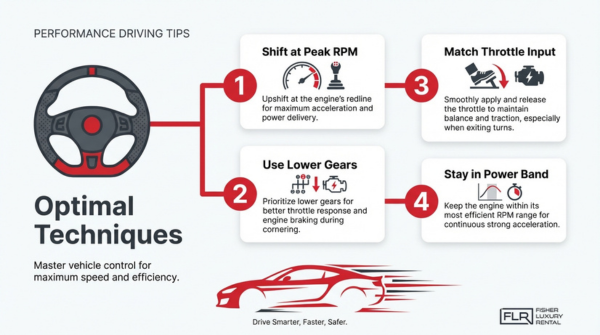
The driving techniques that best utilize a car’s power and torque center on keeping the engine within its optimal RPM range. According to a University of Southern Queensland study on engine performance, optimal gear shifting occurs when the engine is kept within the specific RPM range where both horsepower and torque curves are maximized for the intended performance.
Key techniques include:
- Shift at the right RPM. Upshift before the engine exceeds peak power RPM; downshift before torque drops too low for responsive acceleration.
- Use lower gears for launch. Lower gear ratios multiply torque at the wheels, delivering stronger initial pull from a stop.
- Match throttle to conditions. Gradual throttle application in wet or loose conditions prevents wheelspin and keeps torque productive.
- Stay in the power band during spirited driving. Keeping RPM between peak torque and peak horsepower ensures maximum responsiveness at any speed.
For most performance-oriented drivers, learning to feel where the engine delivers its strongest pull matters more than memorizing spec sheets. Structured exotic car driving experiences on supervised track days provide a controlled environment to practice these shifting and throttle techniques at full performance.
What Should You Consider When Choosing a Car for Optimal Performance?
The factors you should consider when choosing a car for optimal performance include the power-to-weight ratio, torque delivery characteristics, and how specific power aligns with your driving needs. A U.S. Department of Energy report identified increasing specific power (horsepower per unit of displacement) as the primary driver for automotive performance increases over the past two decades.
Practical selection criteria include:
- Power-to-weight ratio. A lighter car with moderate horsepower often accelerates faster than a heavier car with more power.
- Torque curve shape. Broad, flat torque curves deliver usable power across more RPM, making the car easier and more rewarding to drive daily.
- Intended use. High-torque vehicles suit towing and low-speed responsiveness, while high-horsepower cars excel at sustained high-speed performance.
- Transmission type. Dual-clutch and modern automatic transmissions optimize shift points automatically, extracting more usable performance from the engine.
Choosing based on how power is delivered, rather than peak numbers alone, consistently leads to a more satisfying driving experience. Rental services like Fisher Luxury Rental provide an opportunity to experience these power delivery differences firsthand across multiple vehicle types, from the broad torque curve of a Mercedes G-Wagon to the high-revving horsepower of a McLaren 720S. With performance priorities defined, experiencing these differences firsthand becomes the next step.
How Does Understanding Horsepower and Torque Enhance the Exotic Car Rental Experience at Fisher Luxury Rental?
Understanding horsepower and torque enhances the exotic car rental experience at Fisher Luxury Rental by helping renters appreciate what each vehicle delivers. The sections below cover how renting high-performance cars translates technical knowledge into real driving thrills, and the key takeaways about horsepower and torque differences.
How Does Renting a High-Performance Car from Fisher Luxury Rental Let You Experience True Engine Power?
Renting a high-performance car from Fisher Luxury Rental lets you experience true engine power by putting horsepower and torque concepts into physical motion you can feel. The Lamborghini Huracán LP 610-4 Spyder in the Fisher Luxury Rental fleet has a dry weight of 1,542 kilograms (3,399 lbs), producing a power-to-weight ratio of 5.57 lbs per horsepower, according to Lamborghini San Francisco. That ratio translates every principle covered in this article into visceral acceleration, from the initial torque surge off the line to sustained high-RPM horsepower at speed.
Fisher Luxury Rental’s fleet includes the Lamborghini Huracán Spyder Convertible, Ferrari 488 Spider, McLaren 720S, Porsche 911 Carrera S, and Corvette C8 Z06. Each model emphasizes different points on the horsepower-torque spectrum, so matching your knowledge to the right rental ensures the most rewarding drive.
What Are the Main Things to Remember About How Engine Horsepower Works and the Differences with Torque?
The main things to remember about how engine horsepower works and the differences with torque are:
- Torque is the rotational force an engine produces; horsepower is the rate at which that force does work over time.
- Horsepower is calculated as (Torque × RPM) / 5,252.
- Torque drives initial acceleration, while horsepower sustains top speed.
- High-torque engines feel stronger from a standstill; high-horsepower engines excel at maintaining velocity.
- Power-to-weight ratio determines how effectively a car uses its output.
- Gear ratios multiply torque at the wheels, shaping how power reaches the road.
Knowing these fundamentals helps drivers better appreciate the performance characteristics of any exotic car rental, transforming a luxury experience into an informed, exhilarating drive.