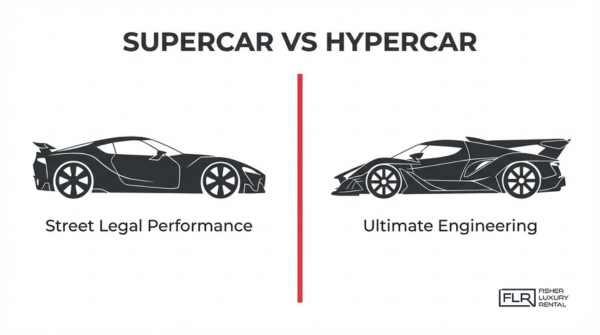
A supercar is a street-legal, high-performance vehicle capable of 0-60 mph times under 3.5 seconds and top speeds exceeding 200 mph. A hypercar represents the top echelon of that category, pushing past 250 mph through advanced technology, extreme engineering, and severely limited production.
This guide covers classification standards, technical performance specs, leading brands and models, pricing and exclusivity, and the rental experience as a way to compare these machines firsthand.
Supercars and hypercars earn their titles through distinct criteria. Supercars are classified by race-track-level power output and sub-3.5-second sprint times, while hypercars must meet higher thresholds in aerodynamics, materials science, and production scarcity to qualify.
Performance gaps between these tiers are measurable and significant. Supercars like the McLaren 750S produce around 740 hp with top speeds near 206 mph, while hypercars like the Bugatti Chiron Bolide deliver 1,825 hp and accelerate to 60 mph in under 2.2 seconds. Hybrid and electric powertrains now define the hypercar segment, with models like the Rimac Nevera generating 1,914 hp through four in-wheel motors.
The brand landscape reflects this divide clearly. Ferrari, Lamborghini, Porsche, and McLaren anchor the supercar market, while Bugatti, Koenigsegg, Pagani, and Rimac compete for hypercar dominance with production runs often limited to fewer than 100 units.
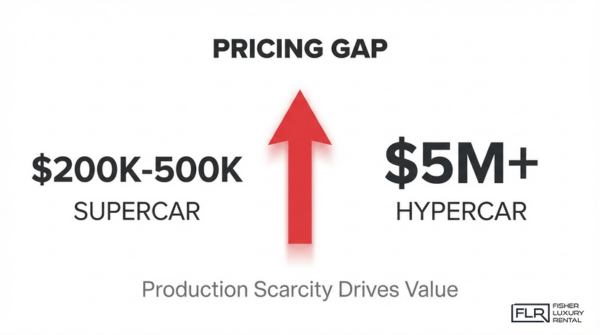
Pricing separates these categories dramatically. Supercars typically range from $200,000 to $500,000, whereas hypercars like the Bugatti W16 Mistral command $5 million per unit. Production scarcity drives these valuations; exclusivity often matters more to collectors than raw performance alone.
For those seeking a direct comparison without ownership commitment, exotic car rentals provide seat time in top-tier supercars and luxury vehicles, making the performance differences tangible rather than theoretical.
What Defines a Supercar Versus a Hypercar?
A supercar is a street-legal high-performance car, while a hypercar represents the most extreme tier above it. The distinctions come down to classification benchmarks and the standards each category must meet.
How Are Supercars Classified in the Automotive World?
Supercars are classified in the automotive world by a combination of acceleration, top speed, and street-legal performance capability. According to a 2021 Forbes classification guide, supercars are typically characterized by 0-60 mph acceleration times under 3.5 seconds and top speeds exceeding 200 mph. Race-track-level power output in a road-legal package is the baseline requirement.
Key classification criteria include:
- Acceleration from 0 to 60 mph in under 3.5 seconds.
- Top speeds surpassing 200 mph (approximately 330 km/h).
- Mid-engine or rear-engine layouts optimized for weight distribution.
- Street-legal homologation with high-performance engineering.
Models like the McLaren 750S and Porsche 911 S/T exemplify modern supercar classification, though neither crosses into hypercar territory. Understanding these benchmarks is important because the line separating supercar from hypercar depends on how far a vehicle exceeds them.
What Standards Must a Hypercar Meet to Earn Its Status?
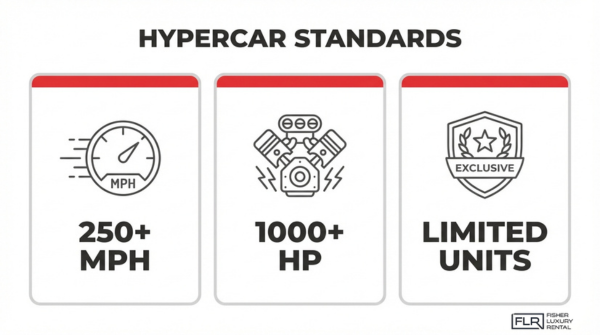
The standards a hypercar must meet to earn its status go beyond raw speed into cutting-edge technology, extreme rarity, and performance that exceeds the top 1% of supercars. Where supercars set the bar, hypercars shatter it.
A hypercar typically must demonstrate:
- Top speeds regularly exceeding 250 mph (400 km/h), with some targeting 280 mph or higher.
- Powertrains producing well over 1,000 horsepower through advanced hybrid or electric systems.
- Production volumes limited to double or single digits.
- Pioneering engineering, such as active aerodynamics and carbon fiber monocoque construction.
Industry analysts note that the term “hypercar” only emerged with the introduction of the Bugatti Veyron, created specifically to differentiate vehicles with capabilities significantly beyond their supercar peers. Exclusivity and technological innovation matter as much as horsepower in earning the designation.
With these definitions established, the technical specs behind each category reveal exactly how wide the performance gap runs.
What Are the Key Technical Specs That Differentiate Supercars From Hypercars?
The key technical specs that differentiate supercars from hypercars span horsepower, top speed, acceleration, and engineering complexity. The following subsections break down performance metrics and design features that define each tier.
How Do Performance Metrics Like Horsepower, Top Speed, and Acceleration Compare?
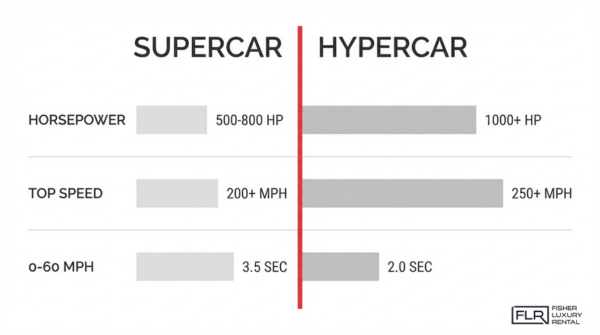
Performance metrics like horsepower, top speed, and acceleration compare across a wide gap between supercars and hypercars. Supercars typically produce between 500 and 800 horsepower, while hypercars routinely exceed 1,000 horsepower. According to Managing Composites, most supercars reach top speeds around 330 km/h (205 mph), whereas hypercars regularly exceed 400 km/h (250 mph), with some models aiming for 450 km/h or higher.
The contrast sharpens when looking at specific models side by side:
| Metric | McLaren 750S (Supercar) | Bugatti Chiron Bolide (Hypercar) |
| Horsepower | 740 hp | 1,825 hp |
| 0-60 mph | 2.6 seconds | Under 2.2 seconds |
| Top Speed | 206 mph | 250+ mph |
| Engine | Twin-turbo V8 | 8.0L quad-turbo W16 |
Even among hypercars, the performance ceiling keeps climbing. The Rimac Nevera produces 1,914 horsepower through four in-wheel electric motors, while the Koenigsegg CC850 reaches an estimated 280 to 310 mph on E85 fuel. These figures represent a fundamentally different engineering category, not just incremental improvement over supercars. For context on where the lower performance tier begins, our supercar vs sports car breakdown defines the threshold separating everyday performance machines from the supercar class.
Which Design and Engineering Features Set Hypercars Apart?
The design and engineering features that set hypercars apart center on active aerodynamics, lightweight construction, and advanced powertrain integration. Where supercars rely on proven performance architectures, hypercars push into technologies borrowed directly from Formula 1 and aerospace engineering.
According to Continental Autosports, lightweight carbon fiber monocoque structures allow vehicles like the Aston Martin Valkyrie to achieve power-to-weight ratios exceeding 1:1. That ratio is nearly unheard of in road-legal vehicles and explains why hypercars feel qualitatively different at speed.
Key engineering distinctions include:
- Active wings and diffusers dynamically balance drag reduction and downforce at varying speeds.
- Extreme cooling systems manage the thermal loads generated by engines producing over 1,000 horsepower.
- Hybrid powertrains, such as the McLaren W1’s 4.0-liter twin-turbo V8 paired with an E-module electric motor, deliver a combined 1,258 hp and instant electric torque.
For anyone weighing which tier of performance truly matters, nothing substitutes for seat time behind the wheel.
Which Brands and Models Dominate the Current Supercar and Hypercar Markets?
The brands and models dominating the current supercar and hypercar markets span legendary manufacturers like Ferrari, Lamborghini, McLaren, Bugatti, and Koenigsegg. Below, the most respected supercars and top-ranked hypercars of 2024 are compared.
What Are the Most Respected Supercar Models in 2024?
The most respected supercar models in 2024 include the McLaren 750S, Porsche 911 S/T, and Lamborghini Revuelto. Each combines iconic brand heritage with benchmark performance figures that define this tier.
According to duPont REGISTRY, the 2024 Porsche 911 S/T produces 518 horsepower and carries an MSRP of $290,000, positioning it as a collector-grade supercar. Leading models stack up as follows:
- The McLaren 750S produces 740 hp and reaches 0 to 60 mph in 2.6 seconds with a 206 mph top speed.
- The Lamborghini Revuelto pairs a 6.5-liter V12 with three electric motors for approximately 1,001 hp.
- The Ferrari SF90 XX Stradale generates a combined 1,016 hp from its twin-turbo V8 and three electric motors.
These models represent the upper boundary of supercar capability, where hybrid powertrains are rapidly becoming standard rather than exceptional. Our Ferrari vs Lamborghini vs McLaren comparison breaks down how each brand’s performance philosophy translates behind the wheel.
Which Hypercars Are Topping Global Rankings This Year?
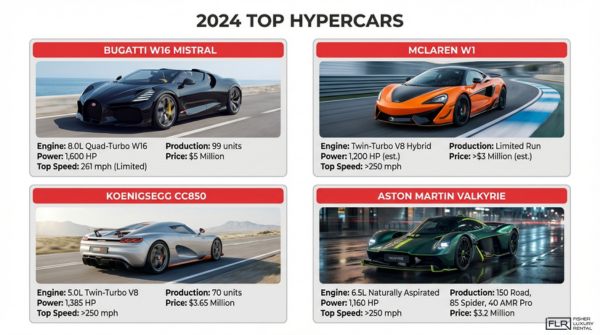
The hypercars topping global rankings this year are the Bugatti W16 Mistral, McLaren W1, Koenigsegg CC850, and Aston Martin Valkyrie. Each pushes performance well beyond supercar thresholds through extreme engineering and strict production limits.
According to Bugatti Automobiles, the W16 Mistral achieved a verified top speed of 453.91 km/h (282 mph) in November 2024, making it the fastest roadster in the world. Limited to 99 units at $5 million each, it exemplifies hypercar exclusivity. Other standout models include:
- The McLaren W1 delivers 1,258 hp and 988 lb-ft of torque from a twin-turbo V8 paired with an electric motor.
- The Koenigsegg CC850 produces up to 1,385 hp on E85 fuel, with estimated top speeds between 280 and 310 mph.
- The Aston Martin Valkyrie generates 1,160 hp at 10,500 rpm from its 6.5-liter V12 hybrid system.
What separates these machines from top supercars is not just raw output; it is the convergence of sub-2,000-unit production, seven-figure pricing, and technology derived directly from motorsport. For a broader view of where each manufacturer stands in the performance hierarchy, see our luxury car brands ranked guide. Understanding how pricing and exclusivity shape these tiers adds further context to the comparison.
How Do Pricing and Exclusivity Vary Between Supercars and Hypercars?
Pricing and exclusivity separate supercars from hypercars more dramatically than any performance spec. The sections below explore why hypercars command multimillion-dollar price tags and what makes certain supercars comparatively attainable.
Why Are Hypercars Priced So Much Higher Than Supercars?
Hypercars are priced so much higher than supercars because of extreme production limits, bespoke engineering, and proprietary technology developed for fewer than 100 units. When a manufacturer like Bugatti restricts the W16 Mistral to 99 units at $5 million each, the per-unit cost of research, hand-assembly, and materials climbs exponentially. According to Pedal Commander’s 2024 analysis, the Mercedes-Maybach Exelero commands an $8 million price tag, illustrating how singular builds push pricing into territory no volume supercar can reach.
Several factors compound hypercar pricing beyond the sticker:
- Bespoke carbon fiber monocoques require hundreds of labor hours per chassis.
- Proprietary powertrains, such as quad-turbo W16 or four-motor electric systems, have no shared-platform economies.
- Personalization programs let buyers specify materials, stitching, and liveries unique to their unit.
For most collectors, the price reflects rarity as much as performance. Our deep dive into why luxury cars are so expensive examines the full spectrum of engineering, materials, and exclusivity factors that drive these valuations across every tier.
What Makes Some Supercars Attainable Versus Ultra-Rare Hypercars?
Some supercars are attainable because manufacturers produce them in higher volumes on shared platforms, spreading development costs across thousands of units. A 2024 duPont REGISTRY listing placed the Porsche 911 S/T at $290,000, a significant sum yet accessible to a broader pool of enthusiasts compared to single-digit-million hypercars.
Key differences in accessibility include:
- Production scale: Supercar runs often span 2,000 to 10,000+ units annually, while hypercars rarely exceed 99 to 500 total builds.
- Dealer availability: Supercars sell through established dealership networks; hypercars require invitation-only purchase relationships with the manufacturer.
- Ownership history requirements: Many hypercar allocations demand that buyers already own multiple vehicles from the brand.
This tiered exclusivity is precisely what makes the hypercar segment so appealing to collectors, yet so inaccessible to most drivers. For enthusiasts who want to experience supercar-level performance without a seven-figure commitment, rental offers a practical path forward.
How Should You Approach Comparing Supercars and Hypercars With an Exotic Car Rental?
You should approach comparing supercars and hypercars with an exotic car rental by driving the vehicles yourself. Specs and rankings tell part of the story, but seat time reveals what numbers cannot.
Can Fisher Luxury Rental Help You Experience Top Supercars and Luxury Cars Firsthand?
Yes, Fisher Luxury Rental can help you experience top supercars and luxury cars firsthand. Fisher Luxury Rental offers a specialized fleet of exotic and luxury vehicles, including top-tier models like the Lamborghini Huracan Spyder, McLaren 720S, and Ferrari 488 Spider.
Reading that a supercar accelerates to 60 mph in under 3.5 seconds is one thing; feeling that force press you into the seat is something else entirely. According to a 2024 SkyQuest Technology report, the global luxury car rental market was valued at USD 64.57 billion and is projected to reach USD 117.71 billion by 2032, reflecting surging demand for hands-on supercar access. Fisher Luxury Rental serves Phoenix, Scottsdale, Portland, and Vancouver with curated exotic options that let you compare performance, handling, and cabin refinement across multiple marques without a six-figure purchase commitment.
What Are the Key Takeaways About Comparing Supercars and Hypercars by Specs, Data, and Rankings?
The key takeaways about comparing supercars and hypercars by specs, data, and rankings center on three pillars: performance thresholds, engineering philosophy, and exclusivity.
- Supercars deliver sub-3.5-second 0-60 mph times and top speeds above 200 mph, while hypercars push past 250 mph with over 1,000 horsepower.
- Hypercars rely on advanced aerodynamics, carbon fiber monocoques, and hybrid or electric powertrains that separate them from even the fastest supercars.
- Production caps of fewer than 100 units and price tags reaching millions of dollars make hypercars inaccessible to most collectors.
- Market data confirms rapid growth in both the hypercar and luxury rental segments, signaling that experiential access is becoming the most practical way to evaluate these machines.
Ultimately, data provides the framework for comparison, but driving the car completes the picture.