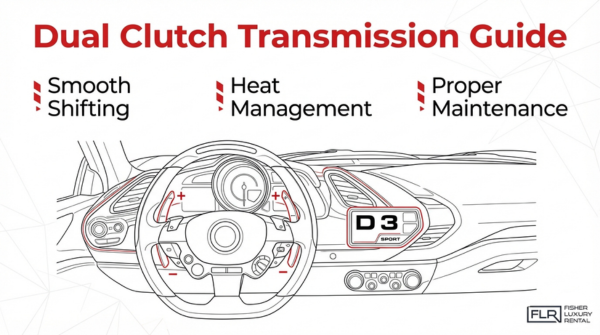
A dual-clutch transmission (DCT) is a high-performance gearbox that uses two separate clutches for odd and even gears, enabling near-instantaneous shifts and uninterrupted torque delivery in exotic cars from Ferrari, McLaren, and Lamborghini.
We cover DCT engineering fundamentals, driving habits that accelerate wear, best practices for smooth shifting and heat management, maintenance and fluid change protocols, common myths about DCT fragility, and how Fisher Luxury Rental keeps its fleet in peak mechanical condition.
DCTs split gears across two independent clutch packs and pre-engage the next ratio before the current one releases. This design eliminates the torque interruption found in traditional manuals and delivers faster transitions than sequential gearboxes.
Aggressive launches, constant stop-and-go creeping, and excessive use of launch control generate significant clutch heat and accelerate friction material wear. Understanding which habits compound stress helps drivers avoid premature shudder, slipping, and costly repairs.
Smooth throttle application, strategic use of manual mode in traffic or on hills, and allowing the transmission to reach proper operating temperature before hard driving all reduce clutch wear substantially. Matching the right drive mode to road conditions keeps heat within safe limits.
DCT fluid degrades under thermal stress and loses the friction properties needed for clean engagement. Manufacturer intervals vary; some exotic models require fluid changes as early as every 30,000 miles, and onboard diagnostics can flag problems like abnormal slip rates before they escalate.
Persistent myths, such as the belief that idling in Drive destroys the clutch packs, have been addressed directly by manufacturers who confirm it makes no meaningful difference to longevity. Properly maintained DCTs can deliver extraordinary service life, with documented cases exceeding 250,000 miles in high-performance Ferraris.
What Is a Dual-Clutch Transmission and How Does It Work in Exotic Cars?
A dual-clutch transmission (DCT) is a type of automated gearbox that uses two separate clutches to deliver near-instantaneous gear changes. Below, we cover why DCTs dominate high-performance vehicles and what core components make the system work.
Why Are Dual-Clutch Transmissions Popular in High-Performance Vehicles?
Dual-clutch transmissions are popular in high-performance vehicles because they deliver faster shift times, uninterrupted power delivery, and precise electronic control that manual and traditional automatic gearboxes cannot match. The Getrag 7DCL750, a wet-clutch 7-speed DCT with torque capacity up to 750 Nm, equips supercars from Ferrari, McLaren, and Lamborghini. Launch control further elevates the appeal; according to Gearstar Performance Transmissions, launch control in DCTs optimizes acceleration from a standstill by managing wheel slip and engine power, making it indispensable for drivers seeking maximum acceleration.
Durability reinforces the case. A Ferrari 458 Italia has been documented reaching nearly 250,000 miles under single ownership since 2011, proving that properly maintained DCTs can achieve extreme longevity. For anyone considering an exotic driving experience, that combination of speed, efficiency, and proven reliability explains why nearly every modern supercar relies on dual-clutch technology.
What Are the Basic Components of a DCT System?
The basic components of a DCT system are two clutches, a divided input primary shaft, two output mainshafts, a mechatronic control unit, and a set of synchronizers. One clutch handles odd-numbered gears while the other manages even-numbered gears. This split architecture allows the transmission to pre-select the next gear on the idle shaft before the active clutch disengages, producing seamless power shifts.
The two output mainshafts connect to a shared final-drive gear and differential, enabling uninterrupted torque transfer to the wheels. A mechatronic unit, which combines hydraulic actuators with electronic sensors, orchestrates clutch engagement, shift timing, and torque distribution. Understanding these components helps drivers recognize how their inputs directly affect clutch wear and shift quality in exotic cars.

What Driving Habits Can Shorten the Lifespan of a DCT in Exotic Cars?
Driving habits that can shorten the lifespan of a DCT in exotic cars include aggressive acceleration, frequent stop-and-go driving, and overuse of launch control. Each of these stresses clutch packs, generates excess heat, and accelerates wear.
How Does Aggressive Driving Impact a DCT’s Longevity?
Aggressive driving impacts a DCT’s longevity by accelerating clutch wear, overheating transmission fluid, and straining internal components beyond their intended duty cycles. Abrupt throttle inputs force rapid clutch engagement, generating friction heat that degrades clutch plates and fluid integrity far faster than smooth, progressive inputs.
According to Clutch Masters Industries, drivers should avoid abrupt acceleration and hard braking to extend the life of a dual-clutch transmission. Hard launches from standstills are particularly damaging because they demand maximum clamping force from the clutch packs while the vehicle is stationary, converting all engine torque into thermal energy rather than forward motion.
Repeated high-RPM downshifts compound this problem. For anyone driving a Ferrari 488 Spider or McLaren 720S, maintaining smooth throttle transitions is one of the simplest ways to preserve DCT health.

Do Frequent Stop-and-Go Situations Harm Dual-Clutch Systems?
Yes, frequent stop-and-go situations harm dual-clutch systems by forcing continuous partial clutch engagement at low speeds. Unlike a traditional torque converter automatic, a DCT relies on physical clutch slip to creep forward in traffic. This repeated slip generates heat without adequate airflow for cooling.
Heavy traffic compounds the issue because the transmission constantly cycles between first and second gear, keeping both clutches partially engaged. To reduce this strain, drivers should:
- Use manual mode to hold a single gear rather than letting the TCU hunt between ratios.
- Maintain a steady following distance to minimize constant braking and re-acceleration.
- Avoid riding the brake while the car creeps forward, which forces the clutch against resistance.
Even wet-clutch DCTs designed for heat dissipation have thermal limits that sustained low-speed operation can approach. Switching to manual mode in congested conditions is one of the most underrated habits for protecting clutch life.
Should Launch Control Be Used Frequently in Exotic Rentals?
No, launch control should not be used frequently in exotic rentals. Launch control optimizes acceleration from a standstill by managing wheel slip and engine power, according to Gearstar Performance Transmissions. While effective for maximum straight-line performance, each launch subjects the clutch packs to extreme thermal and mechanical stress.
Most manufacturers engineer launch control for occasional use, not repeated activation. Frequent launches compress the service life of clutch plates, stress the dual-mass flywheel, and accelerate fluid degradation. In a rental context, where multiple drivers may use the feature across a vehicle’s lifecycle, the cumulative effect is significant.
For renters wanting to experience an exotic car’s full acceleration, a firm but progressive throttle application from a rolling start delivers thrilling performance with far less transmission stress. With these habits in mind, adopting proactive driving techniques preserves DCT performance even further.
What Are the Best Practices for Driving Exotic Cars with Dual-Clutch Transmissions?
The best practices for driving exotic cars with dual-clutch transmissions center on smooth shifting habits, strategic mode selection, and thermal awareness. The following subsections cover each practice in detail.
How Can You Shift Smoothly to Protect the DCT?
You can shift smoothly to protect the DCT by applying gradual throttle inputs and avoiding abrupt transitions between acceleration and braking. Smooth driving keeps both clutch packs engaged predictably, reducing friction-generated heat and mechanical stress on synchronizers.
Key habits that protect the DCT during shifts include:
- Applying throttle progressively from a stop rather than stabbing the pedal.
- Allowing the transmission to complete each gear change before requesting another.
- Easing off the brake smoothly when pulling away in traffic.
- Avoiding sudden full-throttle demands at low RPMs, which force the clutches to slip excessively.
Because a DCT pre-selects the next gear on its secondary shaft, harsh driver inputs force the system to re-evaluate and re-engage, adding unnecessary clutch wear. Treating throttle and brake inputs as deliberate, measured actions is the single most effective way to preserve clutch plate life over thousands of miles.
When Should You Use Manual Mode Versus Automatic in a DCT?
You should use manual mode in a DCT during heavy traffic, hill driving, or spirited canyon runs where you want direct gear control. Automatic mode is best suited for relaxed highway cruising, where the transmission’s software optimizes shift points for efficiency.
According to Clutch Masters Industries, drivers should utilize manual mode in heavy traffic or hilly conditions, avoid abrupt acceleration and hard braking, and minimize extended idling to prevent unnecessary engine wear and energy loss. Manual mode prevents the DCT from hunting between gears on inclines and eliminates low-speed gear confusion in stop-and-go situations.
For most drivers in an exotic car, switching to manual mode whenever conditions demand frequent gear changes gives the transmission clearer instructions and reduces the partial clutch engagement that accelerates wear.
What Temperature Considerations Should You Be Aware Of?
The temperature considerations you should be aware of involve clutch heat buildup, fluid thermal limits, and ambient operating conditions. According to the MDPI Energies Journal, dual-clutch transmissions require wet clutches for effective heat dissipation during gear shifts, though this can reduce overall energy efficiency in certain operating points.
Factors that influence DCT operating temperature include:
- Extended low-speed driving, which generates sustained clutch slip and heat.
- Aggressive driving patterns that compound thermal stress on transmission fluid.
- Hot ambient conditions that reduce the cooling system’s heat rejection capacity.
- Insufficient fluid levels or degraded fluid that loses its thermal management properties.
Allowing the transmission to cool during extended spirited driving, rather than pushing through continuous hard laps, is a practical habit that prevents thermal degradation of both clutch plates and fluid. With temperature management habits in place, proper maintenance routines become the next critical layer of DCT protection.

How Do Maintenance, Fluid Changes, and Monitoring Extend DCT Life?
Maintenance, fluid changes, and monitoring extend DCT life by preventing premature wear on clutch packs, synchronizers, and internal seals. The subsections below cover fluid change intervals, warning signs of transmission problems, and the role of onboard diagnostics.
How Often Should DCT Fluid Be Changed in Exotic Cars?
DCT fluid should be changed in exotic cars according to each manufacturer’s specific service interval, which typically falls between 30,000 and 45,000 miles. The C8 Corvette DCT maintenance schedule, for example, mandates a transmission filter replacement at 7,500 miles and 22,500 miles, with a full transmission fluid change using GM-approved Dexron HP fluid required every 45,000 miles (Schumacher Corvette). Exotic manufacturers like McLaren and Ferrari often specify shorter intervals due to higher thermal loads on wet-clutch systems. Because degraded fluid loses its ability to maintain proper friction characteristics, staying ahead of scheduled changes is one of the most cost-effective ways to protect a high-performance DCT.
What Warning Signs Indicate a Dual-Clutch Transmission Problem?
The warning signs that indicate a dual-clutch transmission problem include clutch shudder, delayed or harsh gear engagement, unusual grinding noises, and slipping between shifts. Because a DCT divides gears into odd-numbered and even-numbered groups connected to two separate clutches, a fault in either clutch pack can produce distinct symptoms. Hesitation during upshifts often points to synchronizer wear, while vibration at low speeds typically signals degraded friction material. According to Taylor & Francis and GTE Engineering, the divided input primary shaft and dual output mainshafts mean that issues on one clutch side may not immediately affect the other, making early detection critical before damage spreads.
Can Onboard Diagnostics Help Identify Issues Early?
Yes, onboard diagnostics can help identify DCT issues early by monitoring clutch engagement times, fluid temperature, and shift adaptation parameters in real time. Modern exotic cars log transmission fault codes that flag abnormal clutch slip rates or excessive heat well before the driver notices performance changes. BMW, Mercedes-Benz, and Volkswagen have confirmed that certain commonly feared behaviors, such as leaving the transmission in Drive at traffic lights, make no measurable difference to longevity. Paying attention to diagnostic alerts rather than myths provides far more reliable protection for a dual-clutch system.
With proactive maintenance and diagnostic awareness covered, understanding common DCT myths helps separate real risks from unnecessary worry.
What Are Common Myths and Misconceptions About DCT Longevity?
Common myths about DCT longevity include the belief that resting your foot on the brake destroys the clutches and that dual-clutch transmissions are inherently fragile in supercars. The following subsections separate fact from fiction.
Does “Resting Your Foot on the Brake” Really Ruin a DCT?
No, resting your foot on the brake does not really ruin a DCT. This widespread myth suggests that holding the brake at a stoplight while in Drive causes excessive clutch wear, but the reality is more nuanced. Major automotive manufacturers including BMW, Mercedes-Benz, and Volkswagen have stated that it makes no difference to the transmission’s longevity whether a driver leaves a DCT in Drive or shifts to Neutral while waiting at a traffic light, according to WapCar.
What does cause unnecessary wear is prolonged creeping in heavy traffic, where the clutch repeatedly slips at low speed. For brief stops at lights, simply holding the brake in Drive is perfectly acceptable. In extended stop-and-go congestion, shifting to Neutral can reduce heat buildup, though the difference during short pauses is negligible.
Is It True That DCTs Are Always Fragile in Supercars?
No, it is not true that DCTs are always fragile in supercars. This misconception likely stems from the higher maintenance costs associated with exotic vehicles, which drivers sometimes interpret as a sign of inherent weakness. In reality, modern supercar DCTs are engineered for extreme performance loads. According to HotCars, a Ferrari 458 Italia has been documented reaching nearly 250,000 miles under single ownership since 2011, demonstrating remarkable longevity when properly maintained.
Fragility perceptions often arise from neglected service intervals rather than flawed engineering. Consistent fluid changes, appropriate driving technique, and adherence to manufacturer schedules keep these transmissions performing reliably for years. For most supercar owners and renters, the DCT is one of the most durable components in the drivetrain when it receives the care it was designed to need.
With these myths clarified, proper DCT care becomes straightforward in any exotic car.
How Should You Approach DCT Driving in Exotic Car Rentals from Fisher Luxury Rental?
You should approach DCT driving in exotic car rentals from Fisher Luxury Rental by combining the smooth driving techniques and maintenance awareness covered throughout this article with a rental experience built around well-maintained, high-performance vehicles.
Can Renting an Exotic Car from Fisher Luxury Rental Help Ensure Peak DCT Performance?
Yes, renting an exotic car from Fisher Luxury Rental can help ensure peak DCT performance. Fisher Luxury Rental maintains a fleet of top-trim exotic and luxury vehicles, including DCT-equipped models like the Ferrari 488 Spider, McLaren 720S, Lamborghini Huracan Spyder, and Corvette C8 variants. Each vehicle receives professional maintenance and fluid servicing on schedule, so renters start every drive with a transmission operating within optimal parameters. This means you can focus on applying smooth shifting habits and proper driving techniques rather than worrying about deferred maintenance or degraded fluid condition. Fisher Luxury Rental buys only top-trim models, ensuring the mechanical foundation beneath every rental supports confident, transmission-friendly driving from the moment you take the keys.
What Are the Key Takeaways About Extending Dual-Clutch Life in Exotic Cars We Covered?
The key takeaways about extending dual-clutch life in exotic cars we covered center on a few actionable principles:
- Avoid abrupt acceleration and hard braking, which generate excessive clutch heat and accelerate wear.
- Use manual mode during stop-and-go traffic or hilly terrain to give the DCT’s automated logic cleaner shift points.
- Minimize extended idling to reduce unnecessary thermal stress on clutch packs.
- Stay aware of transmission temperature, especially during spirited driving sessions.
- Follow manufacturer-recommended fluid change intervals, as degraded fluid is the leading cause of clutch shudder.
- Reserve launch control for occasional use rather than repeated back-to-back launches.
Treating these practices as non-negotiable habits, whether you own or rent, is the most reliable path to preserving dual-clutch longevity in any exotic car.