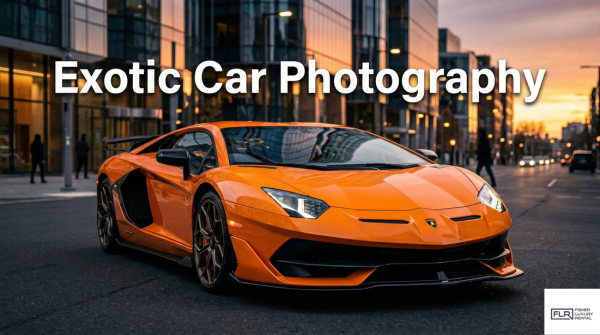
Exotic car photography is the capturing high-performance vehicles like Lamborghinis, Ferraris, and McLarens in images that highlight their design, power, and prestige. It combines technical camera knowledge with creative composition to produce portfolio-quality results.
This guide covers gear and camera settings, location scouting and lighting, composition and angles, motion and action techniques, post-processing workflows, legal considerations, and how renting an exotic car can elevate your shoots.
Choosing the right equipment starts with matching your lens focal length and camera body to the shot you need. Wide apertures isolate a supercar against blurred backgrounds, while narrower settings keep both the vehicle and its environment sharp. ISO and shutter speed adjustments change dramatically between golden hour, nighttime, and bright daylight scenarios.
Location and lighting shape the mood of every image. Shooting minutes after sunset produces soft, even illumination that reduces harsh reflections on metallic paint, while urban streets, natural landscapes, and motorsport events each create distinct visual narratives.
Strong composition turns a good photo into a striking one. Techniques like the Rule of Thirds, leading lines, and low-angle perspectives draw attention to a supercar’s contours and proportions.
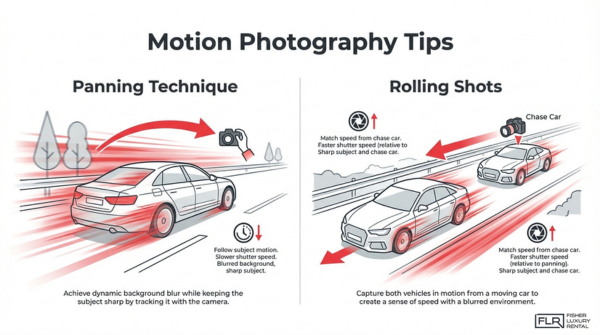
Capturing motion requires specialized methods such as panning and rolling shots, where shutter speed synchronization with vehicle velocity keeps the car sharp while the background conveys speed.
Post-processing refines the final image through RAW adjustments, reflection cleanup, exposure blending, and precise color correction for the complex layers in metallic automotive paint.
Legal and etiquette factors, including permits, model releases, and copyright ownership, protect both photographer and vehicle owner in commercial work. We also explore how renting from Fisher Luxury Rental gives photographers direct access to supercars built for unforgettable imagery.
What Are the Essential Camera Settings and Equipment for Exotic Car Photography?
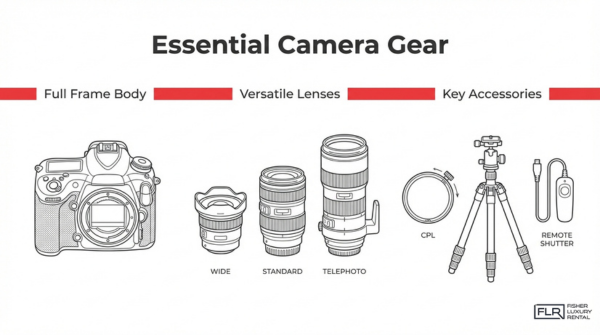
The essential camera settings and equipment for exotic car photography include full-frame camera bodies, versatile lenses spanning wide-angle to telephoto focal lengths, and precise exposure controls tailored to reflective surfaces. The subsections below cover ideal lenses and accessories, then exposure, focus, and ISO adjustments.
Which Camera Lenses and Accessories Are Best for Capturing Supercars?
The best camera lenses and accessories for capturing supercars span focal lengths from 14mm wide-angle for environmental context shots to 200mm telephoto for compressing perspective and isolating design details. According to DPReview’s 2025 buying guide, the Canon EOS R5 II and Nikon Z8 rank among the leading high-end camera bodies for automotive photography, while the Sony A7R V offers a 61 MP full-frame sensor with AI-driven autofocus.
Beyond bodies and lenses, a few key accessories elevate supercar shoots:
A circular polarizer cuts glare and controls reflections on glass and metallic paint in bright sunlight.
A sturdy tripod enables long exposures for light painting and sharp static compositions.
A remote shutter release eliminates camera shake during slow shutter speeds.
For photographers serious about capturing the curves of a Lamborghini or the aggressive stance of a McLaren, investing in at least one wide-angle and one mid-telephoto lens provides the most creative flexibility.
How Do You Adjust Exposure, Focus, and ISO for Shiny Car Exteriors?
You adjust exposure, focus, and ISO for shiny car exteriors by balancing aperture, shutter speed, and sensitivity to control how reflective paint and chrome surfaces render in the final image. Static shots benefit from an aperture of f/2.8 to f/5 for shallow depth of field, or f/8 and higher when both the car and environment need sharp focus. According to Sony Scene, golden hour or overcast conditions typically require ISO 200 to 400, while nighttime automotive shoots call for ISO 800 to 1600.
Key exposure considerations for reflective surfaces include:
Use spot metering on the car’s body panel rather than evaluative metering, which bright reflections can fool.
Set shutter speed to at least 1/1000s when freezing a moving vehicle.
Dial white balance manually, since metallic paint layers react differently to light and auto white balance often misjudges color temperature.
Shiny exteriors punish lazy metering. Spending an extra minute dialing in exposure before the first frame saves hours of corrective editing later. With these settings locked in, composition and lighting become the next factors that separate good shots from portfolio-worthy images.
Where Are the Best Locations and Backdrops for Photographing Exotic Cars?
The best locations for photographing exotic cars combine clean sightlines, complementary architecture, and controlled lighting conditions. Choosing the right environment involves evaluating permits, reflections, and weather, while matching urban, natural, or event backdrops to each vehicle’s character.
What Environmental Factors Should You Consider When Choosing Shoot Locations?
The environmental factors you should consider when choosing shoot locations include lighting conditions, permit requirements, surface reflections, and weather. Each element directly affects how an exotic car’s paint, curves, and finish translate on camera.
Timing matters most. According to The Digital Picture, the optimal time for automotive photography is a few minutes after sunset or before sunrise, when the broad sky acts as a soft, even light source that minimizes harsh reflections on the vehicle’s paint. Overcast skies offer a similar diffused quality during daytime hours.
Key environmental factors to evaluate before any shoot:
Permit requirements: Commercial photography on public rights-of-way, city parks, and sidewalks typically requires permits in major metropolitan areas.
Ground surfaces: Dark asphalt and wet pavement create reflections that add depth, while gravel or dirt can kick up dust onto freshly detailed paint.
Wind and debris: Leaves, sand, and airborne particles settle on glossy surfaces quickly, adding post-processing cleanup time.
Background clutter: Signage, trash cans, and parked cars distract from the subject vehicle.
Scouting a location at your planned shoot time reveals lighting angles and shadow patterns that photos taken at other hours simply cannot predict.
How Do You Use Urban, Nature, and Event Backdrops to Highlight Exotic Cars?
You use urban, nature, and event backdrops to highlight exotic cars by matching each setting’s visual character to the vehicle’s design language and intended mood.
Urban backdrops: Concrete parking structures, glass-walled towers, and industrial corridors complement angular supercars like the McLaren 720S or Lamborghini Huracan Spyder. Clean geometric lines in architecture reinforce aggressive body styling.
Nature backdrops: Mountain roads, desert landscapes, and coastal highways suit grand tourers and convertibles such as the Ferrari 488 Spider. Open horizons provide negative space that draws attention to the car’s silhouette.
Event backdrops: Car shows, racetracks, and concours lawns supply built-in context and energy, though crowds and competing vehicles require tighter framing to isolate the subject.
Artificial lighting eliminates temporal constraints entirely, enabling consistent illumination and reflection control regardless of time or weather, as noted by ArtRewards. For most exotic car shoots, pairing one urban and one natural location in a single session produces the portfolio variety that separates professional-quality work from casual snapshots.
With locations and backdrops selected, composing each frame to maximize the car’s visual impact is the next step.
How Can You Compose Striking Photos of Luxury and Exotic Cars?
You can compose striking photos of luxury and exotic cars by combining deliberate angle selection with strategic lighting techniques. The following subsections cover the best perspectives for supercars and how timing and light shape every shot.
What Are the Best Angles and Perspectives for Shooting Supercars?
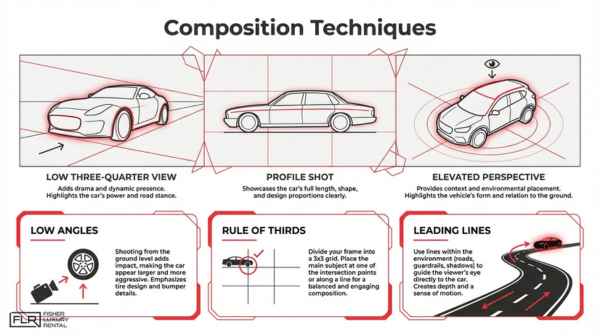
The best angles and perspectives for shooting supercars are low three-quarter views, front-on stances, and elevated rear profiles that emphasize each car’s design language. A low shooting position, roughly bumper height, exaggerates the wide stance of vehicles like a Lamborghini Huracan Spyder or Ferrari 488 Spider.
According to PetaPixel, leading lines such as road markings, walls, or patterns guide the viewer’s eye through the image and focus attention on the vehicle’s design elements. Placing the car off-center using the Rule of Thirds creates visual balance and leverages negative space effectively.
Key perspectives to master include:
Low three-quarter front: Highlights aggressive front fascia and wheel arches.
Rear three-quarter: Showcases exhaust layout, diffuser, and rear haunches.
Profile at wheel height: Stretches proportions and conveys speed even when stationary.
Elevated overhead: Reveals rooflines and body sculpting on mid-engine supercars.
Incorporating the Golden Ratio alongside dynamic angles adds a sense of movement and prestige, particularly on open roads. For most exotic car shoots, starting low and working upward yields the widest variety of compelling frames.
How Can You Use Lighting Techniques and Timing to Enhance Car Photos?
You can use lighting techniques and timing to enhance car photos by shooting during soft-light windows and supplementing with artificial sources when natural light fades. According to The Digital Picture, the optimal time for automotive photography is a few minutes after sunset or before sunrise, when the broad sky acts as a soft, even light source that minimizes harsh reflections on the vehicle’s paint.
Golden hour and overcast skies produce diffused illumination that wraps around curves and reduces hotspots on metallic finishes. Circular polarizers cut glare on glass and chrome, giving you cleaner reflections in bright conditions.
When natural light is unavailable, artificial lighting eliminates temporal constraints entirely, enabling consistent illumination and reflection control regardless of weather or time of day. Positioning a large softbox at a 45-degree angle to the car’s longest panel creates a smooth gradient that reveals body lines without blowing out highlights.
Mastering both natural timing and controlled artificial light gives you the flexibility to shoot any supercar in any condition confidently.
What Are Proven Tips for Capturing Motion and Action Shots of Exotic Cars?
Proven tips for capturing motion and action shots of exotic cars include mastering panning technique, using rolling shots from a chase vehicle, and selecting shutter speeds that balance motion blur with subject sharpness.
How Do You Take Rolling Shots and Pan Effectively?
You take rolling shots by positioning a camera car alongside the subject vehicle, matching its speed to create a sharp car against a motion-blurred background. According to Artists Across America, rolling shots differ from panning because they require a camera rig or handheld operation from a second moving vehicle to convey a sense of high-speed travel.
Panning, by contrast, involves tracking the car from a stationary position while using a slow shutter speed. The key to both techniques is smooth, controlled movement. Even slight jerks during the exposure will soften the subject. For panning specifically, planting your feet, rotating from the hips, and following through after the shutter fires produces the sharpest results. Mastering these two methods gives you the foundation for dynamic action photography, and dialing in the right settings makes the difference between a sharp frame and a blurry one.
What Camera Settings Work Best for Action and Track Photography?
The camera settings that work best for action and track photography depend on whether you want frozen motion or intentional blur. To freeze a supercar mid-corner, Digital Photography School recommends a shutter speed of at least 1/1000s, which may require widening the aperture or raising ISO to compensate for reduced light.
For panning shots that emphasize speed, slower shutter speeds between 1/60s and 1/125s blur the background while keeping the car relatively sharp. Synchronizing shutter speed with vehicle velocity is critical; too fast eliminates all sense of movement, while too slow renders the subject unusable.
Key settings to start with for track days:
Set continuous autofocus (AF-C) to track the car through the frame.
Use burst mode to capture multiple frames per pass.
Keep ISO at 200 to 400 in daylight for clean files.
Dial aperture between f/5.6 and f/8 for sufficient depth of field.
With the right motion technique and settings locked in, the next step is refining your images through editing and retouching.
How Can You Edit and Retouch Exotic Car Photos for a Professional Result?
You can edit and retouch exotic car photos for a professional result by using dedicated RAW editors and retouching software, then carefully balancing color accuracy, contrast, and reflection control during post-processing.
What Are Recommended Editing Tools and Techniques for Automotive Photography?
The recommended editing tools and techniques for automotive photography center on Adobe Lightroom for RAW processing and Adobe Photoshop for advanced retouching. According to the Automotive Photographer Community on Facebook, a standard automotive post-processing workflow in Lightroom and Photoshop begins with culling and basic RAW adjustments, followed by spot removal to clean up dust, dirt, or unwanted light flares on the car’s surface.
Key techniques in a professional workflow include:
Culling selects to identify the strongest compositions before editing begins.
RAW adjustments correct exposure, white balance, and lens distortion.
Spot removal eliminates sensor dust, road debris, and stray reflections.
Layer blend modes in Photoshop merge multiple exposures for controlled highlights and shadows.
For exotic cars specifically, the “Soft Light” layer blending mode in Photoshop enhances contrast and color depth without losing detail in highlights or shadows. This single technique often separates amateur edits from professional automotive retouching.
How Should You Balance Color, Contrast, and Reflection During Post-Processing?
You should balance color, contrast, and reflection during post-processing by addressing each element as a separate editing pass. Metallic car paint is composed of multiple layers that react differently to light; according to research published by Wiley Online Library, this requires a precise white balance adjustment for every layer to maintain color accuracy.
A structured approach works best:
Color: Set accurate white balance first, then fine-tune saturation and luminance per channel to preserve the vehicle’s true paint tone.
Contrast: Use targeted tone curves or the Soft Light blend mode to deepen midtones without clipping blacks or blowing out specular highlights.
Reflection: Mask and selectively adjust reflected areas on glass, chrome, and body panels to reduce distracting hotspots while preserving the natural sheen that defines exotic car finishes.
Rushing through these adjustments as a single pass almost always produces unnatural results. Treating color, contrast, and reflections as distinct layers of refinement is what gives professional automotive images their polished, editorial quality.
With editing fundamentals covered, understanding the legal and etiquette side of exotic car photography protects your work and reputation.
What Legal and Etiquette Considerations Apply to Exotic Car Photography?
Legal and etiquette considerations for exotic car photography include securing permits, obtaining model releases for commercial use, and respecting vehicle owners’ privacy. The following subsections cover permission requirements and owner-relations best practices.
When Do You Need Permission or Model Releases for Car Photography?
You need permission or model releases for car photography whenever images will be used commercially. According to Digital Photography School’s legal guide, model and property releases are legally required for commercial usage of photographs, including uploading to stock platforms or using images in advertising for a car rental business.
Under U.S. Copyright law, the photographer owns the copyright from the moment of creation, regardless of who owns the vehicle. However, copyright ownership does not eliminate the need for releases when people or recognizable private property appear in commercial shots.
Key situations requiring releases include:
Advertising campaigns featuring identifiable individuals near the vehicle.
Stock photography submissions to platforms like Shutterstock or Getty.
Branded promotional content for dealerships or rental companies.
Shoots on public property in major metro areas where commercial photography permits are mandatory.
For editorial or personal portfolio use, releases are generally not required. When in doubt, securing written permission protects both photographer and client.
How Can You Respect Owners’ Privacy and Brand Requirements in Your Shoots?
You can respect owners’ privacy and brand requirements by communicating clearly before, during, and after the shoot. Commercial usage rights are typically governed by licensing agreements that specify duration, territory, and platforms where images can be displayed.
Before photographing someone else’s exotic car, follow these etiquette guidelines:
Ask the owner’s explicit permission before shooting, even at public car shows.
Discuss where and how the images will be published.
Avoid capturing license plates, personal belongings, or identifiable bystanders without consent.
Honor any brand restrictions; some manufacturers limit how their vehicles appear in certain contexts.
Renowned automotive photographer Desmond Louw emphasizes that every car has a unique story, and the photographer’s job is to unveil it by researching the vehicle’s features and selling points beforehand. That research phase is also the ideal time to clarify the owner’s expectations around image use. Treating every shoot as a collaborative partnership, rather than a one-sided capture, builds trust and often leads to repeat access.
With legal and etiquette foundations in place, the right vehicle makes every shoot more compelling.
How Can Renting from Fisher Luxury Rental Enhance Your Exotic Car Photography Sessions?
Renting from Fisher Luxury Rental enhances exotic car photography sessions by providing access to high-performance supercars without ownership costs. The following sections cover fleet availability for shoots and key takeaways from this guide.
Can Fisher Luxury Rental’s Fleet of Luxury Cars Be Used for Photo Shoots and Special Projects?
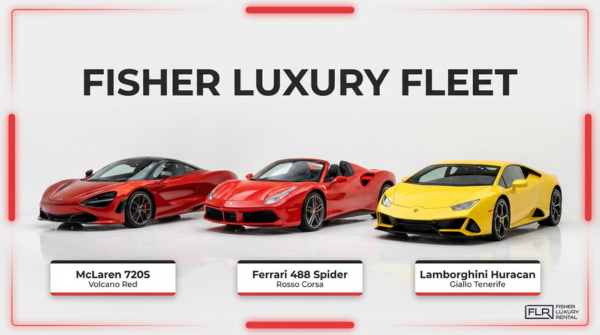
Yes, Fisher Luxury Rental’s fleet of luxury cars can be used for photo shoots and special projects. Fisher Luxury Rental offers exotic vehicles including the 1100 horsepower McLaren 720S, the Ferrari 488 Spider, and the Lamborghini Huracan Spyder, with daily rates ranging from $1,099 to $1,499. This fleet gives photographers access to world-class subjects without the six- or seven-figure purchase commitment.
Renting requires a valid driver’s license, proof of insurance with 100/300/100 minimum coverage, and a security deposit between $5,000 and $20,000. Fisher Luxury Rental also advises customers to photograph any pre-existing damage, such as rim scratches or low bumper marks, before leaving the lot. For photographers, this pre-rental documentation doubles as a practical warm-up to study the car’s lines, paint condition, and unique details before the actual session begins.
What Are the Key Takeaways About Exotic Car Photography Tips: Shoot Supercars Like a Pro We Covered?
The key takeaways about exotic car photography tips covered in this guide center on five core principles:
- Master your camera settings. Use f/2.8 to f/8 for static shots, shutter speeds of at least 1/1000s for freezing motion, and ISO 200 to 1600 depending on lighting conditions.
- Scout locations deliberately. Shoot a few minutes after sunset for soft, even light, and secure commercial permits when working on public property.
- Compose with intention. Apply the Rule of Thirds, use leading lines, and experiment with low angles to emphasize a supercar’s aggressive stance.
- Capture motion purposefully. Panning and rolling shot techniques transform a parked car into a dynamic subject that conveys speed and power.
- Refine in post-processing. Start with RAW adjustments and spot removal, then use layer blending modes to control reflections and enhance color depth.
Applying these techniques to a vehicle from Fisher Luxury Rental connects professional-grade skill with a showroom-quality subject.