A supercar investment is the purchase of a high-performance exotic vehicle with the expectation that its market value will appreciate over time, generating financial returns alongside the experience of ownership.
This guide covers the factors that drive supercar appreciation, historical value performance across key models, 2026 market forecasts and regulatory shifts, risk management and ownership best practices, how supercars compare to traditional asset classes, common investor mistakes, and the role exotic rentals play in a broader investment strategy.
Brand reputation, production scarcity, and collector demand are the primary forces behind supercar value growth. Manufacturers like Ferrari deliberately limit output to sustain secondary market premiums, while limited-edition models and hybrid hypercars continue to lift valuations across the exotic segment.
Select supercars have delivered annualized returns that outpace many conventional assets. Models such as the Porsche 959 and Ferrari F40 have recorded multi-hundred-percent gains over the past decade, though maintenance costs, service history gaps, and economic cycles can erode those returns significantly.
Heading into 2026, evolving EU emissions regulations, rising electric vehicle penetration in the premium segment, and growing fractional ownership platforms are reshaping the investment landscape. These forces create both opportunity and uncertainty for buyers entering the market now.
Proper authentication, complete documentation, specialized insurance, and climate-controlled storage are essential to preserving long-term resale value. Overlooking any of these elements introduces risk that compounds over years of ownership.
Compared to real estate, equities, and gold, supercars offer distinct advantages in tangible enjoyment but carry unique liquidity constraints and tax considerations. Emotional decision-making remains one of the most common pitfalls, and exotic car rental services offer a practical way to experience supercars before committing capital.
What Factors Determine Whether a Supercar Is a Good Investment?
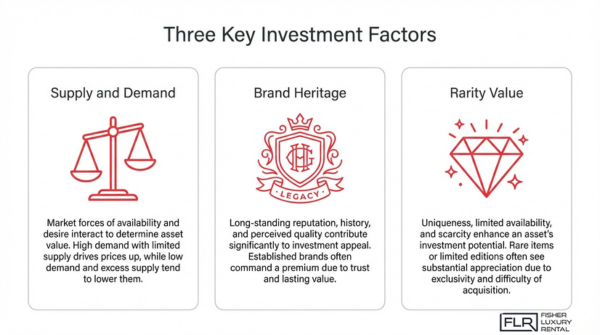
The factors that determine whether a supercar is a good investment include supply and demand dynamics, brand reputation, and production rarity. Each of these elements shapes long-term appreciation potential in distinct ways.
How Do Supply and Demand Influence Supercar Values?
Supply and demand influence supercar values by creating price pressure when production stays limited while collector interest grows. Ferrari reported global sales of only 13,752 units in 2024, a deliberate scarcity strategy that supports high secondary market valuations. When manufacturers restrict output, fewer examples circulate on the resale market, which intensifies buyer competition and pushes prices upward.
Collector demand continues to accelerate across the segment. According to a Technavio forecast, the supercar market is expected to expand by USD 11,925.8 million between 2026 and 2030 at a compound annual growth rate of 6.6%. This sustained growth signals that buyer appetite is outpacing available inventory. For investors, understanding this imbalance is the single most reliable indicator of future appreciation potential.
What Role Does Brand Reputation Play in Supercar Appreciation?
Brand reputation plays a central role in supercar appreciation because marques with deep heritage and perceived exclusivity command stronger resale premiums. Ferrari maintains superior value retention compared to competitors like McLaren and Lamborghini due to strictly controlled supply, high collector demand, and extensive brand heritage.
Limited-run flagship models and hybrid hypercars are also reinforcing brand equity, which lifts valuations across the entire secondary market for exotic vehicles. Not every supercar brand benefits equally from this effect. Manufacturers that dilute their image through overproduction or inconsistent quality typically see weaker long-term returns. For this reason, the badge on the hood often matters as much as the engine beneath it when evaluating investment potential.
How Important Are Rarity and Limited Editions in Investment Value?
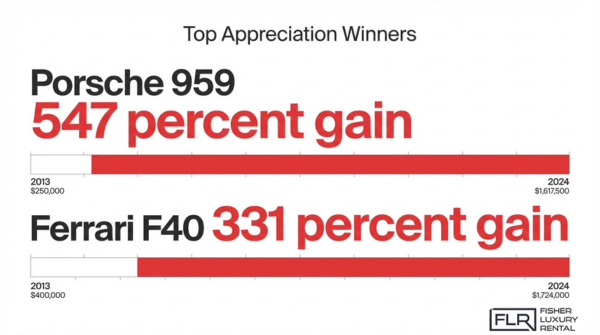
Rarity and limited editions are critically important in investment value because scarcity is the strongest price catalyst in the collector market. The Porsche 959, produced in very limited numbers, saw its average condition 2 value rise from $482,000 in 2013 to $2.7 million by 2024, a 547 percent appreciation according to Hagerty’s Price Guide.
Models with capped production runs, special commemorative editions, or unique performance specifications consistently outperform their mass-produced counterparts. Emotional desirability amplifies this effect; when collectors compete for a finite number of vehicles, bidding wars become inevitable. Rarity alone does not guarantee returns, however. The vehicle must also carry strong brand recognition and verified provenance to sustain long-term demand.
With these core value drivers established, historical market data reveals how they have played out across specific models and economic cycles.
How Has the Value of Supercars Changed Historically?
The value of supercars has changed historically through dramatic appreciation cycles shaped by model scarcity, economic shifts, and ownership costs. The following sections examine top-appreciating models, economic influences, and how maintenance expenses affect net returns.
Which Supercar Models Have Appreciated Most Since 2000?
The supercar models that have appreciated most since 2000 include the Porsche 959 and Ferrari F40, both of which delivered returns far exceeding traditional asset classes. According to the Hagerty Supercars Index, which tracks 15 influential models from 1984 to 2013, the index recorded a 326 percent total gain since its 2013 inception, yielding an annualized return of nearly 14 percent.
Individual models tell an even more compelling story:
- The Porsche 959 rose from $482,000 in 2013 to $2.7 million by 2024, a 547 percent appreciation rate.
- The Ferrari F40 climbed from $744,000 to $3.1 million over the same period, a 331 percent gain.
These figures reinforce why limited-production supercars from established marques consistently outperform broader collector car markets. For serious investors, the pattern is clear: heritage models with motorsport pedigrees and restricted production numbers deliver the strongest long-term appreciation.
What Economic Conditions Have Impacted Supercar Values in the Past?
Economic conditions such as inflationary trends, interest rate fluctuations, and shifts in investor confidence have impacted supercar values in the past. During periods of monetary expansion, wealthy collectors tend to allocate capital toward tangible assets like supercars, driving prices upward. Conversely, tightening credit conditions and rising interest rates reduce discretionary spending power, temporarily cooling demand in the secondary market.
According to a LinkedIn analysis of supercar market investment risks, inflationary trends and fluctuating interest rates are currently influencing capital allocation and market confidence in the luxury car sector through 2026. Supercars tend to behave like other alternative assets during economic uncertainty; when equities falter, collectors often hold rather than sell, which restricts supply and stabilizes pricing.
How Have Maintenance and Ownership Costs Affected Returns?
Maintenance and ownership costs have affected returns by significantly reducing net gains when deferred or poorly documented. High-performance marques require specialized technical service, and those costs show significant variance over 10 years compared to standard vehicles.
Key cost factors that erode supercar investment returns include:
- Specialized servicing that far exceeds the $1,234 average annual maintenance cost for standard U.S. passenger vehicles reported by AAA in 2024.
- Deferred or unrecorded maintenance, which significantly diminishes resale potential.
- Storage, insurance, and climate-controlled housing expenses unique to collectible vehicles.
According to a JD Power analysis, regular maintenance is a critical factor in preserving supercar investment value, as gaps in service history can erase years of market appreciation. Investors who treat ownership costs as part of their total investment strategy protect both the vehicle’s condition and its resale premium.
Understanding these historical cost dynamics helps frame realistic expectations for projected supercar values in 2026.
What Are the Forecasted Trends for Supercar Values in 2026?
The forecasted trends for supercar values in 2026 point toward continued market expansion, shaped by evolving emissions regulations and growing electric vehicle adoption. The following subsections examine key regulatory shifts and the role of electrified supercars.
What Events or Regulations Might Shape Supercar Values by 2026?
The events and regulations most likely to shape supercar values by 2026 include EU emissions policy revisions, digital authentication adoption, and shifting manufacturer compliance timelines. The European Union is considering revisions to its 2035 combustion engine ban that would permit a 90% reduction in emissions rather than a full 100% elimination, according to a 2025 analysis by Akin Gump Strauss Hauer & Feld LLP. If adopted, this revision could extend the production viability of specialized ICE supercars, reinforcing their collectibility.
Automakers are also pushing to phase the interim 2030 target of a 55% emissions reduction over several years. Meanwhile, blockchain-based digital authentication is entering the supercar market, providing verified vehicle history records that strengthen buyer confidence. For investors, these regulatory developments create a dual effect: ICE supercars may gain scarcity premiums while compliance costs reshape future production decisions.
Are Electric and Hybrid Supercars Impacting Investment Potential?
Yes, electric and hybrid supercars are impacting investment potential by reshaping both market growth projections and collector demand patterns. By 2026, EV penetration in the €500,000-plus supercar segment is projected to increase as manufacturers navigate zero-emission targets. High-performance electric platforms, specifically tailored for the luxury segment, are increasingly driving overall supercar market growth as battery technology improves.
Limited-run hybrid hypercars are reinforcing brand equity across the secondary market for exotic vehicles. According to a Technavio forecast, the supercar market is expected to expand by USD 11,925.8 million between 2026 and 2030 at a compound annual growth rate of 6.6%. Electric supercars also benefit from lower maintenance costs due to fewer complex moving parts, which could improve net investment returns over time.
Still, long-term collectibility for electric models remains unproven compared to iconic combustion predecessors. Investors watching this space should weigh technological novelty against the established appreciation track record of traditional performance marques. With market forces and policy shifts accelerating together, understanding broader investment risk strategies becomes essential.
How Can Buyers Minimize Risks When Investing in Supercars?
Buyers can minimize risks when investing in supercars by prioritizing thorough inspection, maintaining complete documentation, and making strategic insurance and storage decisions. Each of these areas directly protects long-term value.
What Should You Look for During Inspection and Authentication?
You should look for verified mechanical condition, originality of parts, and confirmed provenance during inspection and authentication. A pre-purchase inspection by a marque-specialist technician reveals hidden issues that general mechanics often miss, from engine compression irregularities to non-original body panels.
Authentication matters equally. According to Wealth Formula, digital authentication methods and blockchain technology are being integrated into the supercar market to provide robust verification of a vehicle’s history and quality. Key inspection priorities include:
- Matching VIN numbers across the chassis, engine, and title documents.
- Paint depth readings to detect undisclosed accident repairs.
- Complete service records from authorized dealerships or recognized specialists.
- Verification that modifications, if any, are reversible and well-documented.
Skipping independent authentication is one of the costliest mistakes a supercar investor can make, particularly as values climb into seven figures.
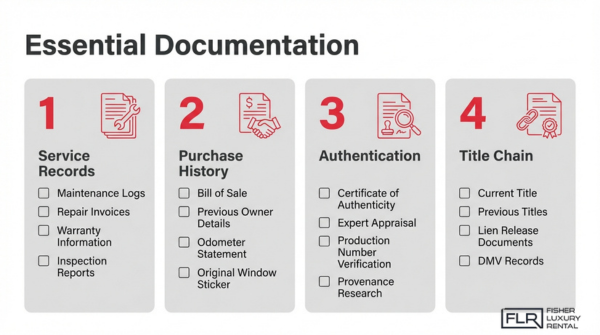
What Documentation Is Essential to Preserve Resale Value?
The documentation essential to preserve resale value includes a complete service history, original purchase records, and any certificates of authenticity tied to the vehicle. According to JD Power research published through Università Ca’ Foscari Venezia, regular maintenance is a critical factor in preserving supercar investment value, as unrecorded or deferred service significantly impacts resale potential.
Essential documents to maintain from day one:
- Factory build sheets and original window stickers.
- Stamped service booklets with dated entries from authorized service centers.
- Receipts for every repair, part replacement, and cosmetic treatment.
- Title history showing a clean chain of ownership.
Gaps in paperwork raise immediate red flags for serious collectors. Even a single missing service interval can reduce a supercar’s resale price by a meaningful margin, regardless of the car’s actual mechanical condition.
How Do Insurance and Storage Choices Affect Long-Term Returns?
Insurance and storage choices affect long-term returns by directly influencing both preservation quality and total cost of ownership. Agreed-value insurance policies protect supercars at their appraised market worth rather than a depreciated estimate, which is critical when values appreciate rapidly.
Climate-controlled storage prevents the degradation that erodes value over time. Proper storage should address:
- Stable temperature and humidity to protect leather, rubber seals, and paint.
- Battery tenders and periodic engine cycling to maintain mechanical readiness.
- Secure facilities with fire suppression and surveillance systems.
- Covered, elevated parking to prevent tire flat-spotting and moisture damage.
Cutting corners on storage or settling for a standard liability policy can quietly erode returns that took years to build. With the right protective infrastructure in place, supercar investors position themselves to capture the full appreciation potential of their vehicles.
How Do Supercars Compare to Other Asset Classes as Investments?
Supercars compare favorably to traditional asset classes in raw appreciation, though they differ significantly in liquidity, carrying costs, and tax treatment. The following sections break down returns versus stocks and real estate, then cover the unique liquidity and tax considerations.
How Do Supercar Returns Stack Up Against Real Estate or Stocks?
Supercar returns stack up competitively against real estate and stocks when the right models are selected. According to Hagerty Media, the Hagerty Supercars Index has recorded a 326 percent total gain since its 2013 inception, yielding an annualized return of nearly 14 percent across 15 influential models from 1984 to 2013. For context, gold delivered an annualized total return of 7.96% over a 30-year period through September 2025, and the S&P 500 has historically averaged roughly 10% annually.
These figures suggest top-tier supercars can outpace both gold and broad equities. However, those headline numbers represent carefully selected models, not the asset class as a whole. Most production supercars depreciate. The gap between a well-chosen collector car and an average exotic purchase is far wider than the spread between individual stocks within a diversified index fund, making model selection the single most important variable.
What Are the Liquidity and Tax Considerations Unique to Supercars?
The liquidity and tax considerations unique to supercars set them apart from nearly every traditional investment. Selling a supercar requires finding a qualified buyer willing to pay fair market value, a process that can take weeks or months depending on the model and condition. Stocks and publicly traded REITs settle in days; supercars do not. Fractionalization platforms are expanding access, with ArtLending.com estimating the fractionalized alternative asset market will reach US$2.861 trillion by 2026, yet most collectors still trade whole vehicles through private sales or auctions.
On the tax side, supercars classified as collectibles may face different capital gains treatment than equities. Storage, insurance, and maintenance costs also erode net returns in ways that dividend-paying stocks or rental income properties offset naturally. For investors weighing supercars against conventional portfolios, factoring in these carrying costs is essential before committing capital.
Understanding how supercars perform relative to other assets helps clarify when they belong in a portfolio and when experiencing them through rental makes more practical sense.
What Mistakes Do New Supercar Investors Often Make?
New supercar investors often make mistakes rooted in emotional buying and inadequate market due diligence. The following sections cover how emotion-driven decisions erode returns and which red flags signal trouble in the market.
How Can Emotional Decisions Jeopardize Investment Returns?
Emotional decisions jeopardize investment returns by replacing data-driven analysis with impulse purchases driven by desire, nostalgia, or social pressure. According to a Limelight Platform study, luxury car buyers are more likely motivated by social status and material wealth desires than utilitarian needs, creating emotional investing patterns that drive price premiums above fair market value.
Overpaying at the point of purchase is the single fastest way to guarantee negative returns, regardless of how well a model appreciates over time. Common emotional traps include:
- Chasing a trending model after its price has already peaked.
- Buying a specific color or specification for personal taste rather than collector demand.
- Rushing a transaction to avoid “missing out” without completing proper inspection.
- Letting brand loyalty override objective valuation data.
Disciplined investors set a target acquisition price based on comparable sales and walk away when the market exceeds it.
What Red Flags Should You Watch Out for in the Market?
The red flags you should watch out for in the market include gaps in provenance, unclear seller identities, and inconsistent service records. A Shufti Pro compliance report found that failure to implement proper identity verification in high-end vehicle sales creates a risk of the sector becoming a source for money laundering activities.
Key warning signs to evaluate before any purchase:
- Missing or incomplete service history, which signals deferred maintenance and hidden mechanical issues.
- Sellers unwilling to allow independent pre-purchase inspections.
- Title discrepancies, salvage history, or odometer inconsistencies on vehicle history reports.
- Pricing significantly below market comparables, which often indicates undisclosed damage or fraudulent listings.
Verification matters more than excitement. Blockchain-based digital authentication tools are emerging to help confirm a vehicle’s history, but nothing replaces hands-on inspection by a qualified specialist. Recognizing these pitfalls early protects capital and positions new investors for stronger long-term returns.
How Should You Approach Supercar Value and Experiences with Exotic Car Rental Services?
You should approach supercar value and experiences by combining informed research with hands-on driving time. Exotic car rental services bridge the gap between investment interest and real-world experience.
Can Renting Exotic Cars from Fisher Luxury Rental Enhance Your Supercar Investment Strategy?
Yes, renting exotic cars from Fisher Luxury Rental can enhance your supercar investment strategy by letting you evaluate models firsthand before committing significant capital. Exotic car rental services allow customers to experience high-performance dream cars without the capital tie-up associated with direct ownership.
Fisher Luxury Rental specializes in high-trim luxury and exotic vehicles, purchasing top-tier models to ensure fleet quality. Spending seat time in a Lamborghini Huracan, Ferrari 488 Spider, or McLaren 720S reveals real-world driving dynamics, ergonomic preferences, and build quality that no spec sheet conveys. According to a 2026 Technavio report, the supercar market is expected to expand by USD 11,925.8 million between 2026 and 2030 at a 6.6% compound annual growth rate. That growth makes informed model selection more critical than ever.
For anyone considering a six- or seven-figure purchase, a rental weekend is the most cost-effective due diligence available.
What Are the Key Takeaways About Are Supercars Good Investments for Value and Appreciation in 2026 We Covered?
The key takeaways about whether supercars are good investments for value and appreciation in 2026 center on selectivity, patience, and cost awareness. The most actionable insights from this article include:
- Brand heritage, controlled production, and rarity remain the strongest drivers of long-term supercar appreciation.
- Historical returns on select models have outpaced gold and certain equity benchmarks, but only for well-chosen, well-maintained examples.
- Ownership costs, including specialized maintenance, insurance, and storage, directly erode net returns when neglected.
- Regulatory shifts around emissions and the rise of electric hypercars are reshaping which models hold future collectibility.
- Emotional buying and insufficient authentication are the most common mistakes that destroy investment value.
- Renting exotic cars before purchasing provides practical, low-risk insight into a model’s real-world appeal and livability.
Supercar investing rewards discipline over impulse. Fisher Luxury Rental offers a practical starting point, letting you experience the vehicles that interest you most before committing to ownership.