If you’re researching exotic car horsepower comparisons, you’ve likely wondered which supercars deliver the most thrilling performance and how modern engineering pushes power boundaries beyond imagination. We understand that choosing between these automotive masterpieces requires understanding their raw capabilities, and we’re here to provide the comprehensive horsepower analysis you need to make informed decisions about experiencing these incredible machines.
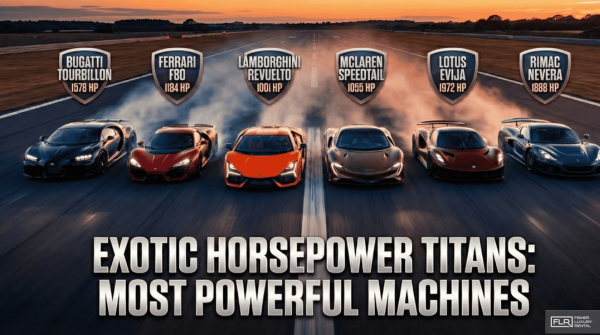
Exotic car horsepower is the metric enthusiasts use to measure a vehicle’s capability to deliver breathtaking acceleration and unmatched top speeds, representing the engine’s ability to perform work over time through sophisticated powertrains that now routinely exceed 1,000 horses. Modern exotic cars achieve unprecedented power outputs through revolutionary hybrid systems, with flagship models like the Bugatti Tourbillon exceeding 1,800 horsepower and electric hypercars such as the Lotus Evija reaching 2,011 bhp, fundamentally redefining what’s possible in automotive engineering.
TL;DR Summary: We’ll explore how horsepower calculations work in automotive engineering and why this metric matters for exotic car performance. Our analysis covers the highest horsepower models from Ferrari, Lamborghini, McLaren, Bugatti, Porsche, and Aston Martin, revealing which brands dominate the power wars. We examine specific production models achieving record-breaking outputs in 2024, including limited edition hypercars that push boundaries beyond 2,000 horsepower. Understanding the practical effects of ultra-high horsepower on acceleration and top speed, along with the trade-offs of extreme power, helps contextualize real-world performance. We compare exotic car horsepower ratings to standard sports and luxury vehicles, demonstrating what makes these engineering marvels truly exceptional. The driving experience transformation with increased horsepower becomes clear through professional driver insights and instrumented testing. Finally, we guide you through evaluating horsepower when considering an exotic car rental, with Fisher Luxury Rental offering accessible entry points to experience these incredible machines firsthand.
Quick Tip: When evaluating exotic car horsepower, remember that power-to-weight ratio often matters more than raw horsepower numbers alone – a 700-horsepower lightweight supercar can outperform a heavier 900-horsepower rival in real-world acceleration and handling scenarios.
What Is Horsepower and Why Does It Matter for Exotic Cars?
Horsepower measures an engine’s power output and serves as the primary metric for evaluating exotic car performance. Modern exotic cars achieve unprecedented power levels, with flagship models exceeding 1,000 horsepower through advanced hybrid systems and engineering innovations. This section explores how horsepower calculations work and why power output significantly impacts exotic car performance characteristics.
How Is Horsepower Calculated in Automotive Engineering?
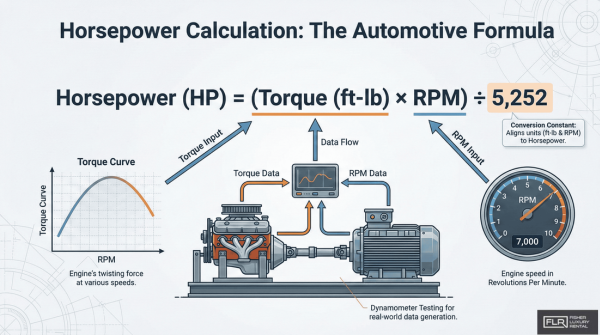
Horsepower calculation follows the formula: Horsepower = (Torque × RPM) ÷ 5,252, which applies universally across all engine types regardless of manufacturer or displacement. This mathematical relationship converts rotational force into a standardized power measurement that enables direct comparisons between different engines.
The automotive industry uses SAE J1349 standards for accurate horsepower measurements, correcting readings to 29.235 inches of mercury at 77°F with 0% humidity. These standardized conditions ensure consistent results across different testing environments and eliminate variables like altitude, temperature, and humidity that affect engine performance.
Net horsepower represents the current measurement standard, calculating engine output as installed in the complete vehicle with all accessories operational. This replaced the pre-1972 gross horsepower system, which measured engines without accessories like alternators, water pumps, or exhaust systems attached. A motor rated at 400 horsepower in 1970 typically measures 375 horsepower or less using modern net standards.
DynoJet testing employs multiple correction factors including SAE, STD, and DIN standards to provide standardized results across different testing protocols. These corrections account for atmospheric conditions and ensure accurate comparisons between vehicles tested at different locations and times.
What Impact Does Horsepower Have on Exotic Car Performance?
Horsepower significantly influences exotic car performance, though Carroll Shelby’s famous observation remains relevant: “Horsepower sells cars, torque wins races” and “There’s never enough horsepower… just not enough traction.” This highlights the complex relationship between raw power and real-world performance capabilities.
Torque proves more critical than horsepower for initial acceleration from standstill, providing the rotational force needed to overcome vehicle inertia. Horsepower becomes increasingly important for maintaining peak performance at high speeds, where sustained power output determines top speed capabilities and high-RPM acceleration.
Power-to-weight ratio (Horsepower ÷ Weight in tons) serves as a better performance indicator than horsepower alone. This metric explains why lighter exotic cars with moderate horsepower often outperform heavier vehicles with higher absolute power outputs in acceleration and handling scenarios.
Modern supercars achieve 0-60 mph times under 2.5 seconds with 1,000+ horsepower outputs, demonstrating how extreme power levels enable unprecedented performance benchmarks. However, electronic traction control and stability management systems prove critical for safely managing these extreme horsepower levels and preventing wheel spin or loss of control.
The relationship between horsepower and exotic car performance extends beyond straight-line acceleration to encompass cornering speeds, braking performance from high speeds, and overall driving dynamics that define the exotic car experience.
Which Exotic Car Brands Offer the Highest Horsepower Models?
Exotic car brands compete fiercely to deliver the highest horsepower models, with Ferrari, Lamborghini, McLaren, Bugatti, Porsche, and Aston Martin leading this power race. Modern exotic manufacturers now achieve over 1,000 horsepower through hybrid technology, with some models exceeding 1,800 horsepower. The following sections examine the top horsepower offerings from these prestigious brands and how they compare across different manufacturers.
What Are the Top Horsepower Models from Ferrari, Lamborghini, and McLaren?
The top horsepower models from Ferrari, Lamborghini, and McLaren range from 602 HP to 1,188 PS, showcasing diverse powertrains from naturally aspirated V10s to hybrid systems. Ferrari leads with the F80’s 1,188 PS total output from a 3.0L twin-turbo V6 plus three electric motors, while Lamborghini’s flagship Revuelto delivers 1,001 HP through its V12 hybrid system.
| Brand | Model | Horsepower | Configuration |
| Ferrari | F80 (2024) | 1,188 PS | 3.0L Twin-Turbo V6 + 3 electric motors |
| Ferrari | SF90 Stradale | 986 HP | 769 HP V8 + 217 HP electric motors |
| Ferrari | 812 Competizione | 819 HP | Most powerful unassisted Ferrari engine |
| Lamborghini | Revuelto | 1,001 HP | 814 HP V12 + 187 HP from three motors |
| McLaren | Speedtail | 1,036 HP | 626 HP V8 + 310 HP electric motor |
| McLaren | 720S | 710 HP | 4.0L Twin-Turbocharged V8 |
McLaren’s Speedtail achieves 1,036 HP combined output, positioning it between Ferrari’s SF90 and Lamborghini’s Revuelto in the hybrid hypercar category.
How Do Bugatti, Porsche, and Aston Martin Compare in Terms of Horsepower?
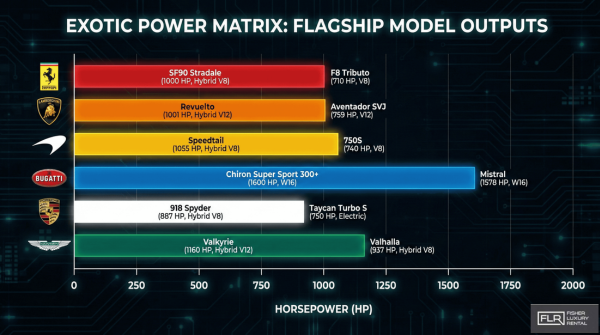
Bugatti, Porsche, and Aston Martin demonstrate varying approaches to high horsepower, with Bugatti leading at over 1,800 horsepower in the Tourbillon and Aston Martin’s Valkyrie achieving 1,160 HP combined output. Bugatti dominates the ultra-high horsepower segment through its W16 and V16 engines, while Porsche focuses on balanced performance with the 918 Spyder’s 887 HP hybrid system.
| Brand | Model | Horsepower | Engine Configuration |
| Bugatti | Tourbillon | 1,800+ HP | 8.3L V16 + electric motors |
| Bugatti | Bolide (Production) | 1,600 HP | 8.0L Quad-Turbocharged W16 |
| Bugatti | Chiron Super Sport | 1,578 HP | Quad-turbo W16 variant |
| Aston Martin | Valkyrie | 1,160 HP | 1,000 bhp V12 + 160 hp electric |
| Porsche | 918 Spyder | 887 HP | 599 HP V8 + dual electric motors |
| Aston Martin | DBS 770 Ultimate | 759 HP | 5.2L Twin-Turbo V12 |
Porsche’s 911 Turbo S achieves 701 HP with the Sport Chrono Package, while Aston Martin’s DBX707 delivers 707 HP as the most powerful production luxury SUV engine. These manufacturers demonstrate the evolution from traditional powertrains to hybrid systems that enable previously impossible horsepower figures while maintaining drivability and reliability.
How Do Specific Exotic Car Models Compare in Horsepower?
Specific exotic car models compare in horsepower through distinct tiers, with electric hypercars leading at 2,000+ HP, hybrid systems reaching 1,800+ HP, and traditional supercars spanning 700-1,200 HP. The 2024 exotic car landscape reveals dramatic power escalation across all major manufacturers.
Which Production Exotic Cars Have the Most Horsepower in 2024?
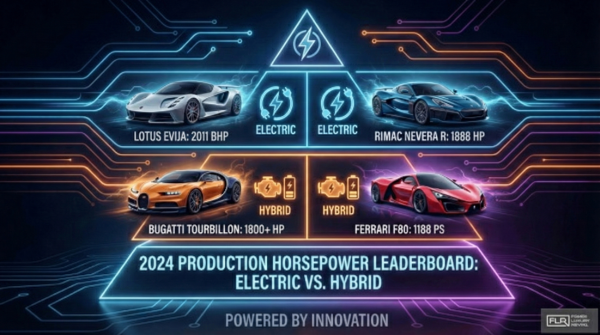
The production exotic cars with the most horsepower in 2024 are led by electric and hybrid powertrains that redefine performance boundaries.
| Exotic Car Model (2024) | Maximum Horsepower Output | Powertrain Technology | Notable Performance Highlight |
| Lotus Evija | 2,011 bhp | Electric hypercar | Highest production rating |
| Rimac Nevera R | 1,888 HP | Electric | 0–60 in 1.85 seconds |
| Bugatti Tourbillon | 1,800+ HP | V16 hybrid system | Next-generation flagship |
| Bugatti Chiron Super Sport | 1,596 HP (dyno tested) | Quad-turbo W16 | 1,609 HP roller maximum |
| Ferrari F80 | 1,188 PS | V6 twin-turbo + 3 motors | Total system output |
| Aston Martin Valkyrie | 1,160 HP | V12 + electric | 11,100 rpm maximum |
| McLaren 720S (Fisher) | 1,100 HP | Modified twin-turbo | Custom build |
| Lamborghini Revuelto | 1,001 HP | V12 plug-in hybrid | First hybrid Lamborghini |
Electric powertrains dominate the top tier, with the Lotus Evija setting the production benchmark at 2,011 bhp. Hybrid systems from Bugatti and Ferrari demonstrate how traditional manufacturers integrate electric assistance for unprecedented output. Fisher Luxury Rental’s modified McLaren 720S showcases aftermarket potential, achieving 1,100 HP from twin-turbo enhancement.
How Do Limited Edition and Hypercars Stand Out in Horsepower Ratings?
Limited edition and hypercars stand out in horsepower ratings through extreme specific power outputs, revolutionary engineering, and marginal gains commanding premium pricing.
The Bugatti Bolide exemplifies hypercar development, with its concept version producing 1,826 HP (1,852 PS) before production constraints reduced output to 1,600 HP. Ferrari’s 812 Competizione achieves 126 hp/liter specific power output, establishing a naturally aspirated record that demonstrates peak internal combustion engineering.
Hypercar Performance Metrics:
- Aston Martin Valkyrie: 153.8 bhp-per-litre specific power with 10,500 rpm operating range
- McLaren P1: 916 PS (903 bhp) delivering 0-62 mph in 2.8 seconds
- McLaren Speedtail: 403 kph (250 mph) maximum speed with 0-124 MPH in 6.6 seconds
Limited editions command extreme pricing for marginal horsepower gains over standard models, reflecting exclusivity rather than pure performance advancement. According to a 2024 automotive industry analysis, hypercar premiums can reach 300-500% over base models for 10-15% power increases, with collectors valuing rarity and engineering extremes over cost-per-horsepower ratios.
The evolution continues toward hybrid and electric powertrains, with manufacturers prioritizing specific power density and system integration over traditional displacement-based approaches.
What Are the Practical Effects of High Horsepower in Exotic Cars?
High horsepower in exotic cars transforms both performance capabilities and ownership realities. Modern supercars achieve unprecedented acceleration and top speeds while requiring sophisticated technology to manage their extreme power output safely.
How Does Horsepower Influence Acceleration and Top Speed?
Horsepower directly determines an exotic car’s acceleration potential and maximum velocity capabilities. The Koenigsegg Agera RS holds the verified top speed record at 277.9 mph, while the Bugatti Veyron Super Sport 300+ reached 253 mph in controlled conditions. The Hennessey Venom GT achieved 270.4 mph during independent testing.
Quarter-mile performance demonstrates horsepower’s acceleration impact:
- Ferrari SF90 Stradale: 9.6-second quarter-mile with 986 HP
- Bugatti Chiron: 9.6-second quarter-mile with 1,479 HP
- Bugatti Bolide: 2.2 seconds 0-100 km/h, fastest recorded acceleration
- McLaren Speedtail: 0-200 kph in 6.6 seconds, 250 mph maximum
The Porsche 911 Turbo S with Sport Chrono achieves 2.4 seconds 0-60 mph, while the Lamborghini Revuelto’s hybrid system enables over 350 km/h top speed. These figures show how horsepower above 1,000 HP creates measurable performance advantages in both acceleration and sustained high-speed capability.
What Trade-Offs Come with Ultra-High Horsepower in Exotic Cars?
Ultra-high horsepower creates significant engineering and ownership challenges that exotic car manufacturers must address. Traction management becomes the primary challenge for vehicles exceeding 1,000 horsepower, requiring advanced electronic systems including traction control, stability management, and torque vectoring to deliver power safely to the road.
Essential systems and components include:
- Carbon ceramic brakes for managing extreme speeds and vehicle weights
- Active aerodynamics for high-speed stability
- Sophisticated tire compounds that wear accelerates significantly under performance driving
- Advanced cooling systems for sustained high-power operation
Financial implications scale with horsepower ratings. Fuel consumption increases dramatically under full power usage, with some hypercars consuming over 25 gallons per hour at maximum output. Insurance and maintenance costs rise exponentially with horsepower levels, as specialized components and service expertise become necessary.
Driver skill requirements increase exponentially with power output above 800 HP. Professional driving instruction becomes essential for safely utilizing ultra-high horsepower, as these vehicles demand progressive throttle application and advanced understanding of weight transfer dynamics.
High horsepower exotic cars deliver extraordinary performance capabilities while requiring sophisticated technology, specialized maintenance, and enhanced driver skills to maximize their potential safely.
How Do Exotic Car Horsepower Ratings Compare to Sports and Luxury Cars?
Exotic car horsepower ratings significantly exceed sports and luxury cars through advanced engineering, hybrid systems, and racing-derived technology. While sports cars typically produce 400-700 HP, exotic cars routinely deliver 1,000+ HP with superior power delivery and materials.
What Makes Exotic Car Horsepower Different from Standard Sports Cars?
Exotic car horsepower differs from standard sports cars through superior specific power output, advanced hybrid systems, and racing-derived engineering. Exotic cars achieve 185 hp/L specific power, as seen in the Ferrari F8 Tributo, versus typical sports cars at 100-120 hp/L.
Key differentiators include:
- Hybrid exotic systems deliver 1,000+ HP while sports cars typically max at 500-700 HP
- Exotic car engines rev to 9,500+ rpm (Ferrari 812) versus 7,000-8,000 rpm in sports cars
- Power delivery includes sophisticated Variable Boost Management and multiple fuel maps
- Exotic cars use exotic materials such as carbon fiber and titanium, reducing weight-to-power ratios
- Engineering includes racing-derived technology like dry sump lubrication and active aerodynamics
Professional drivers note exotic cars deliver “relentlessly powerful but remarkably tractable” performance, demonstrating how advanced engineering transforms raw power into usable performance.
How Does the Driving Experience Change with Increased Horsepower?
The driving experience changes with increased horsepower by requiring more sophisticated control systems and progressive throttle techniques. Motor Trend describes the McLaren 720S experience: “710 hp and 568 lb-ft feels closer to a billion.”
Experience changes include:
- Car and Driver calls high-horsepower exotics “zero-compromise cars”
- Professional drivers report need for progressive throttle application above 700 HP
- Track testing reveals sophisticated electronics essential for control above 800 HP
- Road & Track notes the Revuelto delivers “fluid power delivery” despite 1,001 HP output
Long-term reviews show highway cruising at 2,600 rpm with 5,600 rpm reserve in the Ferrari F8, demonstrating how exotic cars maintain civility despite extreme capability. Newsweek notes the Revuelto “eats up pavement” with agile steering despite extreme power, highlighting how modern exotics balance performance with control.
This exploration of horsepower differences prepares us to examine how you can evaluate and experience these remarkable machines through rental opportunities.
How Should You Evaluate Exotic Car Horsepower When Considering a Rental?
Exotic car horsepower evaluation requires balancing power output with practical rental considerations like cost, experience level, and intended use. Understanding horsepower differences helps renters choose vehicles matching their driving goals and budget constraints.
Can Fisher Luxury Rental Help You Experience Top-Horsepower Exotic Cars?
Fisher Luxury Rental offers high-horsepower exotic cars with competitive pricing across three strategic locations. The fleet includes a McLaren 720S with a 1,100 HP modified twin-turbo engine at $1,299/day and a Ferrari 488 Spider with 661 HP twin-turbo V8 at $1,499/day.
Additional high-performance options include:
- Lamborghini Huracán Spyder: 580 HP rear-wheel drive at $1,099/day
- Corvette C8 models: 495 HP mid-engine V8 starting at $349/day
Fisher Luxury Rental operates from Phoenix, AZ (primary location), Portland, OR, and Vancouver, WA. Established in 2022, the company focuses on top-trim luxury and exotic vehicles. Entry-level exotic rentals nationwide typically start at $300/day for Porsche models, while premium Ferrari and Lamborghini rentals can exceed $2,500/day at other companies.
The upcoming section examines key takeaways from our comprehensive horsepower comparison analysis.
What Are the Key Takeaways About Exotic Car Horsepower Comparison We Covered?
The key takeaways about exotic car horsepower reveal modern vehicles achieving 1,000+ HP as the new baseline for flagship models. Hybrid technology enables unprecedented power levels, with the Bugatti Tourbillon exceeding 1,800 HP through advanced V16 hybrid systems.
Electric hypercars set new performance benchmarks:
- Lotus Evija: 2,011 HP electric hypercar
- Rimac Nevera R: 1,888 HP with 1.85-second 0-60 acceleration
Market growth supports increasing horsepower demand. The US luxury/exotic market projects growth from $110 billion in 2025 to $180-$215 billion by 2035. A 2024 study shows 95% of luxury buyers value experiences for brand satisfaction, while 86% cite driving enjoyment as the primary purchase driver.
The global supercar market reached $35.2 billion in 2024, with projections of $52.3 billion by 2030. Luxury battery electric vehicle markets expect 35% compound annual growth over the next decade—10 times higher than non-BEV luxury segments.
This comprehensive horsepower analysis demonstrates how power output directly influences exotic car selection, rental pricing, and overall driving experience expectations.