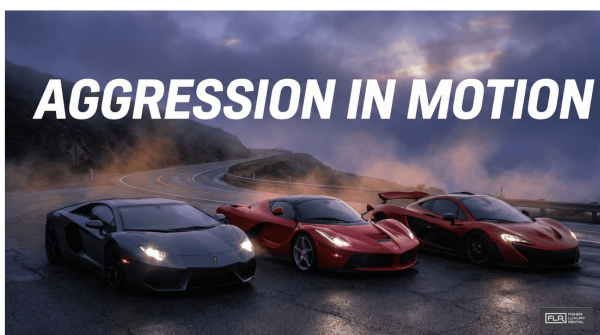
Are you captivated by the raw, visceral presence of exotic cars that command attention on every street? You’re not alone in your fascination with these automotive sculptures that blur the line between engineering excellence and aggressive artistry.
We understand the magnetic pull of sharp angles, menacing stance, and aerodynamic mastery that defines today’s most coveted supercars—you’ve come to the definitive guide on exotic cars with aggressive styling.
Exotic cars with aggressive styling are high-performance vehicles characterized by sharp angular lines, dramatic aerodynamic elements, and purposeful design features that convey power and speed. These automotive masterpieces combine wedge-shaped silhouettes, active aerodynamics, large rear spoilers, carbon fiber construction, and distinctive elements like scissor doors to create an intimidating visual presence while enhancing performance through sophisticated airflow management.
TL;DR Summary:
• Design Evolution: From the 1980s wedge-shaped pioneers like Lamborghini Countach to today’s aerodynamically optimized hypercars, aggressive styling has evolved from pure shock value to integrated performance art
• Key Features: Sharp angles, active aerodynamics, carbon fiber construction, scissor doors, Y-shaped lighting, and functional air intakes define modern aggressive exotic car design
• Leading Brands: Lamborghini’s hexagonal motifs and angular DNA, Ferrari’s form-follows-function philosophy, and McLaren’s minimalist efficiency showcase distinct approaches to aggressive styling
• Market Impact: Aggressively styled exotics command 10-20% price premiums, show better resale value retention, and achieve 4.8% higher social media engagement rates than conservative designs
• Performance Integration: Modern aggressive styling serves dual purposes—visual drama and functional aerodynamics, with cars like the McLaren P1 generating 1,323 lbs of downforce while maintaining 0.34 Cd
• Rental Experience: Fisher Luxury Rental offers access to aggressively styled exotics including the 1,100 hp McLaren 720S and 661 hp Ferrari 488 Spider in Phoenix, Portland, and Vancouver
Quick Tip: When evaluating aggressive styling, look for functional aerodynamic elements rather than purely cosmetic additions—genuine performance-oriented design features like active spoilers, venturi tunnels, and NACA ducts indicate engineering excellence beyond mere visual impact.
The journey from the radical wedge shapes of yesterday to today’s scientifically sculpted hypercars reveals how aggressive styling has matured from attention-grabbing aesthetics to performance-enhancing art. Understanding these design principles enhances appreciation for both the visual drama and engineering sophistication that define modern exotic cars.
How Do Exotic Cars Achieve Aggressive Styling?
Exotic cars achieve aggressive styling through deliberate design elements that create visual impact and serve aerodynamic functions. These vehicles combine sharp geometric forms, advanced materials, and active aerodynamic systems to project power while enhancing performance capabilities.
What Are the Key Exterior Features of Aggressively Styled Exotic Cars?
The key exterior features of aggressively styled exotic cars include sharp angular profiles, functional aerodynamic elements, and advanced materials that create distinctive visual signatures.
Primary Design Elements:
- Sharp angles and wedge-shaped silhouettes, exemplified by the 1980s Lamborghini Countach’s space-age profile
- Low-slung profiles with the Ferrari F40 measuring only 44.3 inches in height
- Exaggerated side strakes as seen on the Ferrari Testarossa’s wide stance design
- Y-shaped lighting signatures and hexagonal air intakes characteristic of modern Lamborghini design language
Active Aerodynamic Systems:
- Large rear spoilers and diffusers generating up to 600 kg of downforce in cars like the McLaren P1
- Active aerodynamic elements including adjustable spoilers and flaps that deploy at higher speeds
- Hood scoops and NACA ducts for engine cooling, a signature feature on Lamborghini models since the Countach
- Venturi tunnels allowing air to flow through the vehicle, as pioneered by the Lotus Evija
Advanced Materials and Features:
- Carbon fiber body panels comprising 80% of the Aston Martin DBS Superleggera’s exterior
- Scissor doors, first introduced on the Lamborghini Countach and now a brand signature
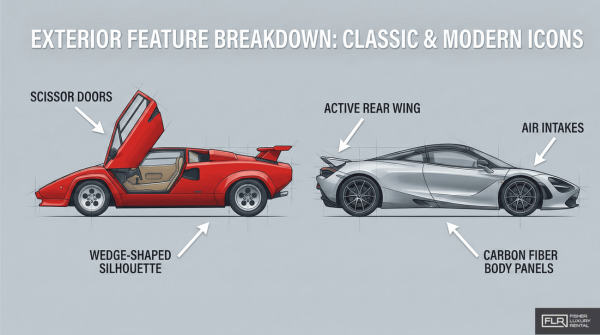
These exterior elements work together to create vehicles that appear ready to attack the road while providing functional benefits for high-speed stability and engine cooling.
Which Interior Elements Enhance the Aggressive Ambiance in Exotic Cars?
Interior elements that enhance aggressive ambiance in exotic cars focus on race-inspired minimalism, advanced materials, and driver-centric configurations that prioritize performance over luxury comfort.
Performance-Focused Layout:
- Centered driver’s seat configuration as featured in the McLaren F1 for optimal weight distribution
- Race-inspired minimalist interiors prioritizing performance over comfort
- Digital displays replacing traditional analog gauges in 2020s hypercars
Advanced Construction:
- Lightweight carbon fiber monocoque chassis weighing just 120 kg in the Lotus Evija
- Aerospace-derived materials and construction techniques throughout the cabin
These interior elements create an environment that reinforces the vehicle’s performance capabilities while maintaining the aggressive aesthetic established by the exterior design.
How Does Aerodynamics Influence Aggressive Car Styling?
Aerodynamics influences aggressive car styling by requiring design elements that manage airflow while creating the dramatic visual forms that define exotic vehicles. Modern aerodynamic development relies on computational fluid dynamics to optimize both performance and appearance.
Aerodynamic Performance Achievements:
| Vehicle | Drag Coefficient | Downforce Generation | Special Features |
| McLaren Speedtail | 0.278 Cd | Lowest drag coefficient | Computational Fluid Dynamics optimization |
| McLaren P1 | 0.34 Cd | 1,323 lbs downforce | Active rear wing deployment |
| Lotus Evija | Not specified | 1,500 kg downforce | “Porosity” design concept |
| Bugatti Chiron | Not specified | Enhanced downforce | Aerodynamic silhouette reduces drag |
Technical Innovations:
- Computational Fluid Dynamics (CFD) modeling allows optimization without extensive physical prototyping
- Ferrari’s morphing bodywork patent uses elastically deformable materials for real-time aerodynamic optimization
- Active rear wings on the McLaren 720S deploy at higher speeds to increase downforce without adding drag
- Canards on the Ferrari LaFerraria enhance airflow around front wheels while managing brake cooling
Functional Design Elements:
- Smooth underbody panels prevent air from getting trapped, reducing turbulence
- Strategic placement of diffusers at the rear underside creates low-pressure zones for improved stability
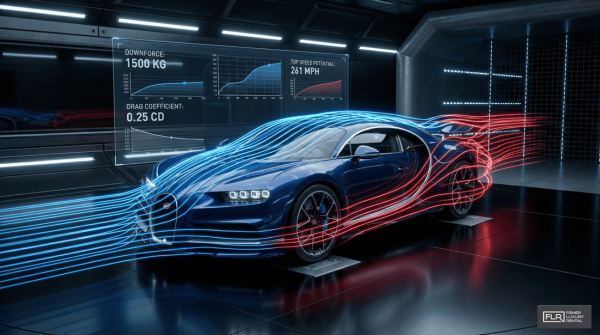
Modern aerodynamic requirements have shifted aggressive styling from purely aesthetic choices to functionally-driven design elements that enhance both visual impact and high-speed performance capabilities.
Which Exotic Car Brands Are Famous for Aggressive Designs?
Exotic car brands famous for aggressive designs include Lamborghini, Ferrari, McLaren, and Aston Martin. These manufacturers have built their reputations on creating vehicles that combine visual aggression with cutting-edge performance technology. Each brand has developed signature styling elements that make their cars instantly recognizable while conveying power and exclusivity. These brands consistently push boundaries in automotive design, using materials like carbon fiber and technologies such as active aerodynamics to achieve their distinctive aggressive aesthetics.
What Signature Styling Elements Set Lamborghini Apart?
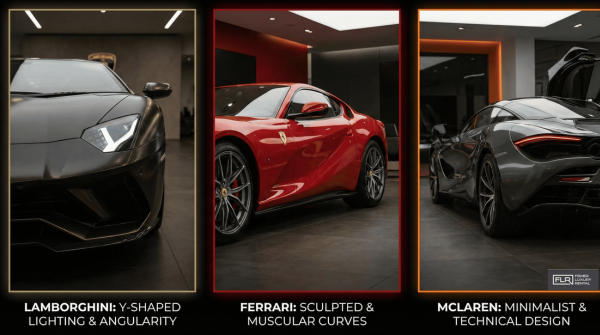
Lamborghini’s signature styling elements include angular wedge-shaped designs, Y-shaped LED lighting, and hexagonal motifs throughout the vehicle. The Countach (1974-1990) established Lamborghini’s wedge-shaped design language with 2,049 units produced, creating the foundation for all future models. Y-shaped LED lighting signatures appear across all modern models from the Huracán to the Revuelto, while hexagonal design motifs are repeated in air intakes, interior switches, and infotainment displays.
Modern Lamborghini engineering maintains aggressive aesthetics through functional elements:
- NACA ducts for sophisticated engine cooling have been a signature since the Countach
- Carbon fiber construction allows for sharper lines than aluminum or traditional materials
- The Aventador SVJ produces 770 hp while reducing drag coefficient by 1% compared to the standard model
- The new Revuelto introduces Lamborghini’s first hybrid V12 while maintaining traditional angular design cues
Chief Design Officer Mitja Borkert describes the brand’s design as “playing a rhythm” with different songs, emphasizing how the brand maintains instant recognizability across all touchpoints according to their holistic design approach. Lamborghini achieved record sales of 10,747 vehicles in 2024, up from 10,112 in 2023, demonstrating continued market appeal for their aggressive design philosophy.
How Does Ferrari’s Design Philosophy Convey Aggression?
Ferrari’s design philosophy conveys aggression through the principle that “real design is when form and function are one.” The F40 (1987-1992) pioneered aggressive aero design as the first Ferrari to exceed 200 mph, establishing the template for combining visual impact with aerodynamic performance. LaFerrari combines 800 hp from a V12 with 161 hp electric motor for 950+ total horsepower, showcasing how modern Ferrari integrates hybrid technology without compromising aggressive aesthetics.
Ferrari achieves aggression through advanced aerodynamic technologies:
- F1-derived active aerodynamics including deformable winglets adapt to driving conditions
- Ferrari’s morphing bodywork patent filed in January 2026 uses composite materials with elastomers
- The Testarossa’s exaggerated side strakes became an iconic 1980s design element
- The F50 brought Formula 1-inspired design cues directly to road cars in the 1990s
Modern Ferraris balance aesthetic needs with aerodynamic optimization through CFD modeling, ensuring that aggressive styling serves performance functions. Ferrari ranks among top three automotive brands for social media engagement on YouTube, demonstrating the visual appeal of their aggressive design language. Ferrari California T offers aggressive styling at Fisher Luxury Rental starting at $599/day, making this design philosophy accessible to enthusiasts.
What Makes McLaren and Aston Martin Stand Out in Aggressive Styling?
McLaren and Aston Martin stand out through innovative use of carbon fiber technology and distinctive design philosophies that blend aggression with sophistication. McLaren F1 (1992-1998) introduced the first fully carbon-fiber monocoque body in a sports car, establishing McLaren’s commitment to lightweight construction. McLaren’s carbon fiber is 45% lighter than aluminum and 80% lighter than steel, enabling aggressive styling without weight penalties.
These brands distinguish themselves through specific technological approaches:
McLaren’s Performance-Driven Aggression:
- The McLaren P1 generates 903 hp combined while maintaining ground effect technology
- McLaren 720S features tour, sport, and track modes with 1,100 hp twin-turbo configuration
- McLaren sold 1,569 vehicles in Q1-Q3 2023, focusing on limited production runs
Aston Martin’s Refined Aggression:
- Aston Martin DBS Superleggera delivers 715 hp standard, 759 hp in the 770 Ultimate variant
- Aston Martin’s AeroBlade technology functions “like a big rear wing, but with no drag”
- The DBS features strategic air vents with functional nostrils for heat extraction
Marek Reichman describes Aston Martin’s design philosophy as “beauty is a number” evolving to “beauty can’t be tamed,” reflecting how the brand balances aggressive elements with elegant proportions. Aston Martin delivered 6,700 vehicles in 2023 with aggressive models commanding premium pricing, demonstrating market demand for their distinctive approach to aggressive luxury design.
This section explores the specific brands that have mastered aggressive exotic car design, leading naturally into understanding why this styling approach resonates so strongly with exotic car enthusiasts and the broader automotive market.
Why Is Aggressive Styling Popular Among Exotic Car Enthusiasts?
Aggressive styling attracts exotic car enthusiasts because it combines psychological appeal with functional performance advantages. This design philosophy transforms vehicles into symbols of status while delivering measurable aerodynamic benefits that enhance the driving experience.
The popularity stems from three core factors: owner perception and status enhancement, performance optimization through aerodynamic design, and the evolution of styling trends that balance aggression with sophistication. These elements work together to create vehicles that satisfy both emotional and practical desires among enthusiasts.
How Does Aggressive Styling Affect Owner Perception and Status?
Aggressive styling affects owner perception by triggering psychological responses that associate power with status and success. Scientific research reveals strong consumer preferences for vehicles with aggressive facial features that convey dominance and capability.
Study participants demonstrated marked preferences for vehicles like the BMW 5-series that project power through design cues. The Lamborghini Countach exemplifies this phenomenon, becoming a Hollywood symbol of success and excess during the 1980s cultural boom.
Market data supports the status appeal of aggressive designs:
- Limited edition aggressive variants command 10-20% price premiums over standard models
- Aggressive styling models demonstrate superior resale value retention compared to conservative designs
- Instagram engagement rates reach 4.8% average for automotive brands featuring aggressive styling content
- More than 38% of car buyers in 2024 consult social media campaigns before purchasing decisions
Ferrari, Tesla, and Porsche lead YouTube engagement metrics with aggressive styling content, strengthening their market position and brand value according to automotive market analysis.
What Role Does Aggressive Design Play in Performance and Driving Experience?
Aggressive design plays a functional role in performance by optimizing aerodynamics and weight distribution for enhanced driving dynamics. The Bugatti Bolide exemplifies the “form follows performance” philosophy with its jet-black carbon-fiber body that prioritizes aerodynamic efficiency.
Active aerodynamics systems demonstrate how aggressive styling delivers measurable performance benefits:
| Vehicle | Performance Metric | Aggressive Design Feature | Result |
| Lamborghini Aventador SVJ | 0-60 mph acceleration | Aggressive aero package | 2.8 seconds |
| Ferrari LaFerrari | Top speed | F1-derived active aerodynamics | 217+ mph |
| McLaren 720S | Stability | Active aerodynamics | Improved handling without drag penalty |
| Lotus Evija | Downforce generation | Venturi tunnels | Functional and visual design element |
Weight reduction through extensive carbon fiber use improves performance by up to 40% in modern supercars. The DBS Superleggera’s adaptive spoiler deploys automatically for increased high-speed downforce, while the McLaren P1’s moveable front and rear wings adjust based on driving conditions.
The Rimac Nevera delivers 1,900+ bhp through aerodynamics-driven design rather than pure visual aggression, demonstrating how modern aggressive styling serves dual purposes of performance enhancement and aesthetic appeal.
How Have Trends in Aggressive Styling Evolved Over Time?
Aggressive styling trends have evolved from shock-value designs to sophisticated aerodynamic integration across five distinct eras. The 1980s emphasized bold styling that “screamed performance,” with vehicles like the Lamborghini Countach establishing wedge-shaped design languages.
The evolution timeline shows progressive refinement:
- 1990s: Technological advancement with organic curves, exemplified by the McLaren F1’s flowing lines
- 2000s: Balance between beauty and performance, with the Bugatti Veyron’s rounded yet powerful design
- 2010s: Blurred lines between road and race cars through the “Holy Trinity” hybrid hypercars
- 2020s: Aerodynamic minimalism with fully digital displays and integrated sustainability
Contemporary trends shift from shock value to harmonious integration of aggressive elements. The approach shows maturation in automotive design philosophy, where aerodynamic requirements drive styling decisions rather than pure visual impact.
Sustainability now meets extreme performance through electric hypercars like the 2,011 bhp Lotus Evija, proving that aggressive design adapts to technological advancement while maintaining emotional appeal. Modern aggressive elements integrate seamlessly into overall brand design languages across all manufacturers, creating cohesive visual identities that satisfy both performance and aesthetic requirements.
What Are Some of the Most Iconic Aggressively Styled Exotic Cars?
Iconic aggressively styled exotic cars combine extreme performance with radical design elements that transform automotive engineering into rolling sculptures. These vehicles represent the pinnacle of aggressive automotive design, where manufacturers push boundaries beyond conventional styling to create machines that capture attention through pure visual dominance.
Modern exotic cars lead aggressive design through cutting-edge technology and aerodynamic innovation. Classic models established the foundations of aggressive styling that continue influencing contemporary hypercars. Limited editions and hypercars take aggressive design to its ultimate expression through exclusive materials and extreme engineering solutions.
Which Modern Exotic Cars Are Renowned for Their Aggressive Looks?
Modern exotic cars are defined by radical aerodynamic elements, extreme power outputs, and futuristic design languages that prioritize visual impact alongside performance capabilities.
| Modern Exotic Car | Horsepower Output | Signature Aggressive Design Feature | Defining Performance Metric |
| Bugatti Chiron | 1,479 hp | Aerodynamic efficiency with enhanced downforce | 261 mph top speed |
| Lamborghini Aventador | 770 hp | Angular DNA with flowing modernized lines | 1% drag reduction in SVJ |
| Koenigsegg Regera | 1,500 hp | Minimalist Scandinavian radical hybrid design | Direct drive transmission |
| Lotus Evija | 2,011 hp | Sculpted airflow tunnels | 1,500 kg downforce |
| Rimac Nevera | 1,914 hp | Sleek futuristic design | Red Dot Design Award |
| McLaren 720S | 710 hp | Active aerodynamics system | Available at Fisher Luxury $1,299/day |
The Lamborghini Revuelto introduces the brand’s first hybrid V12 while mixing traditional angular elements with futuristic design lines. Ferrari’s 488 Spider combines 661 horsepower with a 3.0-second 0-60 time and 205 mph top speed capability. Pagani Zonda showcases Italian artistry through aerospace-inspired construction techniques, while the Aston Martin Valkyrie represents British design elegance combined with F1-derived aggressive performance engineering.
What Classic Exotic Cars Set the Standard for Aggressive Styling?
Classic exotic cars established the fundamental design principles and aggressive styling elements that continue influencing modern hypercar development and visual identity.
The Lamborghini Countach (1974-1990) introduced scissor doors and the iconic wedge-shaped design across 2,049 units built. Ferrari’s F40 (1987-1992) pioneered carbon fiber body construction with its distinctive large rear wing configuration. The McLaren F1 (1992-1998) set industry standards with its centered driver’s seat and innovative dihedral door system.
- Ferrari Testarossa defined 1980s automotive excess with wide stance and distinctive side strakes
- Porsche 959 introduced advanced aerodynamics with early all-wheel drive technology integration
- Lamborghini Miura established the mid-engine layout while maintaining elegant proportions
- Jaguar XJ220 combined flowing elegant lines with record-breaking top speed capabilities
- Ferrari F50 brought Formula 1 technology directly to road-legal production vehicles
- Lamborghini Murciélago evolved the traditional wedge design with modernized flowing lines
The Bugatti Veyron became the first hypercar to surpass 250 mph through its rounded yet powerful design approach, establishing new benchmarks for hypercar performance and aggressive styling integration.
How Do Limited Editions and Hypercars Elevate Aggressive Design?
Limited editions and hypercars elevate aggressive design through exclusive production numbers, advanced materials, and extreme aerodynamic solutions that push styling beyond conventional boundaries.
The LaFerrari limited production to 499 units combines a naturally aspirated V12 with the HY-KERS hybrid system. McLaren’s P1 production capped at 375 units achieves 600 kg peak downforce capability. The Porsche 918 Spyder completed the “Holy Trinity” with 918 units featuring advanced hybrid technology integration.
- Lamborghini Sián showcases futuristic aggressive design in limited hybrid V12 configuration
- Lotus Evija planned for only 130 units at £2.4 million with “porosity” design philosophy
- Bugatti Bolide demonstrates F1-inspired aggressive aerodynamics on the Chiron platform base
- Rimac Nevera Time Attack Edition and Founder’s Edition offer exclusive aggressive variants
Limited editions command 10-20% premiums over standard aggressive design models due to exclusivity and enhanced styling elements. The hypercar market is projected to reach $115.51 billion by 2032 with a 9.8% compound annual growth rate. Coupe segments represent more than 75% of the hypercar market due to superior aerodynamic advantages over other body configurations.
These exclusive models demonstrate how manufacturers use limited production runs to showcase the most extreme expressions of aggressive design philosophy while maintaining commercial viability through premium pricing strategies.
How Can You Experience Aggressively Styled Exotic Cars With Fisher Luxury Rental?
Fisher Luxury Rental provides access to aggressively styled exotic cars through a curated fleet spanning three locations. The company has operated in Phoenix AZ, Portland OR, and Vancouver WA since 2022, offering white glove delivery service with competitive pricing on top-trim luxury and exotic vehicles.
What Aggressively Styled Exotic Cars Are Available for Rent From Fisher Luxury Rental?
Fisher Luxury Rental’s fleet features seven distinct aggressively styled exotic cars with varying performance specifications and daily rates:
| Exotic Rental Vehicle | Engine Power Output | Top Speed Capability | Daily Rental Rate | Signature Aggressive Feature |
| Lamborghini Huracán Spyder | 580 hp V10 | N/A | $1,099 | Open-top V10 experience |
| Ferrari 488 Spider | 661 hp | 205 mph | $1,499 | Highest power in fleet |
| McLaren 720S | 1,100 hp twin-turbo | N/A | $1,299 | Three driving modes |
| Ferrari California T | N/A | N/A | $599 | Entry-level aggressive Italian styling |
| Porsche 911 Carrera S | N/A | N/A | $499 | German engineering with aggressive design |
| Corvette C8 Z06 | 495 hp naturally aspirated V8 | N/A | $499 | American supercar performance |
| Mercedes G-Wagon | N/A | N/A | $449 | Aggressive SUV styling |
The fleet focuses exclusively on top trims of luxury and exotic vehicles. White glove delivery service is included across all three operating locations in Arizona, Oregon, and Washington.
What Are the Key Takeaways About Exotic Cars With Aggressive Styling?
The exotic car rental market demonstrates strong growth potential with significant consumer demand for aggressively styled vehicles. According to market research, the global luxury car market is projected to reach $2.79 trillion by 2032 with 9.4% CAGR. The exotic car rental platform market shows even stronger growth, expected to expand from $21,450 million to $58,260 million by 2032.
In 2024, 48 million Americans rented vehicles, representing a 19.4% increase from the previous year. Aggressive styling models show higher booking rates in the rental market, with content creators and influencers prioritizing aggressively styled vehicles for social media content. Fisher Luxury Rental offers customized service for personal use, business content, and special occasions.
Scenic drive packages are available near Phoenix for experiencing aggressive performance capabilities. Direct communication is available at 602-661-3970 for Arizona or 503-883-8756 for Oregon and Washington locations. Aggressive design variants command higher daily rental rates reflecting market demand, while the rental market allows enthusiasts to experience aggressive styling without ownership commitment.